[00:06] Announcer:
Welcome to Principal Center Radio, helping you build capacity for instructional leadership. Here's your host, Director of the Principal Center, Dr. Justin Baeder. Welcome, everyone, to Principal Center Radio.
[00:18] Justin Baeder:
I'm your host, Justin Baeder, and I'm honored to welcome back to the program Dr. Barbara Blackburn. Barbara Blackburn, Ph.D., is the author of more than 40 books and a full-time consultant who works with schools around the world to help raise the level of rigor and motivation for professional educators and students alike. Dr. Blackburn has been repeatedly named to the top 30 education gurus and top 10 professional development programs by global gurus.
[00:41]
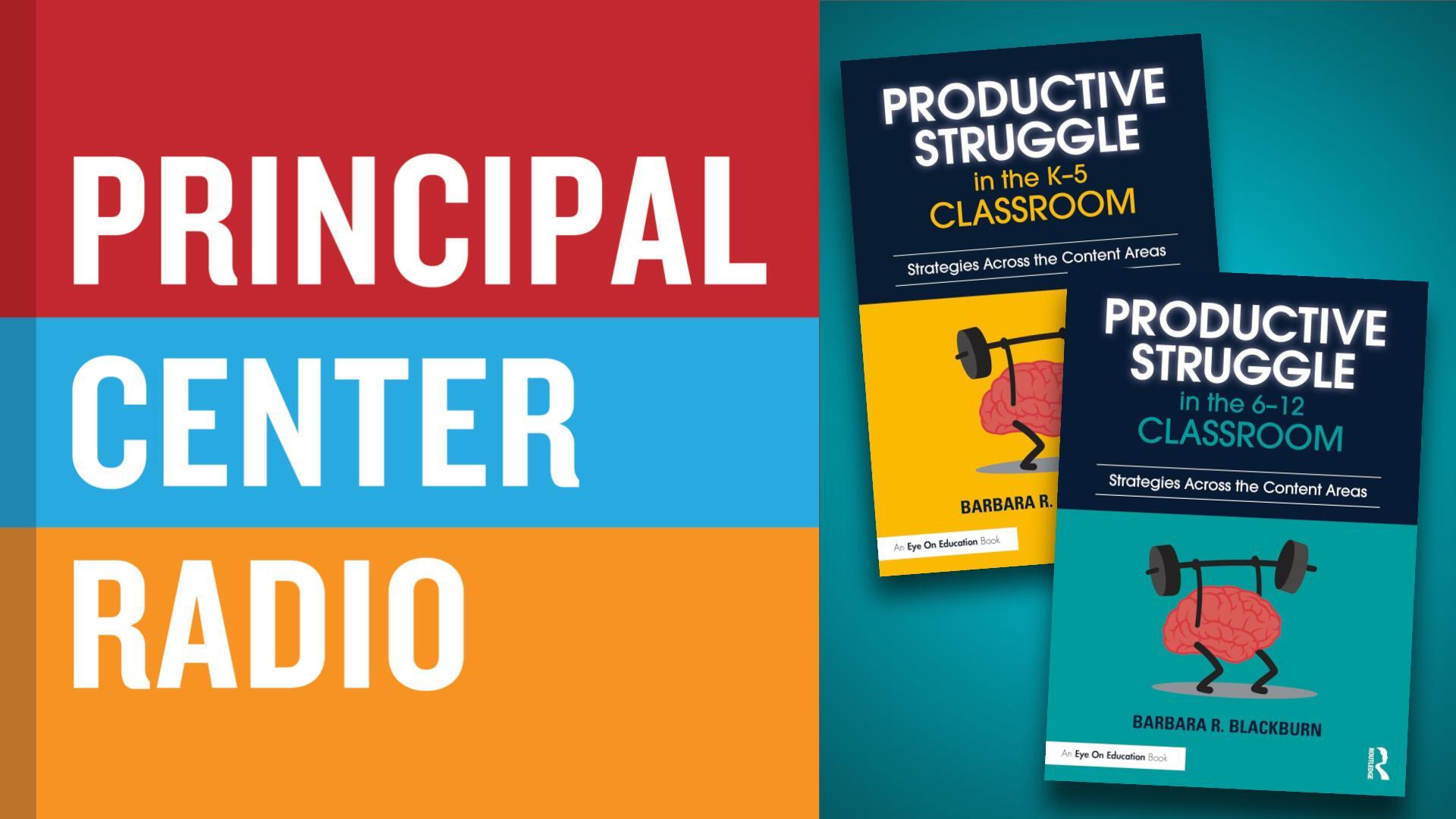
And she is a widely sought after author and speaker on rigor and other topics, including now the topic of her new books, productive struggle in the six through 12 classroom and productive struggle in the K through five classroom strategies across the content areas, which we're here to talk about today.
[00:59] Announcer:
And now our feature presentation, Barbara, welcome back to the program.
[01:04] Barbara Blackburn:
Oh, thank you. It is always such a pleasure to be here with you.
Justin Baeder:
Well, I always enjoy it and it's good that we enjoy it because we've done this lots of times. Our listeners can find many discussions about some of your earlier books and multiple editions of your earlier books here on the podcast. We've been doing this for probably close to 10 years now and always a pleasure. And I'm excited that you've broken into a new topic that I think has had a lot of currency and a lot of attention in our field lately. What drew you to Productive Struggle? What's going on there?
[01:30] Barbara Blackburn:
There were actually a couple of things that drew me to it. One, I have done a lot of work with rigor, and what I have found with rigor is that people aren't sure what to do instructionally with that piece in the middle where students are struggling with rigorous work. So that was probably the impetus. I started looking at productive struggle, and what I found was that there wasn't truly a comprehensive approach approach to what is the research base? What is the philosophical base? What do you do at all aspects of the classroom?
And so those two things from a content perspective got me going. And then I thought about something my dad told me years and years ago. I asked him what was the purpose of education. And he told me the best definition he'd ever heard was from a third grade teacher.
[02:23]
And she said the purpose of education is to figure out what to do when you don't know what to do. And I thought, that's what productive struggle is. You struggle to figure out what to do when you don't know what to do. And so that's really what got me going on it.
Justin Baeder:
Well, let's get into a definition of productive struggle in just a moment. But I wanted to start by thinking of it as something of a Goldilocks issue, right?
[02:47]
Like we recognize when students are struggling too much and they're overwhelmed and they're not being successful. And we recognize when students are not struggling enough and the work is boring, the work is unchallenging. You know, they're not doing anything that is actually exciting or intellectually engaging. There's kind of going through the motions because there is no struggle. Is that sweet spot, that kind of just right Goldilocks place essential to productive struggle? Or how do you think about the level issue there?
[03:15] Barbara Blackburn:
Well, I think it's so important that there's an entire chapter in the books on it because I do think that's critical. If students are working at a level that's too easy, they're really not struggling. They're just sort of going through the motions if it's too easy. If it's too hard, they're struggling, but they're not making any progress. So that's not appropriate. So what we have to do is not think about, oh, well, my student's struggling, so they can't ever do anything that's harder.
[03:42]
They have to think about, all right, let's look at Levels of material. Let's look at skill levels and see what we can do. For example, let's do a math one. A lot of times what we do is we think, okay, it's too easy for them to do computational math. And it may be, and that's okay. But they may say, no, they're struggling with computational math.
[04:04]
I can't do anything more. Well, that's not true because a skill that is more challenging is to recognize and explain misconceptions. So what I can do is, if they're doing okay with computational but not great, what I can do is bump it up by giving them something to struggle with where I give them three computational problems that are already solved. And they have to figure out which one is incorrect, explain why it's incorrect, solve it correctly, and explain why it's right now. So I can still bump up that level to a more challenging skill even if they're working at that level. Now, if I've got students who are really good with computation but word problems is what they're working with, I can do the same thing.
[04:55]
I can give them three word problems that are already solved. And they go through the same process. So what I can do is look at skills that are more challenging, that are appropriate for all students and have them working in that. And I give a very detailed list of what skills we assume are challenging that necessarily aren't and ones that are actually more challenging and how we can work between those two. And then I give sample tasks so that you can actually see what it looks like. So there is a Goldilocks aspect to this, right?
[05:25]
We do have to get that that level right. And we'll talk about some strategies for doing that. I wonder if we could talk next about your definition of productive struggle, because, you know, I think the sloppy definition or the maybe the tacit definition that we might just come up with in our heads is, well, like it should feel challenging for everybody or everybody should be working hard or everybody should be sweating. Right. Like if I go to a sports team practice and everybody is short of breath and sweating, then, OK, it seems like everybody's working hard. If I go to the football field and absolutely nobody has broken a sweat, I'm going to feel like, OK, this is not really enough of a challenge for these kids.
[06:02]
So apart from the Goldilocks issue, how do you define productive struggle itself? Because I think that's something where we like we have a sense, but we don't have a lot of precision. And that was something I spent a lot of time on. I looked at what was out there. I looked at the research. And what I came up with was that productive struggle is an opportunity for students to participate in a structured instructional situation in which they adapt current knowledge.
[06:32]
to solve a novel problem. So there's several aspects that are key, okay? Students are participating. So if they're just sitting and getting, that's not productive struggle. Even if they're sweating, that's not productive struggle. They are participating and it's a structured instructional situation.
[06:49]
So it's something you've planned. It's not just throw a task. You've got to think about what happens before, what happens during, what happens after, what's my formative assessment. There's all kinds of things that happen. So it's part of your instruction. And they have to adapt what they already know.
[07:06]
They have to adapt their prior and current knowledge to solve a novel problem. So I have to take it and use it in a new situation. So I'm going to go back to my dad's definition, which was to figure out what to do when you don't know what to do. That is taking what you know and and applying it to something that's new and novel to you. And so there's a lot of aspects to the definition that are really critical. And one that is just absolutely important that I don't think we are spending enough time on is that it's a structured instructional situation.
[07:39]
So it is something that is planned. Again, it's not, I don't just throw kids into something and hope they are successful. That's not what it is at all. The teacher's role is critical in productive struggle.
Justin Baeder:
Right. And I'd love to talk more about that planning issue, because this is not just, you know, show up and make them sweat.
[07:58] Barbara Blackburn:
Right. There is thoughtfulness. There is a sequence. There is planning that has to go into this. But one thing in your definition that I wanted to call out is the idea of adapting current knowledge. So in order for students to benefit from productive struggle, they have to actually know enough knowledge.
[08:16]
to engage with the material, right? There's some prior knowledge that's being acted upon. Yep, absolutely. I mean, if I don't know anything about Latin and then you expect me to read Latin, that's not productive struggle. OK, that's not. That is frustration.
[08:36]
That is a worthless waste of time. So I want to be able to take what you already know. Now, what you know may look different. For example, you may know the process of problem solving. And maybe you've never applied it in a science experiment, but you know how to problem solve. Therefore, you can apply it over into that novel situation.
[08:59]
So sometimes it's, I know the content. Sometimes it's, I know the process. And so you've got two different pieces there. But, you know, the chapter on what it looks like in the classroom has a whole section on prior knowledge. And you have to activate that prior knowledge. Now, you may give them something where they activate it themselves.
[09:21]
If you want them to do that, that's totally fine. Or you may do a review with the whole class before they start jumping into what they're doing. But I think we do a disservice to students here. When we just throw them into something with no preparation. In the struggle itself, they are doing work as they're not sitting and getting, they're not necessarily getting a lot of input from us. They're not getting a ton of new information.
[09:47]
So we are building on what they already know, putting them in an instructional situation where they can do something with that, that takes them to a new level. Right. And they may have to read some things. They may have to do some research. You may read a story to the whole class about ants so that they know what ants are about. I mean, there are ways to do it.
[10:06]
But again, it would not be fair for me. to ask you to go play major league soccer, okay? That's not fair. That's not equitable. That's not right. I would be setting you up for failure.
[10:23]
And that's what we have to think about productive struggle for students. You want them to struggle in a way that they learn something. And to do that, they've got to have a strong base. And if you don't have that strong base, then what are you doing? Why are you even doing that? I want to definitely get into the strategies because the book is mostly strategies for doing just that.
[10:47]
But before we do, I want to talk about the research base. You reviewed the research extensively for this book, and you said a lot of the research on productive struggle is fairly new, but it's rooted in things that have been familiar to us for a long time. Things like the effect sizes that appear in Hattie's research, especially around high expectations, success criteria. teaching students to drive their learning, you know, some of those practices with fairly large effect sizes that to me cluster around, you know, high expectations, teaching a lot of content, you know, there's some pretty familiar precedents here in the research. Or what was your take on the research base as you looked into productive struggle? Well, it was interesting because some research I found, I have a dear, dear friend I taught with him when I was at Winthrop University, and he is my go-to guy on everything research-based.
[11:38]
And a couple of the things that are out there, you know, he pointed out to me, that's really been discredited. And I was like, okay, well, we're not doing that. So I really had to work to find what is actually there. And most of it is with math. And that's because NCTM really put productive struggle in their standards. So math sort of has been the place it's been the most used probably.
[12:02]
But so I really worked down on, OK, what's actually there? And then I thought, OK, but that's not enough for a teacher because that doesn't give me enough knowledge. to really spend time on this in the classroom because right now in the classroom, if I'm gonna spend time on something, it better be research-based. And I thought, well, Hattie, of course Hattie, because you go to Hattie for everything. And when I really pulled from Hattie, it was amazing how much it worked, not just in terms of teacher behaviors, but also student characteristics that line up so well. They're not necessarily called productive struggle, But they really line up very nicely.
[12:43]
And so once I did that, I was like, this is what you got to have. So I was able to really do that. I put the other in there, but I really, really focused on Hattie. And then the other thing was I thought about when I was a beginning teacher, when I was actually in college thinking about being a teacher. One of the things they had us do was write our philosophy of education based on all the philosophers we've been learning. And I said, you know, I wonder what educational philosophy says about productive struggle.
[13:11]
And when I went back through the educational philosophers, it's there. You know, it's in Dewey. It's in all the educational philosophers. So I pulled those pieces too. So what you've got for a strong research base is not something new. It's something that exists that we know works and it applies to productive struggle.
[13:30]
So it gives you a firm foundation for why to do productive struggle. Right. So even if the term is having a moment, if the term is new, the concept has been with us all along, especially related to high expectations. You talk in the book about intrinsic motivation, and we've talked a bit about, you know, school being challenging and enjoyable. for the challenge. Let's talk about some classroom specifics now.
[13:55]
What does this look like in the classroom? And we should mention again that this is actually two books, one for K through five and one through six through 12. And obviously there's some differences in what it looks like at different grade levels, but how do we actually implement productive struggle and what does it look like in the classroom? Well, you've got a couple of sets of activities. I talk about the dispositions that are really critical. So, for example, one disposition that is needed for productive struggle is creativity because you've got to creatively apply to a novel situation.
[14:27]
And you've got activities for those. So for example, a third grade activity for creativity is based on what they've been doing in physical education and during recess, if you have recess, they have to create their own game. So you've got some activities for that. So you have that in a chapter. Then I go to what does this look like in the classroom? And for the elementary, there are activities for each grade level.
[14:55]
For the secondary, there are activities for each subject area. So math, middle school and high school, science. And one thing that's unique is I've also got activities for things like foreign language and technology and band and chorus because so many books leave that out. And so that's in there. So then once you've got an activity, then when we get to the chapter on scaffolding, I take those same activities and add in all the scaffolding so they can see what that looks like. Let's go with a science one.
[15:28]
This is a high school one. Scientists are currently researching new aspects of immunobiology. And they have to research at least three investigations related to a particular area of immunobiology. Formulate a specific research question related to that topic. Design a new investigation that would allow you to find a solution to the question. and then present your information to the group presenting a valid argument as to why your investigation would benefit society.
[15:59]
So it's really definitely a higher level of what you're looking at. Now, let me pull an elementary example so you see sort of what that looks like. Okay, here's a second grade one. This is social studies. Students are studying community workers, such as a police officer, a firefighter, a librarian, a nurse, etc. At the end of the unit, the students identify a worker's job they would like, and they have to complete a job application.
[16:28]
And on the job application, they have to put the title for what they're applying for, why they are interested in their job, and then here's the real productive struggle piece. Analyze and describe how you are qualified for the job. You must include specific experiences you have had to prepare you and specific traits you have that qualify you. All examples must include why each prepares you for the job, linking to what you have learned about the job. So think of that for second grade. I mean, isn't that great?
[17:00]
Let's do one of the related arts because they always feel like they're forgotten. Here is one that can be used for chorus or band or drama or theater. The student listens or view a performance of their choice. Maybe it's one on the internet. Maybe it's one, you know, that they participated in. Each student writes a short critique, which must include the student's opinion of the work Support of the opinion based on the lessons taught by the teacher and the student's own experiences and recommendations for improvement.
[17:31]
And again, look at how it links what they know with something new because they're doing the critique and they have to give recommendations. So this is what I love about productive struggle. It's not don't do this. I mean, we have people critique a performance all the time. I'm just tweaking it to make it more appropriate for productive struggle. There's tons of rubrics in chapter three in particular for what it looks like on the teacher side and what it looks like on the student side.
[17:59]
And I wonder if we could circle back now to the idea of planning, because I think as we've talked about before, You know, a lot of the difference in quality of execution of these strategies or other strategies for rigor comes down to planning, right? We're not going to ask great questions if we're just thinking of everything in the moment. This does require planning. So talk to us a little bit about the planning. When does that occur? Kind of at what scope does that planning occur for teachers to effectively plan for productive struggle?
[18:31]
Because we know it's not going to happen on the fly. Right, right. Well, it's before, during, and after. And that's the model that I use. What do you do before the students are participating in this? What do you do during?
[18:42]
What do you do after? And assessment is key all the way through because you've got to do some pre-assessments to make sure you're getting them in the right place. You've got to do formative assessment to see if they need help. I mean, productive struggle doesn't mean they just struggle and you leave them alone. Productive struggle means they're working and you give them some guidelines so they can see if they can get help on their own. But if they can't get help on their own and need it, then you're there to help.
[19:07]
I mean, you're still there. I don't know where... The idea of just throwing them in the deep end and letting them go came from, you know, when we do that, people drown. That's not what we're looking for.
[19:17]
I used to be a lifeguard. Not a good thing. And then after, so you've got the summative assessment. And so you really have to plan during all of that. And again, with the pre-assessment, you may find that your students have got enough prior knowledge to do the task. And so you don't do anything with the whole group.
[19:34]
Or you may find that two of them don't have it and everybody else does. Okay, then you just work with those two to beef theirs up a little bit. Maybe you give them something to read. Maybe you do a little mini lesson with them. You know, you see if they need to watch a video. You know, there's all kinds of things you can do.
[19:49]
And this is, I promised you before we started that I was going to give you my favorite reading activity. Okay, and this one's it. Let's say that I need students to read something as a part of the productive struggle task. But I have five students who can't read it because they can't read on grade level. Okay, then I need to do something prior with them. And here's what I do.
[20:14]
It's a strategy called layering meaning. I read about this in 1992 in either the Reading Teacher or the Reading Journal. It is just the most fabulous strategy. I'm always amazed when people haven't heard about it. So here's what layering meaning says. They're having to read this article about biomes, which goes something basic.
[20:34]
and but I've got my five who can't read that what I do is I give them another article on biomes that's written at an easier level that's written where they are and they read that first maybe they read it by themselves maybe I give them a study guide maybe I go through and guide them through it whatever whatever's appropriate for the students but they read that first then and this is where it is so key is they go back and for the productive struggle, they read the on grade level article. And because they've read the easier article first, They've built background knowledge and they've built vocabulary. And they may still need a study guide. They may still need you to check in with them. But they can read the on-grade level text. See, leveled reading is not about just dumbing it down.
[21:23]
That is not what it is about. It is about how do we use the levels to help them thrive. akin to the issue of scaffolding, which I know you have a whole chapter on. And just as with expectations, you know, we don't want to have lower expectations for some students. That's not, you know, that's not our intent when we know students are at different levels. We want to have high expectations for all students.
[21:43]
And one major way that we, you know, pull that off and, you know, deal with the reality that students are coming in at different levels is scaffolding. So take us into the scaffolding aspect of productive struggle and some of your strategies in that chapter. Well, scaffolding is part of the during process. And scaffolding can happen in a couple of different ways. It may be that you know they're going to need scaffolding. And so you provide a guide-a-rama for them.
[22:14]
That's a mix of a thinking guide and a study guide. And so maybe you provide that automatically. Maybe you know that certain students, your special needs students, are going to need a guide-a-rama. So you give that just to them. And it's available to anybody else who wants it, but they don't have to have it because they don't really need it. Um, it may be that during productive struggle, you pull a mini group and work with some of them, uh, and then get them back to their original groups.
[22:41]
It can be that. It may be something as simple as having a chart on the board that has a list of things. Here's what to do when you get stuck. Uh, try to figure it out yourself. Ask somebody else in your group. Um, Look it up on the Internet.
[22:57]
Ask the teacher if nothing else works. And so they've got a guide because these students don't remember that. They don't remember what they're supposed to do if they can't figure it out themselves. So you got to have a poster or a chart or something so that they can look at that. And so the goal is for them to try to figure it out themselves first. But you're still there.
[23:17]
I mean, you're still there. I was yesterday, I was walking my puppy. I have a little mix of a Yorkie and a Dachshund. And she has a really long leash because when we go out for a walk in the neighborhood, she likes to go out about 10 feet. And she had gone out about 10 feet and was just walking along, not paying me any attention. And then she heard a sound.
[23:37]
And she, you know, beat hay back to me. I mean, it was like right back to me. And that's the thing about students. They want to try things on their own, but they want to know that you're there if you need them, you know. So you want to really try to balance those two. So I want to help develop the independence because that's what productive struggle is about.
[23:58]
But I also want to be there so that they're not failing and feeling like I'm not there for them. The flip side is I don't want to answer for them. I've seen too many times where the student has a question and honestly, we're just tired. It's Friday afternoon and we just answer for them. That is not what productive struggle is about either. Productive struggle is about me saying, well, what do you think it is?
[24:20]
Oh, you don't know? Well, how do you think you might figure that out? Well, I thought I might ask you. Well, okay, if you didn't ask me, how could you figure that out? What can we do together to figure this out? I mean, you want to really work on that independence.
[24:31]
Yeah, absolutely. And that leads us to an issue that I think we've probably all encountered. And I know you talk about this a little bit in the chapter on scaffolding as well as maybe collaboration and some of the concerns about productive struggle. And that is around supports and learned helplessness. And sometimes especially for our students with IEPs, we tend to maybe over support them or they're used to getting lots of supports. And that can result in a situation where the student is experiencing learned helplessness.
[25:02]
And they think, okay, as long as I just look like I don't get it for long enough, somebody will swoop in and rescue me and I won't actually have to try. And I feel like that is the situation for a lot of kids a lot of the time, that as adults, we want to help them, we want them to be successful, and yet that's put us into this kind of dysfunctional relationship where they don't try because they know that we'll swoop in to help them. How do you think about that issue for students who legitimately do need some help? They do need some scaffolding, they do need some support, but we don't want that to put them in the situation of helplessness. We want to actually challenge them and move them forward. and actually be helpful to them in that way, not just in providing the assistance that they may need or not need.
[25:45]
Yeah, I think it's sort of an if-then scenario, okay? So if they need help, then we're going to do this. But what I want to do is go to them and say, okay, so what can you do first? If you need my help, then I'll help you, but we're going to try something with you first. And you've got to break that cycle. I mean, and that's exactly what it is.
[26:10]
It's breaking a cycle because they've learned to be helpless and they've learned that they can outweigh the teacher because you're tired, you're busy, you're doing a hundred things. They'll just outweigh you and then you'll get fed up and say it. And so you've got to sort of do this if then. And I really do like starting with, oh, okay, so you need help on this. Tell me what you already know. Tell me what you already understand.
[26:34]
Now, what have you already done? So, based on what you've done in the past, what else could you do? It takes more time. It takes more effort. But it's worth it in the long run if you can break the cycle. It just takes a lot of time and effort.
[26:50]
And, you know, the thing is, I'll have teachers who say, I don't know where they got this learned helplessness. They get it at a very young age. I watched a neighbor of mine. She had a two-year-old. She was rolling him a little ball, and then he would roll it back. Well, she rolled it and it went about five feet further than him.
[27:05]
And she immediately jumped up, ran over, got it and handed it to him. And she was teaching him learned helplessness. You know, they learn it at a very, very, very young age. So it makes it harder, particularly the further up you go to break the cycle. But I do think it's worth it to break the cycle. Very well said.
[27:24]
Very well said. Worth it to break the cycle, worth it to do the planning, worth it to do the before, during and after. I wonder, Barbara, if you have any advice for school leaders who would like to see more productive struggle in their schools, but don't want the, you know, the bad version of it where it's just, you know, stress for no reason or high expectations without support, that kind of thing. What's some of your advice for school leaders who want to see more productive struggle? Well, the good news is my publishers already talked to me about writing a leadership book. OK, the bad news is I'm already working on another one.
[28:00]
So we're about a year out. But that's sort of the good and bad news. One of the things that I would say is it's really important and you can do this with the teacher book to identify what productive struggle looks like and doesn't look like. And then when you observe, whether you're doing walkthroughs, whether you're doing formal observations, whether teachers are observing each other, whether you're showing a video to talk about it, then look for those, you know, good and bad. And I try to avoid the good and bad, but it is sort of what it does look like and what it doesn't look like. And I think you've got to do that.
[28:36]
You've also got to make it a priority. I would recommend, I'm going to give you a freebie thing. Go to my website, which Justin's going to have up. And go to places, go to free resources and articles, but also go to Just for Leaders. There's all kinds of articles about how to be a leader, how to model things you want, how to build a culture of what you want, just sub in productive struggle for rigor. And I think you would find a lot of things there.
[29:04]
You can also email me through my website and I can send you some specific things because I do think it's about you building a culture that... supports productive struggle. And if you don't understand what it is and isn't, you can't do that. Very well said.
[29:22]
Very well said, as always. So the books are Productive Struggle in the K-5 and 6-12 Classroom Strategies Across the Content Areas. Barbara, if people want to find more about your other books or get in touch with you, where's the best place for them to go online? On my website, which is blackburneducation.com. And there are, as I said, there are over 100 free resources on there.
[29:46]
So there's a lot on there you can get for free. There's a lot of downloads for the books. You just go to the books and go to free downloads. My leadership books are on there as well as my teacher books. I've even got a parent book, so it's on there. And you can contact me through the website.
[30:03]
Barbara, thank you so much for joining me again on Principal Center Radio. Always a pleasure. Absolutely. Thank you.
[30:09] Announcer:
Thanks for listening to principal center radio for more great episodes, subscribe on our website at principal center.com slash radio.