[00:01] Announcer:
Welcome to Principal Center Radio, helping you build capacity for instructional leadership. Here's your host, Director of the Principal Center, Dr. Justin Baeder. Welcome, everyone, to Principal Center Radio.
[00:14] Justin Baeder:
I'm your host, Justin Baeder, and I'm honored to welcome to the program David M. Corvi.
[00:41] Announcer:
And now, our feature presentation.
[01:07] Justin Baeder:
David Corvi, welcome to Principal Center Radio.
David Corvi:
Thanks, Justin. Glad to be here. Thanks for having me.
Justin Baeder:
I'm excited to talk with you because, you know, we see a lot of books about Tier 1 instruction. We see a lot of discussion about Tier 1 instruction.
[01:19]
But you've chosen to take the angle specifically of leadership for Tier 1 instruction. Why leadership, and what is the role of leadership in fixing your Tier 1 instruction?
[01:31] David Corvi:
Yeah, I... So I've been doing this work as a leadership coach for six years now. And it really came out of the work that I've done directly with school leaders, um, in Ohio, um, and in Massachusetts, where we're located. Um, and the more that I talk to them, and our focus is similar, yours, right, instructional leadership.
[01:55]
It's get out of your office, get into classrooms, get a pulse on the teaching and the learning that's going on in the classroom. And the more that I worked with leaders and the more that I worked with schools, um, And the more I listened to them talk, they were trying to figure out how to teach their teachers. And that's really where it started, was this idea of the book. The book was gonna be called, uh, You Are the Teacher of Teachers. As a former principal, right, you, I'm sure you understand, when you become the principal, you know, you, you're one step removed from the students. And, you know, the lever to pull, the people to work with in the building are, are the adults in the building.
[02:34]
And... Um, and so, those two ideas and then listening and working with those school leaders, it, it, it came out that, like, um, well, you need to be teaching your teachers, you need to be developing your teachers, and then what better framework to do that and then just strong tier one instruction that you should be seeing in the classroom, whole group, small group, individual. Yeah. Yeah.
[03:00] Justin Baeder:
Yeah. Let's talk about that issue of adult learning because I think, you know, we're kind of conditioned to believe that the learning is done when the preparation is done, right? That we enter this profession fully formed as a result of our preparation and, you know, any kind of on-the-job learning that we do is supplemental. But it sounds like you're saying that that learning that we do after landing the job is pretty critical.
[03:26] David Corvi:
Uh, yeah, I would 100% agree with that. It's new things to always be learning. And, you know, that kind of, that fixed mindset is what has got us in trouble a little bit, right? Is, is once you, once you get a job, once you work, then, then you know everything. Um, and then you're, like, I like your idea of, like, being formed, right? Then, yeah, you're completely formed.
[03:48]
Um, and that's just not, that's just not the case. Um, I was a high school English teacher. I became a elementary school principal, um, Um, you know, I didn't know a thing about teaching first grade math and math, and first grade math standards. If I had that idea that I was completely formed and I knew everything, I, um, I would have led differently. Um, we would have had, would not have had the success that I had. Um, so, yeah, it's, it's really important for both leaders and teachers to be continuously seeking out development and learning opportunities to grow their craft and grow their experience.
[04:27] Justin Baeder:
A lot of people might say, well, I'm not sure there is such a thing as Tier 1 instruction for adults because everybody needs something different and everything has to be differentiated, everything has to be individualized. What do you see as the role of Tier 1 instruction for adults?
[04:44] David Corvi:
Well, I mean, if you think of Tier 1 instruction for students, um, you know, the theory and the practice behind it when done right, um... Right, and...
[05:17]
Teacher-centered, standing at the class, you know, anything like that. But, you know, what it comes down to is, um, differentiation is built right into Tier 1 instruction. Um, these aren't, like, two separate things. Within Tier 1 instruction, as I said before, is whole group, right? What's everybody need? What's the expectation?
[05:38]
What's the standard, um, that everybody's learning? What's the goal that everybody is trying to achieve as a group? Uh, and then the differentiation comes out in the small groups, right? So, hey, we're all looking on improving discourse in the classroom. All teachers, that's a, you know, that's always like a, how do we get kids to talk more? Um, right?
[06:01]
Um, that could be the focus for all the teachers to develop that, those skills and the knowledge of how to get students' discourse, you know, more effective and efficient in the classroom. Um... That's going to look different across grade levels. It's going to look different across content areas.
[06:16]
And then, so that's when the small group comes in and the differentiation comes in. What does the discourse look like in an art classroom? What does discourse look like in a kindergarten classroom versus a seventh grade classroom? Um, and then down to the individual, which...
[06:30]
Yeah.
[06:50] Justin Baeder:
You say in the book and even considered it as a title to leaders, you are the teacher of teachers. Take us into that responsibility a little bit. Why do you, why do you frame that as a responsibility of leaders to be the teacher of teachers?
[07:05] David Corvi:
When you become a school leader, so much more gets on your plate. Right.
[07:33]
Right, so those things are very, very real. In addition to, you know, alluding to what we talked about before is...
[07:59]
Teachers are, and, uh, and leaders are, are just people, and we're just humans, and we all have our own, you know, limiting thoughts. We have our own insecurities, as I mentioned, right? I didn't know a thing about teaching first grade math when I became a principal. Um, and so...
[08:17]
You know, those human side of things can be very detrimental to us leading if we don't address that and if we're not self-aware of that. If we walk into the room and think that we should have all the answers and know everything, um, I would say as a principal, as a leader, that's the first thing that you need to acknowledge is that, like, you don't have all the answers and you don't know everything, and so you really need to lean on people around you. And so how that looks in terms of, like, being the teacher of teachers is not... Uh, you know, I've got some comments on LinkedIn of...
[08:55]
People, you know, a little more critical of this lens, which is fine, but it's like, oh, it's not teaching... It's not treating adults like kids. That's not what this is. That's not what this is, right?
[09:06]
You shouldn't even really treat kids like kids, right? You should have higher expectations. It's you being the facilitator of the conditions and the systems where people are learning, right? And that's how I position myself. That's how the rest of us position ourselves at Lynch Leadership Academy is...
[09:23]
We were successful principals. We had, I would say, overall, I was successful. Were there days that I was ineffective? Absolutely. Did I make some ineffective decisions? Absolutely.
[09:33]
But overall, I feel like I was effective. Um, and so your job as a leader is not to know everything, is not to go in with the answers, and not to tell people things. Your job is to create the conditions and systems where other people... Right.
[09:58] Justin Baeder:
And part of my definition of instructional leadership is that there is a role of both making decisions and implementing decisions and doing support work that people might not say, well, that's instructional leadership. And I really believe that if you are supporting teaching and learning, anything that you're doing in the service of that, you know, should kind of count as instructional leadership. And I wonder, drawing on your experience as kind of a turnaround principal and seeing big changes happen in a school... What did you see as the relationship between operations and support and some of the practical things and the instruction?
[10:35]
Because it's my impression that if a school is doing very poorly, if it has substantial opportunity and need for turnaround, there are some operational things that have probably gotten so bad that they interfere with instruction. And that can lead to frustration on the part of teachers. Teachers can say, well, I can't teach effectively here, so I'm going to leave. And then you end up with people who have less skill, and then you have both an operational and an instructional issue. Uh, what do you see as some of that relationship, and how did some of those operational issues intersect with the, you know, the instructional side in the school that you turned around?
[11:14] David Corvi:
Yeah, yeah, no, that's a really good question. Um, and again, right, people see them as two separate things. You know, there's... You know, there's camps of... You know, it's got...
[11:26]
Even in classroom teaching, right, it's like... You gotta get the culture set first, right? You gotta get the... You gotta get the routines, the procedures, you know, you gotta spend your time doing that before any kind of learning or anything kind of takes place.
[11:39]
And there's truth to that. Um, there's definitely truth to that. Um, but, uh, it doesn't have to be one or the other. Things can happen simultaneously. The story I'll tell is on the very...
[11:50]
The opening day of my first day as a principal... I had two, two staff get into almost a physical altercation, like, got into an argument at dismissal in front of kids and parents. And that is, you know, it could be perceived as a cultural thing, but then it impacts the learning environment. Um, you know, and I had to mediate that and, you know, tell people that, hey, that's not how we're going to do things around here anymore.
[12:20]
Um, right? So that's an example of just how culture, how relationships, how interactions can impact instructional time. Um, definitely the belief that kids can achieve, the belief that kids can learn, um, great, let's just call it grade-level standards, right? If you're putting rigorous tasks, work in front of kids...
[12:46]
Um, so...
[13:09]
And then in terms of, like, operational, I think just another anecdote that I'll share is, you know, at the time I was principal, there was a lot... It was... We were going through the one-on-one device.
[13:20]
Um, and we were behind. My school was... Did not have any of, like, the one-on-one devices or anything. I think we still had, like, an antiquated computer lab and everything.
[13:28]
Um... You know, but that was also impacting instruction. That was impacting instruction and learning, and that was in the time of the transition to PARCC and, like, the state assessments were online and everything. Um, and so one year I took $90,000 of our budget and just made the decision to order, you know, one-to-one laptops for students and to put them in the classrooms, right?
[13:53]
So that impacts... You can't do other things then that year that you might have needed that funding for or had that funding for before. So, you know, all of those operations, um, culture, instruction, these things are intertwined. They're complex.
[14:14]
They're complicated. Um, the term that we use at Lynch Leadership Academy is braided, right? These aren't beads on a string. This work is a braid. Yeah, and that, that you, people usually like that description and that visual of a braid.
[14:27] Justin Baeder:
Take us into that a little bit more, because it's, it's interesting to think about that technology adoption as a catalyst for some things that probably need to happen instructionally, some things that probably need to happen operationally. There maybe were some, you know, some professional shifts that had to happen there. Uh, how do you connect the dots between all those changes and the massive results that you saw? I mean...
[14:51]
Pretty short period of time, pretty dramatic turnaround in test scores. What do you attribute that to, and how does that braid come together?
[14:58] David Corvi:
Um... Well, in...
[15:04]
It's funny, because I've been, uh, in the coaching of the principles that I'm doing every... I'm like, maybe it's because I'm thinking of this through the framework and the lens of this book, but everything is just coming back to, like, teaching. It's... And what does it start with, right?
[15:18]
It starts with... What does a good lesson start with? It starts with clear standards, clear objectives, clear outcomes, right? And then what's it end with?
[15:28]
It ends with... An assessment or a product that is aligned to that, right? And so, you know, in the book, I talk a lot about...
[15:41]
I just talk a lot about clarity. Um, clarity of roles, clarity of goals, clarity of what this looks like, clarity of, like, what... Yeah, what is my job versus what is your job? What is our function here?
[15:55]
I talk a lot about clarity because... Um, there's a lot of assumption, um, that is made. Um, you know, not just in education, but just across, you know, businesses and organizational organizations, uh, in general. Um, so I think it was getting very, very clear at first about, um...
[16:20]
Yeah.
[16:44]
And it was laid out in advance and there was clarity around it and people knew what to expect and knew what was gonna happen and were there, like, challenging days and difficult decisions and, like, 100%, 100%. Um, but, um, I think that's where it starts with, uh, is just that, like, clarity of vision and the communication that comes around with that and making sure that everybody, um, is on the same page and understands it. And if people don't, then... They can ask.
[17:14]
And, you know, I had, I had my open door policy of my office was literally, if my door is open, come in. If it was closed, come back. Right? That was, like, my door, that was my policy. That doesn't mean interrupt me whenever or not. I mean, it was literally, like, door open, come in, I'm, I'm around.
[17:29] Justin Baeder:
I'm always curious when there is a pretty dramatic turnaround... Mm-hmm.
[17:54]
You know, this isn't for me. I'm out of here. If you had new people come in who were great, uh, if there were changes in the people that stayed, um, anything like that.
[18:03] David Corvi:
Yeah. Yeah, and that time, that was in Camden, and the state of New Jersey had taken over the school district at the time, and, you know, they had discovered... I mean, a lot...
[18:13]
They were just operating over budget, so there was a lot of... I mean, every year, there was a lot of layoffs as well. Um, which kind of ultimately people ask me, like, oh, why did you leave? And it was, again, it was like this confluence of things.
[18:26]
You know, kids being born and just, you know, kind of five years in this and everything. I mean, then one of the things was... Um...
[18:58]
But yeah, I don't know if there's any, like, one specific thing, right? I said, like, start with clarity, but, um, I think it's just, it's the pieces that all come together. Um, I had, uh, I had an assistant principal when I started. The district moved to more of, like, director of operations. Um, we could pick, we could choose, did you want an assistant principal or did you want a director of operations? And this also goes back to, like, Knowing your leadership style, too, right?
[19:28]
Like, I wanted to be the instructional leader person, right? Like, so I... Unfortunately, my assistant principal, who he and I were, like, solid together, he had to transfer to another school because I wanted to lean into the instructional, and I really needed somebody to do the operation. So I handed that off.
[19:51]
Other principal colleagues that I had in the district... Right, so, you know, I think to an earlier question is around...
[20:10]
Yeah. Yeah.
[20:37] Justin Baeder:
Yeah, let's zoom out back to that whole group, small group, individual framework, because, you know, you've taken this idea that we would apply to a lesson, you know, here's the portion of the lesson I'm going to have for everybody, and then we'll have small groups and work with individuals. Take us into some of how you apply that in adult learning and leadership.
[20:56] David Corvi:
Yeah, um, first thing we talk about is having, uh, just like in the classroom, you have a curriculum, right? You have a scope and sequence, you have units of study for students. Um, you need that for, you need that for your faculty. Um...
[21:17]
not just in your, not just, again, in your school, but also, like, district-wide, right, or in a larger organization, you need a, call it a scope and sequence, call it a learning arc, call it a curriculum, right? You need to know what the cadence is over the course of the year, um, centered in on, on the goals and the standards that you're trying to achieve. Um, so that's where it starts. I mean, and if you don't If you don't have a curriculum, if you don't have that scope and sequence, you know, are you just walking into your classroom? Right, if you were a teacher without a curriculum or a scope and sequence, what would you do? You would walk into your classroom every day and just...
[21:57]
Teach what you wanted to teach or respond to the students. So you need the same thing for adults. Um, I recently, uh, a principal that was in one of our groups said that during his... We were talking about adult learning and, like, particularly we were talking about, like, the school-wide whole group.
[22:15]
And I said, what do you do during your faculty meetings? And he's like, oh, I usually walk in and, um, you know, they... They share out things and we...
[22:23]
Yeah.
[22:38]
Right, right.
[23:03]
Um, whether it's a school-wide focus, you know, independent schools have, like, accreditation goals, right, that you go through a pretty rigorous process with, right? It should be aligned to those accreditation goals. Um, it should be aligned to the output, so student learning, student achievement. So there's, you know, inputs and outputs. Um, and it can't be...
[23:27]
Um, and then you can build that out.
[23:43]
Most schools have two to four, or two, excuse me, one to two faculty meetings or PDs. They meet with their whole group every month, plus, you know, teacher in-service days and everything. So, um, I mean, you just, you get your yearly calendar and you start plugging in the topics, um, that you're going to address during whole group. Um, and then back to small group and leveraging those people around you, using assistant principals, using department chairs, right, you call it an instructional leadership team, call it an academic board...
[24:23]
utilizing those people to, um, empower them to facilitate those small groups. Because you can't, again, you can't be everywhere. You can't be doing everything. Um, uh...
[24:36]
And so, what is, again, what does... What is our school priority? What is our school goal? What does our accreditation goal look like across grade levels?
[24:44]
What does it look like across content areas? And there's practices that you, you know, do that you do. There's data protocols. There's tuning protocols. There's lesson planning protocols. There's all of that kind of stuff that you can do in those small groups.
[24:57]
That's a little bit more like the technical stuff. But the question for small groups is, like... to answer is, what are teachers doing when they get together in groups? Um, you know, and... and is what they're doing actually developing their teaching and improving student learning?
[25:17]
And then the one-on-one individual framework is... is your teacher evaluation framework, right? Like, I mean, that's what it comes down to. Everybody is...
[25:30]
Public schools, you know, they're expected to observe. Most independent schools want to observe. Um, and so you need to be, you need, and again, not just you as the principal, but it could be your assistant principal, it could be your directors, it could be your department chairs, um, building that system of getting people into classrooms to see each other teaching, giving each other feedback, again, on the school goal, on the teaching standards and frameworks. One of the big questions we ask at Lynch Leadership Academy is, you know, what's your vision of excellent instruction? You know, we're not looking for jargon. We're not looking for, like, rigor and engagement.
[26:09]
We're looking for when you walk into a classroom... Right, right.
[26:37]
Um...
[27:02]
So I think that would be kind of, like, teasing out more of, like, this whole group-small group individual framework is pieces of them are already in the schools. It's just how do you braid them together and align them together, um, so that they're happening in sync.
[27:20] Justin Baeder:
Well, I appreciate the question that you posed earlier about, you know, would you ever walk into a classroom with no lesson plan or with no unit plan? No, you would, you know, you would be prepared. And when it comes to the work that we do with adult learners, with our faculty, we need to have a plan. And I wanted to maybe close by asking your thoughts on how we close the loop on that with assessment. Because, you know, we don't want to just...
[27:44]
You know, throw some things out there and say, there, you know, we're done. How do we close that loop with, you know, with our faculty on the assessment side and then the figuring out, you know, now what? What's the next step?
[27:58] David Corvi:
Yeah. Yeah, um, that's a really good question. Um, and I know that I've dropped the ball. I mean, what you're asking about assessment in terms of, like, adult and faculty is...
[28:10]
Is follow-through, right? Follow-through and follow-up. And I know I've dropped the ball on that as well as a leader. Um, I probably dropped the ball on that as a dad and a husband, too. Um, right? It's about the integrity of, like, hey, I'm gonna do what I say I'm gonna do, right?
[28:27]
So, if it's a whole group professional development that's taking place for your faculty or your school district, right, are you then... A day later, a week later, um, are you walking into classrooms? Are you walking into your grade-level department meetings, your PLCs, your common planning time, and keeping that thing in front of teachers, right? And then asking them...
[28:54]
Right.
[29:15]
Right. Right.
[29:42]
Yeah.
[30:03]
Where do you think you are in terms of this expectation, this goal that we set, and what you need to continue to improve to do it? So it just becomes a cycle. Again, call it an assessment cycle, call it a coaching cycle. Um, but in my mind, the assessment's never, it's not an ending point. Um, it's just a continuous cycle of, okay, what comes next? What am I going to work on next?
[30:26]
Or how am I going to continue to improve this thing? Would you do with your faculty meeting, right? You wouldn't walk into your classroom and do this. You'd walk into a faculty meeting with a plan. Um...
[30:37]
Right, right.
[30:52]
Right, right.
[31:11]
Right, right.
[31:29]
Who, who, and who's a good teacher, right? Who's, like, an effective teacher? It's like, how do I, how do I coach them, right? And, I mean, I always ask, like, how would you, how would you have taught one of your gifted students, right? Like, one of your high-accelerating students, how would you have taught them? Like...
[31:47]
You don't have to direct them and tell them to do things. You have to create the conditions for them to still want to learn and to let them keep progressing. So you approach it, you approach your adults like they were students. What would you do if this person was your student? Some of the kids you need to be more directive with and break things down for and be next to and walk with and learn with. So that's just another thought that's coming out of all of this book and this work and everything.
[32:13]
So I appreciate you asking if there was anything else.
[32:17] Justin Baeder:
Wonderful.
[32:17] David Corvi:
I think that's it.
[32:18] Justin Baeder:
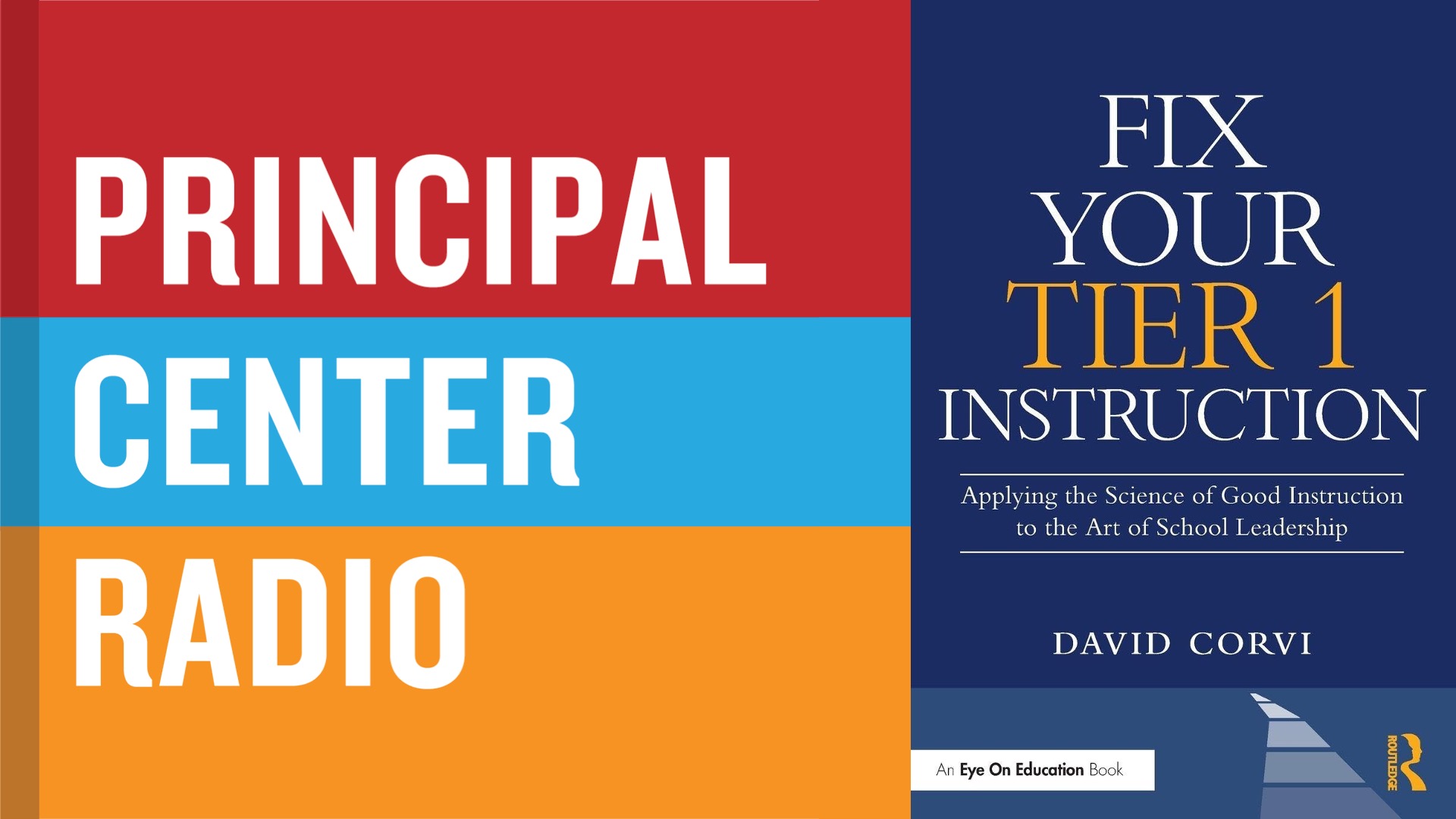
Good deal. So the book is Fix Your Tier One Instruction, Applying the Science of Good Instruction to the Art of School Leadership. David Corvi, if people want to learn more about the book or your work or get in touch with you, where's the best place for them to go online?
[32:33] David Corvi:
I've created my own website now, so everything is there. It's It is FixYourTier1Instruction.com.
[32:42]
Um, you can find the book. You can get the chapter one for free on the website. Um, and what I'm trying to do is also create a community. Um, I had a bunch of school leaders that contributed...
[32:55]
And from the field notes in the book as well, so it wasn't just me talking. Um, and I would love for people to consider contributing, um, their thoughts, their ideas, their stories around how they have become the teacher of teachers, how they've fixed a tier one instruction, um, how they've helped develop, um, the teachers in their building, and... We'll share those on the website. We'll share them on social media.
[33:22]
So hopefully we're just trying to start a community around this.
[33:27] Justin Baeder:
Wonderful. David Corvi, thank you so much for joining me on Principal Center Radio. It's been a pleasure. Thanks, Justin.
[33:34] Announcer:
Thanks for listening to Principal Center Radio. For more great episodes, subscribe on our website at principalcenter.com slash radio.