[00:07] Announcer:
Welcome to Principal Center Radio, helping you build capacity for instructional leadership. Here's your host, Director of the Principal Center, Dr. Justin Baeder.
[00:19] Justin Baeder:
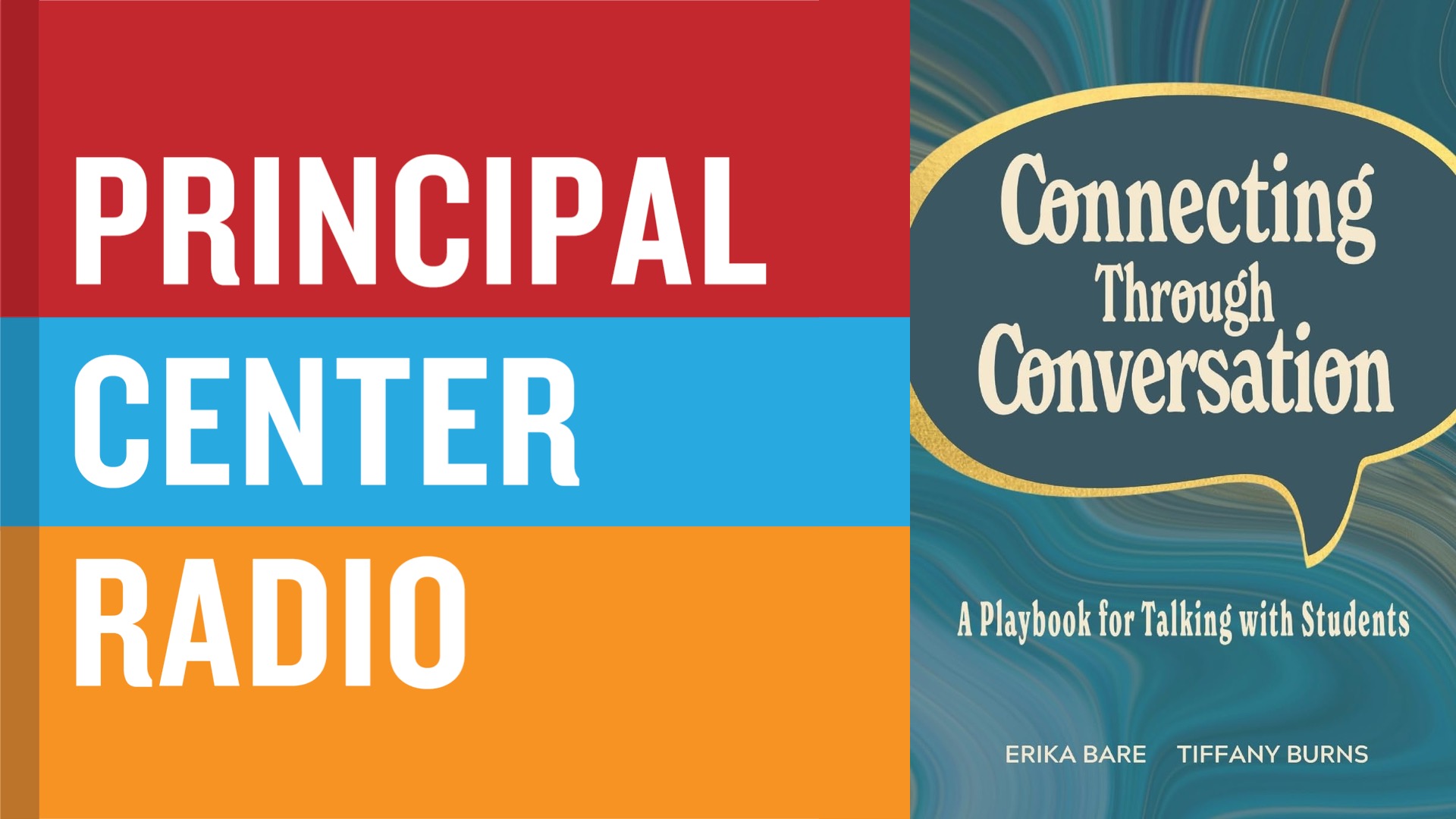
Welcome, everyone, to Principal Center Radio. I'm your host, Justin Baeder, and I'm honored to welcome back to the program Erica Bare and Tiffany Burns. Erica is Superintendent of the South Umpqua School District in Oregon and has more than 20 years in the profession as a teacher, principal, and district leader. Tiffany Burns has served as a principal, instructional coach, and teacher in her more than 20 years in K-12 education and is currently teaching pre-service teachers at the university level. And they've worked together for more than a decade, including on several books, including A School Leader's Playbook for Tough Conversations, which we've talked about previously here on Principal Center Radio, as well as Connecting Through Conversation: A Playbook for Talking with Students, which we're here to talk about today.
[00:57] Announcer:
And now, our feature presentation.
[01:00] Justin Baeder:
Erica and Tiffany, welcome back to Principal Center Radio.
[01:03] Tiffany Burns:
Thanks so much. Thrilled to be back. Thanks, Justin. Thanks for having us again.
[01:07] Justin Baeder:
Well, thanks for being here. And I'm excited to talk about talking with students because, you know, thinking back on being a principal and being a teacher, it's one of those things that we have to do constantly. It is absolutely central to the work of being an educator, and yet it's often something that we don't really have any training on. What did you see happening in your experience that prompted you to think, you know what, we need a book on this?
[01:32] Erika Bare:
Well, I think it really stemmed from a conversation that Tiffany and I were having back when we were working in the same district, and it was during kind of a crazy time in education. It was as folks were returning from distance learning after COVID, and students came back with some unique and different things that we hadn't seen previously, and Tiffany and I found ourselves doing a There's a ton of coaching around how we are showing up for kids. And a staff member reached out to Tiffany and asked her to kind of go through her tips and tricks. Tiffany, do you want to tell a little bit about that PD?
[02:08] Tiffany Burns:
Absolutely. Well, it was still during COVID time. We had kids back in the building, but as staff, we weren't allowed to gather. So we were all on Zoom. And one of the staff said, you know, can you... We have all these new staff.
[02:20]
Can you talk to them about some of these strategies that you use when working with students? And I was like, What? What are you talking about? You know, she said, well, you know, like, don't force eye contact. Don't ask a question if it's not a choice. How do we avoid power struggles?
[02:33]
Those kind of things. And I said, oh, yeah, sure, no problem. So I wrote down this long list of things to share. And I am a teacher at heart, so I pride myself on doing really great professional development that's interactive. And this was not that. This was me just going through and kind of standing and delivering, or sitting and delivering, I guess, and explaining all these different things to do.
[02:53]
And I look up in the Zoom, and every single person is writing down everything that I'm saying. And Erica and I had talked years earlier about someday writing a book together. And so I reached out to Erica, and I was like, okay, I found it. I found the book that we need. It's How to Talk with Kids.
[03:11] Erika Bare:
And so being the support person that I am, I immediately, you know, I'm on Amazon looking for the book, trying to find this resource that I thought she was asking me for, for her staff and her school. And I text her, I'm like, Tiffany, I need an author or something where I can't seem to find the book that you're talking about. And she's like, all these laughing emojis. She's like, no, that's the book we need to write. And so that was our bit of market research. And...
[03:38]
We did. So we dove in and wrote it while we were also really... And that caused us to really think about what is it that we do that really works? And this was such an interesting time in education because we had so many folks who were new to the profession.
[03:54]
You know, we had so many folks who were trying it out for the first time in this kind of interesting... Yeah.
[04:20]
Write those things down and also test the impact. So, when Tiffany really focused on rolling this out through the entire staff in her building, really thinking about that collective efficacy, how are we all responding to students, how are we all thinking about how we are... Speaking with them, supporting, um, making better behavioral choices, connecting with their caregivers, all of those pieces, what impact does that have? And we saw a over 30% reduction in behavioral refer... 36, thank you, yep, 36% in behavioral referrals over the course of that year, and then significant...
[05:03]
increases in both literacy and math scores. Of course, there were more pieces that went to that, but we know when we're able to build those connections with students and support their behavior in really positive ways, academics are going to be given the space they need to really begin to thrive. So, that's how it all got started, and it's been a really fun journey for us.
[05:27] Justin Baeder:
And there's some great insight there for prospective authors. You know, you look online for the book that you want to read, and if it doesn't exist yet and you have the expertise, maybe you're the one to write it. But it's not always an easy thing to find a topic that doesn't have a book about it yet, but I'm glad you realized that and have moved to close that gap. Because certainly we need to talk to kids frequently, and often the stakes are high. And for those of us who have been...
[05:55]
In the principal's chair, you know, often, you know, we want to be proactive, we want to be positive, we want to be out there and connecting with students proactively, but often the reality is we're talking to kids when something is wrong, right? What's some of what's going on in a kid's head and in our heads as adults when something is wrong that we need to be mindful of? Because, you know, as much as we would like to imagine that we're all perfectly, you know, on an even keel every time we talk to a kid, we know there's a lot going on for both of us.
[06:24] Tiffany Burns:
Yeah. Well, we talk a lot about the idea that emotions are contagious. And so we really, like Erica said, we really kind of geeked out about what's the science behind it. There's an art and a science to talking and connecting and building relationships. And we, for folks that do that so naturally, then to be able to explain that to somebody else or to think, gosh, this isn't working and why isn't it? We wanted the science behind it.
[06:48]
Why does this work and why doesn't it work? And And so we really spent a lot of time, in both of our books, actually, in talking about this idea that emotions are contagious. And so in all of us, we have mirror neurons. And mirror neurons, Eric and I call these our empathy cells. So they're the part of our brains, the cells that they, they kind of turn on when they're seeing someone else having some kind of emotional response. So, our mirror neurons in our own bodies start to match what we're seeing someone else experience, what we're observing them experience.
[07:19]
So, when we have a kid who is having a big emotional outburst, actually, it's true for adults, too, but when we're having, that we're seeing someone having this big emotional outburst, they might be experiencing a lot of anger, they might be experiencing a lot of fear, and any one of those things are contagious. We can catch those. So, our mirror neurons... Okay, so, um, I mean, right, actually...
[08:01]
And it's really tricky when we catch there. So we, you know, for me personally, when I catch it, I start to feel kind of, um, butterflies in my stomach or a little bit of nervousness there. I might start, my hands might start to get a little sweaty. I might turn red and get a little flushed. We also can start mirroring their behavioral patterns, right? So they go louder and faster, and our speech patterns start to match theirs.
[08:24] Justin Baeder:
Which makes total sense from an empathy perspective, right? We want to match the other person in order to empathize with them, but when something is wrong, when there's some sort of conflict, then that can just get into this kind of escalating spiral, right?
[08:37] Tiffany Burns:
And I love that you said it that way because that's what we try to teach folks is that there's no blame or shame for that. When that happens, when you catch someone else's emotions, that does mean that you're empathetic. That does mean that you're connecting with them. And that's part of our connected, you know, superpowers. But what we do want to know is really intentionally be aware of that and unmatch. And so we want to just realize, I caught those emotions.
[09:01]
I'm going to get myself calm. I'm going to plant my feet solid on the floor. I'm going to start taking some really deep breaths. I'm going to slow down my speech patterns. If they get faster and louder, I'm going to go lower and slower. And what we want to do is remember that they can pick up our emotions the same as we can pick up theirs.
[09:22] Erika Bare:
Right. And as the adult, we set the weather. We set the tone for our classroom, for our office, for our school. And so our emotions are the most contagious in these environments when we're working with kids. So especially if we're a classroom teacher or we're supporting a group of students at the same time and we have a student get really escalated in some kind of way, if we also go to that same place of escalation, All of the other students are going to quickly enter that same state of anxiety, worry, frustration. So we have to be very aware.
[09:56]
The other piece that I think is just important to know, like, you asked what's happening in our brain, what's happening in the kid's brain when we're going through some of these behaviors. School leaders are busy, and we have so much going on, and students so rarely schedule the need for these really important connected conversations at a time that's convenient for us. Like, they just don't. And so it's always when we're running late, when we've got to get someplace, when we've got a thousand and one things on our to-do list. And so, we really do have to be intentional about some real honest frustration, right? Some really, like, oh my gosh, this is not something I was planning to do right now, and we've talked about this before, and oh my gosh, you know, so we have to really...
[10:43]
Be aware of that. Think about how we can show up and be present for the student and what is a really, really important conversation for them. And it's really going to set the trajectory for how our relationship is moving forward. So, having some awareness that that is a totally natural human feeling and it's okay. Acknowledge it and then also...
[11:05]
You kind of have to put it aside and say, okay, I'm here with you now. I'm going to put these things aside, take care of anything immediate, wait for a couple minutes oftentimes. So, I think that's another piece to just know.
[11:16] Tiffany Burns:
Well, and it's super helpful to be able to coach other educators with that information, right? So, we know as leaders, there are sometimes folks in our building that Right. Right.
[11:53]
And, you know, it seems like in that, you wanted the conversation to go a little longer, you know, but, like, you're so great at connection. And in that connection, it seems like sometimes you, you, um, pick up kids' emotions and they pick up theirs. And I just learned this really cool thing about emotions are contagious. Let's talk about it and see how we can shift that behavior for you.
[12:14] Justin Baeder:
I was, I was gonna jump ahead there and ask about that very thing because... And often we're in the position of not only needing to manage ourselves in these conversations, but coach other adults, you know, often the adults who work directly with students, often it's paraprofessionals or, you know, other people who work directly with kids who may just not come in with that same skill set. And I, like, I'm the kind of personality that I'm, like, I'm pretty unflappable with kids. Like, I've seen it, but I've also seen that there's a learned skill set there and there's a...
[12:45]
You know, there's a vulnerability that I think a lot of people approach their work with that is central to why they connect with kids. And I'm really glad that you pointed that out. But that, you know, if we're mirroring, that can allow us to get into an escalation or a power struggle of some sort. So, yeah, I wanted to acknowledge that and keep that in mind. Everything that we're talking about is both for ourselves and for the other people that we lead to help develop those skills.
[13:09] Erika Bare:
Wow. I think it's such a central idea because some of these pieces, like you said, come naturally to us, right? So many of us, building connection is not hard. Kids are not going to make us frustrated because they're kids. And so, you know, even when they do something that's frustrating, we kind of have that dissonance. But what we know is that it's the collective efficacy around how we respond to a behavior in a building that is going to make the difference.
[13:36]
It can't always be the principal or the dean or the assistant principal who is stepping in and addressing these behaviors. It has to be on the playground with the instructional assistant. It needs to be on the school bus with the bus driver. It needs to be, of course, in the classroom with the classroom teacher. And so we really, in this book, wanted it to be written for every educator. And we define educator as anyone who talks with kids at school.
[14:03]
And so that everyone has access to this skill set and this toolbox, because when we're all responding in a positive way, that's when we see that real lift. And the folks who are supporting our students during some of the most challenging times, those unstructured times, right, at recess, at lunch, during passing period, that's when we tend to see spikes in behavior. And the folks who are often supporting those times come in with the least amount of professional training and how to respond to that. So, we really wanted to make sure that it was accessible for everyone and that it was a common toolkit.
[14:43] Tiffany Burns:
Yeah.
[15:00]
And, you know, Erica did the market research. There aren't books on how to do it. And that was our goal, is to be able to say, okay, when you're coaching someone or when you're in the moment, here's exactly what to say. And if they say this, here's how you're going to respond. And here are some really common student moves that we see repeatedly students do. Here's what to do with that.
[15:20]
And when this happened, you know, it's X, then Y. So we really did, it's a playbook. So you can just pick it up and go to the strategy you need.
[15:28] Justin Baeder:
You use a phrase in the book called care out loud. And that jumped out at me because I think especially for people who are maybe doing, you know, like, lunchroom supervision, they don't necessarily have a ton of other opportunities to connect with students, you know, in different ways. It's kind of like, I'm, you know, I'm here to watch and make sure things are okay. And a lot of their interactions tend to, you know, tend to trend a little bit negative. You know, like, oh, that's just the lady who yells at us when we get out of our seats or whatever. How do we teach and model caring out loud?
[15:56]
What does that mean?
[15:58] Tiffany Burns:
Well, Eric and I talk a lot about, like, everyone that went into education went in because they love kids and they care about kids and they want to hang out with kids. And if that's not why they went into education, we really encourage them to reconsider that choice. Because it's really important that that's what we do. So, for folks that are having to, you know, do a lot of redirection... Well, actually, let's think about a student that needs a lot of redirecting, right?
[16:19]
So, this kiddo needs lots of redirection. They need reminders to sit down. In the lunchroom, they need reminders to keep their hands and feet to themselves. They need reminders to get to class on time. All those things, right? That kid is not walking around thinking, gosh, I am so lucky.
[16:34]
Every one of these adults that's telling me what to do cares about me, and they're just dedicated to my success, and they want me to do... You know, they just really want me to do a great job. That kid does not think that, right? That kid is thinking, this lady's yelling at me because I'm standing up.
[16:50]
These people are on my case. This kid is also maybe thinking, the people at school don't like me. They don't care about me. And we know that's not true, but what we have to do is really intentionally and really explicitly...
[17:03]
Tell kids how much we care about them. Tell them and show them with different sentence stems and routines, and we're not going to stop nagging them. We're not going to stop telling them to sit down in the lunchroom, but we have to couple that also with making sure that we tell them how much we care.
[17:22] Erika Bare:
Yeah, and there's two different ways that we, we focus on doing this. The first one, like Tiffany said, is actually saying it. Like, choose some sentence stems that work for you. You know, I think about the lunchroom. Oh, it's so great to see you today. Um, I'm so excited you're here.
[17:38]
Oh my gosh, you make me smile when you respond in this way. Choose some sentence stems that are going to work for you in your context, and then use them All the time. It can be as simple as, oh my gosh, I care about you. I believe in you. I'm so glad you're here today. Any sentence down that is saying, care about you, in whatever way that works, is going to make a difference.
[18:01]
And then, because we are busy people, it's also important to systematize that. So we want to have some really specific routines that are embedded in how we do our work to ensure that every student receives messages like that on a regular basis. So one of them, and we have a ton of these routines on our website as a free downloadable resource, so we encourage folks to check that out. But one of them I want to make sure we touch on because it's perfect for...
[18:30]
Folks in the cafeteria, folks in the lunchroom, folks out on recess is the use of positive postcards. And so, in every building and classroom I've been in, I find someone who knows how to print off the address labels for everyone in my class or my school. There's always someone who knows how to do this. And you just...
[18:49]
Go through them systematically, so you make sure no one is missed, because that student Tiffany was talking about that needs lots of reminders, they often can get missed in that I care about you message, and so having a way to make sure that everyone's getting that, and then just spending five minutes a week, ten minutes a week, filling out a couple of postcards... makes such a significant difference. Nobody gets mail anymore. Actually, mail at home, kids especially don't get mail.
[19:16]
Grown-ups are just getting the bills. And so, in this way, the family is also seeing this connection, and that can make a big difference. They're going to put it on their refrigerator. It's going to live there forever. And you can use that as a tool, also, to support behaviors that you're working on. So, if you've got a student who...
[19:35]
You've really been focusing on attendance with, and you start to see some improvement. Oh my gosh, I'm going to send them a postcard and say, oh my god, I've noticed you've been here more, and I'm so excited. School is always better when you're here. Keep up the good work. That message can then be used as a tool for the family to be like, look, Ms. Bear says you need to get to school.
[19:55]
And it can... So that's just one routine. But when we are supporting students, especially around their behavior...
[20:04]
They don't recognize or realize that the reason we're doing that is because we care about them, because we care about their success, because we want to see them do well. And so we have to tell them that because they're not going to know just because... We know.
[20:18] Justin Baeder:
So you, you print out basically a set of label, address labels for the entire school. You've got one for every kid. That's kind of your to-do list, right? And then you write out the postcards, throw it in the mail, and you've connected with the family. Love it.
[20:31] Erika Bare:
And I would, when I was a building leader, we would have those out at every staff meeting. And as we were doing staff celebrations... They were also, everyone took three postcards, and they were working through filling out postcards during the staff meeting. They're going to be multitasking anyway, so let's give them something productive to do.
[20:50] Tiffany Burns:
Better than checking email, yeah. Yes, exactly.
[20:52] Erika Bare:
Exactly.
[20:54] Justin Baeder:
Well, and I love, you know, having that set of labels there because you can think, okay, I'm probably going to need to connect with this family at some point. I can see maybe in the future, but I don't have to wait for the negative thing to occur to reach out. I can say, okay, this is a relationship that I need to start building now. Let me reach out about something positive. Let me reinforce something. I love it.
[21:14] Tiffany Burns:
Well, and especially when you're, and when you are reaching out about something that is more negative, where you are having to call, we still recommend carrying out loud. It really matters when you're talking with the parent or the caregiver, you know, hey, I want to talk to you about something today, but before we start, I just want to let you know how awesome Justin is. He's just such a cool student. I'm so glad he's here. This is something that happened the other day that I really appreciated. Now I gotta talk to you about this other thing, right?
[21:43]
But what they're knowing is that I do care about your child, and that makes all the difference, and that is something that we, Eric and I, both have had to coach educators to make sure to say, like, we're having this meeting, this caregiver is really upset, the kid thinks that you don't like them... You know what we're going to open with? How much you care about the child. That's really important.
[22:04]
It's true! So let's make sure that they know that. And then it really... I've seen so many meetings just completely change direction once they're... Once they understand, we are on the same page.
[22:15]
You do like my kid. Okay.
[22:17] Justin Baeder:
Let's talk a little bit more in detail about those negative conversations, especially, you know, when a student has gotten in trouble and we need to talk to that student. It's just our job to talk to that student. Maybe we need to figure out what's going on. Maybe we need to develop a plan to take some next steps. What are some of the pitfalls that you see people falling into? Some of the mistakes that we tend to make over and over.
[22:39]
And what should we be doing to just maximize that learning opportunity and make the best of it?
[22:45] Tiffany Burns:
Well, I think realizing that it is a learning opportunity is so helpful. As in school, we spend so much time talking about how important it is for students to make mistakes and to learn from their mistakes, and their mistakes teach us how to do better. And we talk about that with math and with problem solving, with literacy, and we forget about that. with behavior. And so it's, it's really helpful for us to remember that students are doing, you know, raw screen. Kids do as well, or could do well, they would do well, right?
[23:12]
And so we think about it as, as skills and missing skills that they, that they have. And so what we really want to do is continue to care out loud. So when we're having this, when we're having a conversation with a student that So this is where we start with, hey, you know what, you are such a great kid.
[23:42]
Or you are someone who has a lot of integrity. Or you're someone who really wants to be a good friend. Whatever it is. Like, it needs to be true because kids are really good at knowing when it isn't. But we start with this idea of saying, I'm going to go with, you know, you are such a great kid. You know, the thing I know is that even really, really great kids make mistakes sometimes.
[24:02]
And the most important thing when we make a mistake is to own up and take accountability and do what we can to make it right. When... I mean, I, as a building principal, had so much opportunity to have conversations with students who were not making great choices, right? So, when I started with that, kids were so much more likely to tell me what actually happened, right?
[24:24]
Because when you have good relationships with students... They don't always want to tell you what they did. They don't always want to own up right away because they're afraid they're going to get in trouble. They're afraid you're not going to like them anymore.
[24:35]
They're afraid that you're judging them. And so what we want to do is just come right out of the gate saying, I care about you. I know you're awesome. This was a mistake. This thing you did, not cool. We got to talk about it.
[24:45]
But what we're doing is separating the child from the behavior because what we know is behavior is what a child did. It's not who they are.
[24:54] Erika Bare:
And that's such a central idea for, you talked about what mistakes do we make, and when educators forget that, when we get sucked into the idea of, this is a, I hope everyone can see my air quote, like a bad kid, it makes me uncomfortable just to say it, um... Then we, then we run into a couple different roadblocks, right? A student's behavior is what they did. It's not who they are.
[25:17]
And this is critical for the grown-ups to remember for a couple of reasons. It helps avoid another pitfall that many of us fall into, which is to occasionally take student behavior a little bit personally. We know we're not supposed to. We've all been told, like, we can't take it personally. No one set out to ruin your day. And yet...
[25:33]
Like, we are people, and so sometimes that's hard, right? But when we can remember, you know what? This is just a thing they did. This isn't who they are. It can help. But more important than that, it helps us frame it in a way that is so much more helpful, because we're educators.
[25:48]
We're about teaching kids. We're about helping them grow. We're about plugging in missing skills, scaffolding, and so if we have the mindset of, oh, this is a thing they did, they're trying to communicate with us, they don't have the skill set to approach this in the right way, this is something we can work on and change, that's such more, so much more hopeful than, like, oh my gosh, here comes Johnny again, nothing we can do, it's just going to be a long, a long year, or in the case of a principal, a long, many years, if we don't really feel as though we can influence that Through our teaching and our supports. So that's something, I think it goes back to that idea of every conversation that we have with a student is the opportunity to teach.
[26:31] Justin Baeder:
And you have a lot of specific moves that people can use in different situations. So I wonder, is there anything from that chapter that you'd like to share?
[26:39] Erika Bare:
The common moves. So, um, what we see with students is that sometimes there's patterns to their behavior, right? So, one of the things that we see often with students is just straight-up denial, right? Like, nope, didn't happen, didn't do it. And I know it's like, what? Me?
[26:57]
I have no idea what you're talking about, despite significant evidence to the contrary, we'll say. And so, having some, some tools for how you respond to that is important. One, just Laying out the evidence, like, gosh, well, I'm so surprised then, you know, Miss Julie would have shared with me that they saw XYZ, and that I'm looking at this, this video here, and it shows XYZ. So, really, laying out the evidence, also giving folks, um, who maybe haven't been honest yet, an opportunity for a do-over, you know, kind of like...
[27:32]
You know, I know you're someone who often shows up with a lot of integrity. I want to give you an opportunity to really think about what you're saying right now. I'm actually going to give you a couple minutes. I just want you to think it over. And I might even leave the room. I might go take care of something else.
[27:48]
I'm going to let them sit there and think about it. And then circle back and say, okay, now I'd really like to hear what actually happened and not try and get into a battle over whether or not they're being honest, but just giving them that reset, that new opportunity to tell us what's actually going on. Save us all a lot of time and energy here.
[28:10] Tiffany Burns:
Well, and then, so say that doesn't work, right? Like, so you gave them a break, and you said, well, this is really different than what Miss Julie said. You give them a break. They think about it. You come back, and they're dug into that story, and you're like, gosh. Again, we're going to stay neutral.
[28:25]
We are not going to catch that. We're not going to get frustrated with them. We're not going to be irritated that this happened at a completely inconvenient time, but we are going to lay out some consequences, right? So we're going to say, so I hear what you're saying, and Gosh, that's so different than what I heard from other folks. So, what I'm going to need to do, it sounds like, is go spend a lot of my time doing an investigation. And so, I'm going to talk to different, you know, people that were there.
[28:51]
I'm going to hear from some witnesses. It's gonna take me a while. And, you know, that's okay. If what you're saying is really true and honest, then my investigation will show that, and okay. But if my investigation shows that you were really, you were being dishonest, gosh, then there'll be extra consequences for that, too. And I just want to make sure it's really clear to you that you know what happens next.
[29:18]
And I'm happy to give you another break if you want. You want me to get you a glass of water? Let me grab that. I'll be right back, bud. That, more often than not, does work. And you're not...
[29:27]
It's not threatening. Like, to be clear, it's really not as threatening. Like, if I find this out, like, you have to keep it really neutral. And what you're doing is showing them, I'm on your page. And I get it. And that's when I'm infusing that Kolba technique as well.
[29:39]
Like, I get it. We make mistakes. It happens. And sometimes we get really nervous, so we don't want to tell the truth right away. I get it. Yeah, you know, the most important thing is just to own up.
[29:49]
So, you want to tell me what really happened? Nine times out of ten, it works. It just works.
[29:55] Justin Baeder:
Love it. You have tons of resources for people on your website. Where can they find that website?
[30:02] Erika Bare:
It's connectingthroughconversation.com, and yeah, we have tons of resources on there. We would love to connect with folks. Our social media is on there. You can email us there. It's kind of your one-stop shop.
[30:13] Justin Baeder:
Again, the name of the book is the same, Connecting Through Conversation, a playbook for talking with students. Erica Bare and Tiffany Burns, thank you so much for joining me again on Principal Center Radio.
[30:23] Erika Bare:
Thanks, Justin. Thank you. This was fun.
[30:25] Justin Baeder:
Been a pleasure.
[30:33] Announcer:
Thanks for listening to Principal Center Radio. For more great episodes, subscribe on our website at principalcenter.com slash radio.