[00:01] Announcer:
Welcome to Principal Center Radio, helping you build capacity for instructional leadership. Here's your host, Director of the Principal Center, Dr. Justin Baeder. Welcome, everyone, to Principal Center Radio.
[00:12] Justin Baeder:
I'm your host, Justin Baeder, and I'm honored to welcome to the program Frank Rodriguez and Gene Tavernetti. ...and teacher and principal coaching.
[00:40]
With his partner, Dr. Gene Tavernetti, he co-developed the FAST, F-A-S-T framework, a direct instruction teaching model. More recently, he's overseen RISE school programs, which serves more than 3,000 students in seven districts in northern Los Angeles County. Dr. Gene Tavernetti's journey in education began in 1977, encompassing roles as coach, teacher, counselor, and administrator. And in 2006, Dr. Tavernetti co-founded Total Educational Systems Support, T-E-S-S,
[01:06] Announcer:
And now, our feature presentation.
[01:27] Justin Baeder:
Frank and Gene, welcome to Principal Center Radio.
[01:29] Dr. Gene Tavernetti:
Gosh, thank you for having us, Justin.
[01:31] Justin Baeder:
Let's get into the title right off the bat. What does it mean to say that someone is a digital captive? And who do you assert in the book is a digital captive?
[01:41] Dr. Gene Tavernetti:
So, a little bit more than two years ago, Frank brought together a group of colleagues from all across the country. Uh, and when I say all across the country, Florida, New York, Washington, Hawaii, just from everywhere. And he wanted to talk and find out about their experiences and just to verify what he was seeing in his after-school programs and just some behaviors that, that he hadn't seen before, excessive behaviors. And they seem to emerge as a result of excessive screen time. And so, after meeting virtually for a time, we actually got together to meet for several days and to talk in person to really flesh out the issues. What were the issues?
[02:22]
And not only what were the issues, but what can we do about it? And so, over time, the work evolved into a real systematic approach that schools could use to address what we saw as runaway technology. And that runaway technology was making us all captives. And so, what we wanted to do was to change the conversation to where we were controlling technology instead of technology driving what was happening. And so, not long after that, you know, the book emerged, Digital Captives. And the real thing that we think is different with this book is that we wanted to provide a systematic approach to actually address the issues that we were facing.
[03:07]
And, and, again, another thing that's different that we'll talk about more is that these are things that we've all had actually done. When Frank pulled these people together, it was, I don't know what the good, the best metaphor would be, if it's George Clooney and, you know, Ocean's Eleven, where he pulled all the people together, or just kind of forming a supergroup of people who had actually done the work, and not just, wouldn't this be interesting to do?
[03:32] Dr. Frank Rodriguez:
I think, to your question about who's a captive, I think we started with the mindset that the captives were the kiddos, that the students were captive, that they were showing a lot of behaviors, like Gene was talking about, that were new to us. Uh, you know, we all learned the term dysregulation about three or four years ago, I think. We were seeing students having a harder time regulating themselves. In the young grades, in the middle grades, a lot of mental health concerns from kids, cutting themselves, depression. In the older, um, the older population, even 18, 19, 20-year-olds that we, that we hired for our programs, we were seeing behaviors that, um, were different, like showing up for Zoom interviews in pajamas, for example, that hadn't been the case before. So just a sense of displacement from behaviors prior to the pandemic.
[04:18]
And initially, we thought... It was pandemic-related, but the further we got from that, the more that it continued. As we got into the work, we realized that, yeah, the students are captives, and they're captives before they ever get to even preschool, many of them. You can see them in the grocery store, you know, in the shopping cart, on their phones and on their tablets.
[04:37]
But what we realized is the school districts are even more so captives. That they went whole hog in the 2014, 15, 16. At that time, you know, No Child Left Behind went away and got replaced by ESSA. Uh, the test went online, the Smarter Balance in the park, and the E-Rate, which funded a lot of the bandwidth...
[05:00]
And when that happened, it allowed classrooms that before had three or four computers, typically desktops, to be able to have a whole cart of Chromebooks. When that happened, the market got flooded with apps of all sorts, right? You can walk into a classroom now and see eight or ten apps you hadn't heard about last week. So I think what happened is that the districts became digital captives because it was there to be had. What happened with COVID is it cemented those practices in place. So that after COVID, we've had a lot of administrators talk to us about how hard it's been to go back to classrooms looking like what they looked like prior to COVID.
[05:32]
You walk into a classroom now, Gene and I were in classrooms together last week, 22 classrooms on one day. I observed lessons on a second day, Gene did as well. And what you see is, in more than half the classrooms, laptops are open more than half the time. And that becomes a barrier for interacting, you know, with each other, interacting with a classroom teacher. It becomes a barrier for even for engagement, because you can't see the kids as well, and so you have a lot less engagement. So I think, long answer to your question, who's the captives?
[05:59]
Initially, it was the students. I think that at this point, we would say that the educational systems are captives as well.
[06:05] Justin Baeder:
Yeah.
[06:24]
to close the digital divide and get everybody access, and it seems like for those of us who do a lot of our work on technology, you know, a lot of us are sitting at computers writing and doing things on a computer, so it certainly seems like we should want what we have for every student, and then we have the arrival of Okay, so...
[07:02]
And now I'm noticing that a lot of curriculum is delivered through technology and there is no low-tech alternative. Tell us about the situation that districts are in now based on all those decisions that they've made and all those adoptions that have occurred.
[07:15] Dr. Frank Rodriguez:
I mean, I think where they are is that a lot of the teaching muscles have kind of gone away. Well, it's funny you asked the question in that way. Just on the drive here today, I was thinking, if you walk into a classroom and all they had was a chalkboard and a piece of chalk, How better or worse would the lesson be? And the answer is typically better, because we're going to have interaction between the adult and the children, right? I was in a classroom observing a math lesson at a high school level a couple of months ago, and the teacher's logging on to get some problems on the screen beforehand, and the Wi-Fi wasn't working, and the teacher freaked out. Like, oh my gosh...
[07:48]
What am I going to do? Came on right before we were going to call it quits. And then he went through the lesson, and it wound up being that, like, the last two problems that he was going to do in guided practice were actually on the screen. So he went through the whole lesson without the screen. So when we debriefed afterwards, I said, Tony, what would have happened if the screen hadn't come on? We couldn't do the lesson.
[08:05]
Like, no, we could do the lesson. We could do the lesson. We could do the lesson equally well as we could have done it 15 years ago, because it was like solving systems of equations. Well, you don't need all the bells and whistles for that. And to your point about we want the students to be able to use the technology that we use 100%. We talk about this in the book quite a bit, that we all use...
[08:24]
We all use, you know, video conferencing like we are right now. We use social media. We use email, obviously, every day. We use our phones six, seven hours a day. We use our calculators on our phones, our Google Maps. We know that kids are going to be able to use that.
[08:38]
What we're talking about is the replacement of the human instruction and interaction. And that's what I think we've lost. That's where I think we find ourselves.
[08:46] Dr. Gene Tavernetti:
And I think the teachers just turn over the teaching to the platforms. The folks who develop these platforms are so good at selling these things. It's like, this is all you need. Just follow this. And there really is no instruction. And so, it's just lots of examples of things that teachers can grab.
[09:08]
It's really digital teachers pay teachers, in a sense. So, teachers use these lessons. The kids aren't able to do it. And so, what's the, uh, what's the answer for the remediation? If you listen to the tech people, it's more technology. It's more individualized.
[09:25]
It's more individualized instruction. So, I think the... You know, we talk about in the book, what's important is to go back to what Frank is talking about, and what is instruction? What's good instruction?
[09:37]
How can we use technology to augment what we're doing and help make the lessons better? But we're not taking the teacher out. We're putting the teacher back into that decision-making mode. And again, this is even... We're not even talking about AI yet.
[09:51]
This is about any sort of lesson or platform that's available to teachers.
[09:56] Dr. Frank Rodriguez:
I think in the prologue of the book, there's, like, this fictional, uh, fictional board meeting where it's being debated, should we accept the E-rate funds, and should we go forward with a bandwidth expansion and get a Chromebook in front of every student? Superintendent's really gung-ho about it, and one of the board members says, what about not leaving children behind? And the response is, just to what you said, this will help them close the gap, because kids can be working where they're at. And then the board member says, but then when do they catch up? It's still only a six-hour day. Like, that has an increase.
[10:26]
So, if they're only always working where they're at, when do they ever catch up? And that's what it should have been, right? That's what it should have been. A very, very smart way of grouping students in a way that we can do micro doses of individualized tutoring, but then you pull them back. And there's a, you know, there's a second book besides ours that's out on the market now, Digital Delusions by, uh...
[10:45]
by, uh, Horvath. It's a good book, well-written, and he talks about, um, that, the myths that the tech companies sold districts and teachers, and one of those myths is, well, you know, the tech is adaptive, and he makes a great point. He says, you know who else is adaptive? Teachers. Teachers are adaptive. If they are gathering data at the point of instruction, they can adapt to a whole group, not just to an individual.
[11:11]
And that's how you raise up. And I think by thinking every kiddo will be at their speed all the time, well, then when do they ever catch up? That question never got answered for me in practice, I don't think. Um...
[11:25]
One of the... We interviewed quite a few teachers and administrators, superintendents for the book, about three dozen total, and a few made it into the actual text, and the rest are all really important background. And one of them said, for one of those really, really important, one of those really big digital platforms, very early on, 2015, 2016, he said, you know, this particular platform was supposed to be 45 minutes a week of ELA, 45 minutes of math. Instead, it's become 45 minutes of each every day.
[11:53]
That's 90 minutes out of a six-hour day that's being turned over to a platform. So what gave up, what was given up? You know, and Gene talked about the fact that we, in addition to doing the consulting work and parent education... In writing now, we also run after-school programs and summer programs.
[12:10]
Uh, we've got about 3,000 students in our programs. When we started the programs in, in 2009, the purpose of the programs was to replace, uh, curriculum that had been lost because of the accountability push. No Child Left Behind, the API in California, you know, was so big, and so things were lost, like music and art and theater, right, and even PE in some schools, and that's what we brought with the after-school programs. And, and now, we're having to replace that, and we're having to replace the human interaction. And the collaboration and the communication, because that's been lost now as well. So I think these things have made us, first, accountability.
[12:47]
Accountability, like, just really whiplash, followed by the going the other way with technology being individualized, that has really meant that the experience that kids are getting in a six-hour day, that should be this transformational experience, is so much now between them and the Chromebook. And I think that's been a huge, a huge impact.
[13:06] Justin Baeder:
Yeah, and Frank, you said something there that I think is really important, that that individualized or kind of personalized pacing, you know, meeting kids at their level, you know, we never really stopped to think about what that means and the obvious downside that for some kids, that means they're learning less and slower. then they would if the teacher were kind of pulling them along at that whole class pace and figuring out how to adjust for the individual, but not just to let that individual student go slower and slower and fall farther and farther behind. And I think that's what is happening in some of these cases in the name of personalization because we didn't really think, what does personalization actually mean? And I think we're just now starting to realize the power of the class as a...
[13:48]
I describe it as a social technology, that there is this magic that happens when you get a group of people in a room together, learning together. I think they learn faster in that format than they do in an individualized, kind of self-paced way where everybody's on screens, everybody's doing their own thing, and it's not a social experience. And you talk in the book, in kind of the heart of the book, chapters 3, 4, and 5, about instructional vision and about an intentional vision for instruction as the way back, the way to get out of this trap that we're in as digital captives. Take us into that world of instructional vision and how that can be developed and how it can guide intentional tech use. Because I don't hear you saying, like, burn all the computers, throw them away, and never touch them again. But, obviously, there are some big changes we need to make.
[14:34]
What should guide and inform those changes?
[14:36] Dr. Frank Rodriguez:
A hundred percent. I think, uh, there's a metaphor we use, there's two metaphors we use quite a bit in the book. One is Rip Van Winkle. I don't know if you ever have seen that one before about him coming from the past into, into, uh, you know, modern society and just being astounded by everything he sees. He wakes up in 2006 and looks around and can't believe anything, can't recognize anything until he walks into a school. And then he's like, oh, I know this place.
[15:02]
It's just like what we had, you know, back in, uh, Back in 1906, or back in 1806, that was from a Time magazine article in 2006 that came out. So we use that metaphor quite a bit. The other metaphor that we use a lot is the pendulum, and how we tend to just swing from one, from one extreme to the other. But in, in, uh, the Rip Van Winkle example, we...
[15:24]
I think it's a chapter one. We say, what if, instead of coming from the past, he'd come from the future? And he had said, hey, guys, it's 2014. Guess what? I've been to the future. I've been to 2034.
[15:37]
Here's what we found out, is that we took the instruction that was going on, imperfect, but it was going on, and we decided to spend about $30 billion... Um, on technology every year. And what we're going to get as a result is that the kiddos who were doing really, really well will still be doing really, really well. But the kiddos who needed the most help are going to be falling off, just tanking, just falling off the cliff.
[16:04]
Who would buy that? You know, nobody would buy that vision. So if you think about that vision, like, what are we spending our time on? What are we spending our money on, our resources on? What should it be, right? It should be on intentional personal instruction.
[16:19]
That is augmented, not supplanted by technology, that allows the screens to do that micro-dose tutoring, that individualizing when it's time for that. If you have that as your vision, then that becomes your filter. Then not everything can make its way in. And we think that, you know, Gene talked about this on a recent podcast, is...
[16:38]
The word vision, you know, makes people kind of roll their eyes, and I think we all agree with that. We've all been doing this for a long time, that what's the vision now? But without that filter of, like, well, what should... Does this meet our instructional program?
[16:51]
Does it meet what we want to do with our students? What does it mean to go to Irving School District or Glendale School District or Pomona School District? What does it mean to be a student in that school district if you don't have that vision that anything goes? And that's what we see. Like, Donna Smith, who's not here today, she's our other author, was in a school district recently where she walked just for two hours in an elementary school. And in the two hours that they walked, she and the district superintendent who were walking together came across 12...
[17:19]
Um, student-facing apps at the elementary level that had not gone through any sort of firewall system. They had not gone through any sort of filtering system. Teachers were able to download it somehow, put it on their hotspot, and push it out to the kids. And so these are student-facing. Some of them are asking for student information that's being entered. If you have a strong vision and with that a strong filter, you can keep that stuff out.
[17:41]
And we also compare it in the book to textbook adoption. That is, like, a long, arduous root canal of an experience, right? I mean, it takes a year, year and a half of talking to stakeholders and having people preview it, having people pilot it. Or you could just go on the Apple App Store and just download two apps to put on your phone and push it out to the kids. And so when we talk about vision, we're talking about that. It's like, there's been a slow, methodical way of adopting curriculum for a reason.
[18:07]
And I think we've gotten away from that. And so without the vision... the rest of it falls. And along with the vision is how do we teach?
[18:13]
So I think those pieces are what you talk about as the meat of the book. And that's what Gene, I think, is talking about as well, that I think, you know, we spend the introduction and chapter one talking about the problem and the rest of the book talking about solutions. And that's what I think makes us a little bit different.
[18:28] Dr. Gene Tavernetti:
And, you know, talking about Donna Smith, Dr. Smith is really expert at facilitating these types of discussions about coming up with an instructional vision. Somebody who I really respect had previewed the book for us, and she got to the piece about instructional vision and just started, can anybody really do this? Can anybody really do this? And the answer is, yeah, and we can confidently say it, but you have to do it well so that the stakeholders...
[18:55]
And you have to get the right people in the meeting, in the room, which we talk about that in the book as well, and actually do something that's worthwhile that is going to be used going forward, again, versus the vision statements that we see on the walls when we walk into a school. So, it's important, it has to be done, and it creates, it has to be used systematically in your vision moving forward.
[19:21] Justin Baeder:
a little bit more about that vision and how it can serve as a filter because, you know, if I think back to the beginning of our conversation and the, you know, the 2013 or 2016 school board meeting that the book opens with, you know, that seems like the big thing that was missing the first time around is any kind of filter on what we should do. You know, anything available, any money that was available, any technology that was available, you know, we had a tendency to just kind of say yes to it. And you're saying the vision that we have for instruction should serve as the filter to the way we think about using technology.
[19:52] Dr. Frank Rodriguez:
Yeah, 100%. I think at the end of Chapter 1, there's a talk about a different path forward. And in it, we interviewed two district administrators, one's a superintendent, one's a direct Director of Technology and Curriculum in her district, two different districts, high-performing in both, and both really big tech advocates. And they both talk about, like, especially, like, after COVID, all the money that was being thrown at administrators. So you almost couldn't say no, right? You're buying everything.
[20:18]
And how good it was to have some of that ESSER money go away and make them reprioritize. And when they reprioritize, they realize what we're missing is the instruction. And, you know, you talk about the prologue where the superintendent had a fictional meeting at the beginning of the book. What was lost is, you know, there's talk about the students are doing these lessons, and as they do lessons, they get tokened, and they get to drive a little car. And I remember that exact conversation with the superintendent. You know, the kids are learning.
[20:44]
They don't even know that they're learning. It's not bad that they know that they're learning. It isn't bad. When they know that they're learning, and you know why? Because then they can take that learning and apply it in other contexts. And I think that's a big piece that, that, that Horvath talked about, and some of the recent studies he's talked about as well, is that kids might learn, like, the times tables, let's say, by just being on a screen constantly, and then you move them out of that context, and they don't carry it with them.
[21:08]
There's no transfer, you know? So, I think, back to your question, what is the vision to us, to Gene and I in particular? Gene wrote a whole book about this framework that we developed. It's about how we teach. How do we teach? Do we believe that the human is the best person to teach?
[21:25]
Or do we believe that a non-human is the best way of teaching? And Horvath talks about this as well in his book. We're selling his book also. He talked about, really, there's two ways of learning, trial and error or guidance. Right? Trial and error can work over time, but boy, it's dangerous, and boy, it takes a long time.
[21:40]
And I call it the parable of the chainsaw. Like, if you're taking your kid to Lowe's or Home Depot to have them learn how to use a chainsaw, what do you want the instructor to do? Say, just watch a YouTube video? Like, no. You want them to show them, right? You want them to model in very, very structured, guided practice, right?
[21:57]
That's the parable of the chainsaw. And I think, we don't talk about that in the book, but I think that's a really, an example that I think about all the time is, why should learning, like, how to write a summary, how to summarize, how to pull out evidence that an author is using, why are those treated any differently? Like, the guidance is better than not guidance.
[22:15] Dr. Gene Tavernetti:
You know, and going back to, as you're saying, like, 2015, etc., when we really began to see these big investments in tech, and I remember, uh, and I know, Justin, you're going to remember this, too, when everybody was going to have a $20,000 smart board, and Frank and I would walk into classrooms, and... The tech people placed the smart board right in the middle of where the whiteboard should be, and there's no whiteboard space. And the expectation was that we don't need a whiteboard anymore.
[22:47]
So there were decisions, and again, that's an example of part of the filter that Frank was talking about when you're making these purchases and moving forward with the times.
[23:00] Justin Baeder:
Well, Gene and Frank, I was reading some of Harry Wong's old work today, and I was struck by the simplicity and the clarity of a theme in Harry Wong's work. And, of course, he wrote the legendary book, I think, like every teacher in America had at one point, called The First Days of School. And one of the things that he does not shy away from is that learning is hard work, and the students need to work hard in order to learn. And I feel like in the last 10 or 15 years, we've given students the message that, actually, with technology, learning is not hard work. You don't have to work hard. You just have to use this app, and it will kind of work hard for you.
[23:34]
And as the example from a few minutes ago illustrates, you know, people even think we can trick kids into learning so that they don't even realize that they're learning. What's your view of those issues around hard work and attention and how technology is playing into this?
[23:49] Dr. Frank Rodriguez:
I mean, this could be a discussion for another 30 minutes when you have the time, because we've been talking about primacy, recency, and attention span, and cognitive load in our lesson planning, our lesson framework for 20 years. Gina and I have been working on this together since 2004, 2005. Um, so we've been talking about that part of it and how that's being impacted now. But more to your point, more directly, I actually have, right here next to me right now, this book called The Shallows by Nicholas Carr. It came out in 2010. And in 2010, he was talking about the internet.
[24:21]
Not about social media, not about AI, but just about the internet. And how we learn is, he compared it, well, he quoted, uh, William James. He, um, compared learning to water and neural pathways similar to, like, water running through sand. And that the more that water runs through sand, the deeper channel it cuts, right? And, and then, so the next time the water comes, it has to run through that channel. And that's the same thing with our neural pathways.
[24:45]
When we're practicing certain skills, we are strengthening those. When we don't practice those skills, those are withering away. Right? And so one example that's an easy one that we can all grasp is phone numbers. We used to all know 30 or 40 or 50 phone numbers. And now we all know three, you know?
[25:01]
And that's not as important, but things like memorization, for example, of the times tables. You might think, well, kids don't even know times tables. But you know what? When you think about the fact that they are, they actually form patterns. That they go into proportions and ratios and relationships and fractions. It does matter that they can be able to see these.
[25:17]
And so saying, we'll just take a shortcut around it, is we'll just take a shortcut around the learning that then, when they try to apply it contextually somewhere else, they're not able to. A hundred percent, um, regarding the learning, the learning being difficult and that, that being a good thing. I think if you want to get into a conversation about cognitive load and about attention span shrinking, there's other books that, that all, they all kind of form a foundation for, for the book that we wrote. I mean, I, I'd go back as, as early as Neil Pulsman and, and even before that, Aldous Huxley. You know, A Brave New World, talking about just being distracted, being so distractible. Well, now we have this device in front of us, right, in our phones, in our pockets, that make us distractible constantly.
[25:58]
And how can that not be extraneous cognitive load, cognitive noise? So, yeah, for sure the cognitive impact goes beyond just school learning.
[26:08] Dr. Gene Tavernetti:
Well, you know, it's interesting talking about lessons and how we have, how we have been designing lessons for, for 20 years and have perfected that. And we'll work with a teacher, and some teachers will, will plan a lesson together, they'll deliver the lesson, the kids get it, and, uh, you could just see it on the kids' faces. You know, they're so excited to get it, and you talk to the teacher after. And I said, well, what'd you think? Oh, well, it was an easy lesson. I said, no, you taught it well.
[26:33]
I mean, that was the difference. You taught it well. So, that's something that, you know, with some training, to be able to utilize some of the things that Frank just talked about. And the other thing now, when you're doing professional development with teachers, I don't have to tell you, Justin, I mean, one of the things that you want to be sure is that they're with you. And, you know, we recently did, you know, two-day training. on the FAST framework and instruction, and Frank laid out all the research on, you know, lack of attention span and how that's being diminished.
[27:08]
And all we got from the teachers was they're shaking their heads in acknowledgement. They know what's going on. They know what's going on. And the other thing is, the kids are tired of the screens, too.
[27:20] Justin Baeder:
Yeah. Yeah. Even the kids know. I'm hearing about how kids hanging out now are realizing if they're going to actually have a good time with their friends, they need to put away the phones and actually pay attention to one another. And certainly the, uh, the distraction in school from technology is coming to their attention as well.
[27:39] Dr. Frank Rodriguez:
Just really quickly, in Chapter 6, we talk about how it takes a whole community. It's not going to be just something that schools can fix, you know? Schools only have the students for about 12% of the year, right? An 8,700-hour year, kids are in school for 1,000, 1,100 hours. So it really does require these conversations going on, not just in school, but outside of school as well. So, um, youth participation has declined about 800 hours.
[28:04]
This is in Nicholas Carr's second book, Super Bloom. 100 hours a year in church activities and in sport activities and scouting activities, in time with friends, in time with family. These have all declined. And I think that if I had to say, like, community, read one chapter, it's chapter six. Because it really talks about that. Like, we need to all invest in this.
[28:23]
Teachers recognize that kids have shorter attention spans, but then maybe miss making that connection to, and we're not helping by then putting them on screens more.
[28:34] Justin Baeder:
Well, Frank and Gene, if people want to go online and find more information about your work, where's the best place for them to go?
[28:41] Dr. Gene Tavernetti:
Then go to schoolsnext.org. They can find both of us on X and all over the socials, as they say, Justin.
[28:48] Justin Baeder:
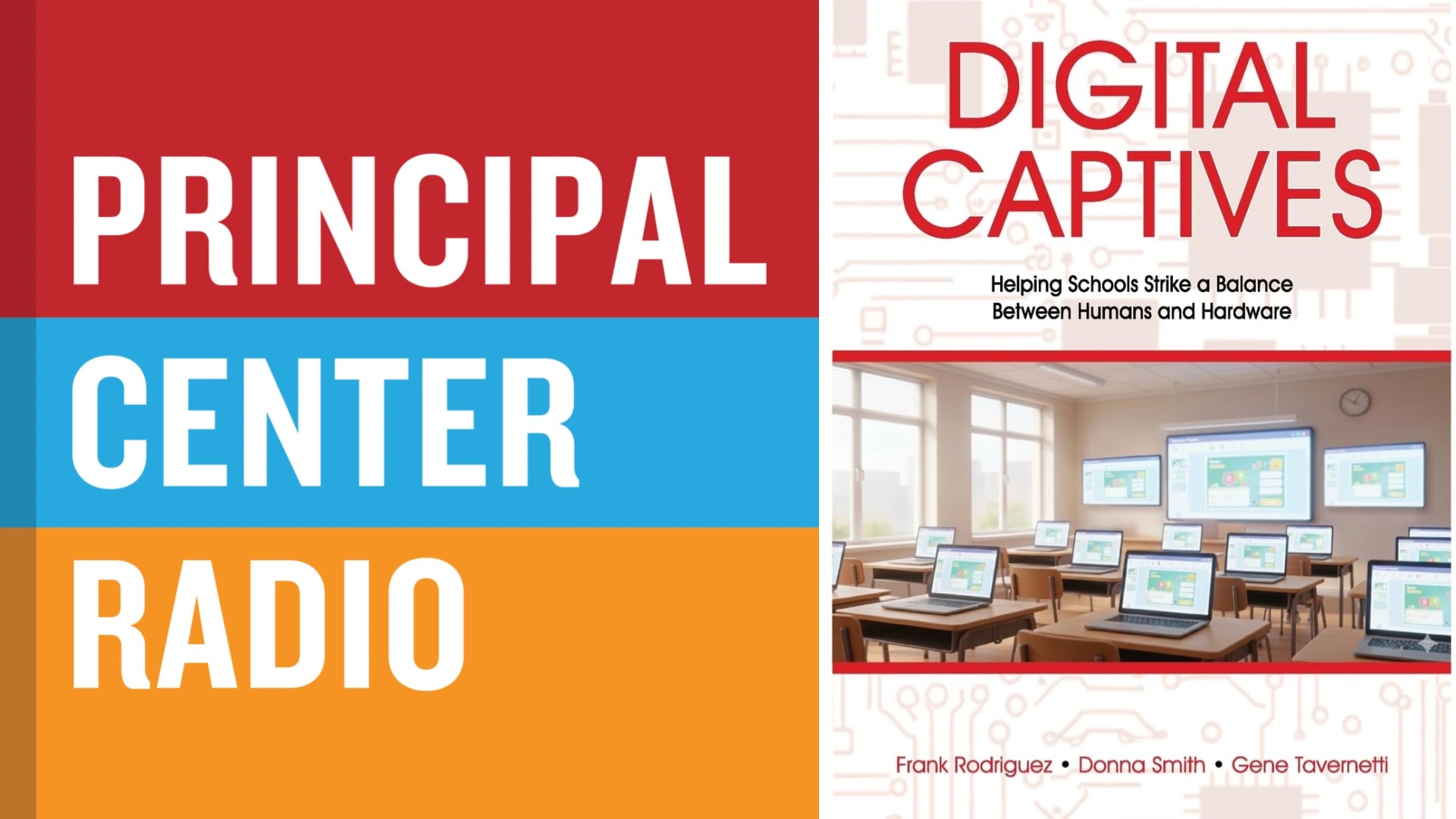
So the book is Digital Captives, Helping Schools Strike a Balance Between the Human and the Hardware. Dr. Frank Rodriguez and Dr. Gene Tavernetti, thank you so much for joining me on Principal Center Radio.
Thank you, Justin.
[28:59] Announcer:
Thanks for listening to Principal Center Radio. For more great episodes, subscribe on our website at principalcenter.com slash radio.