[00:01] Announcer:
Welcome to Principal Center Radio, helping you build capacity for instructional leadership. Here's your host, Director of the Principal Center, Dr. Justin Bader. Welcome, everyone, to Principal Center Radio.
[00:13] SPEAKER_00:
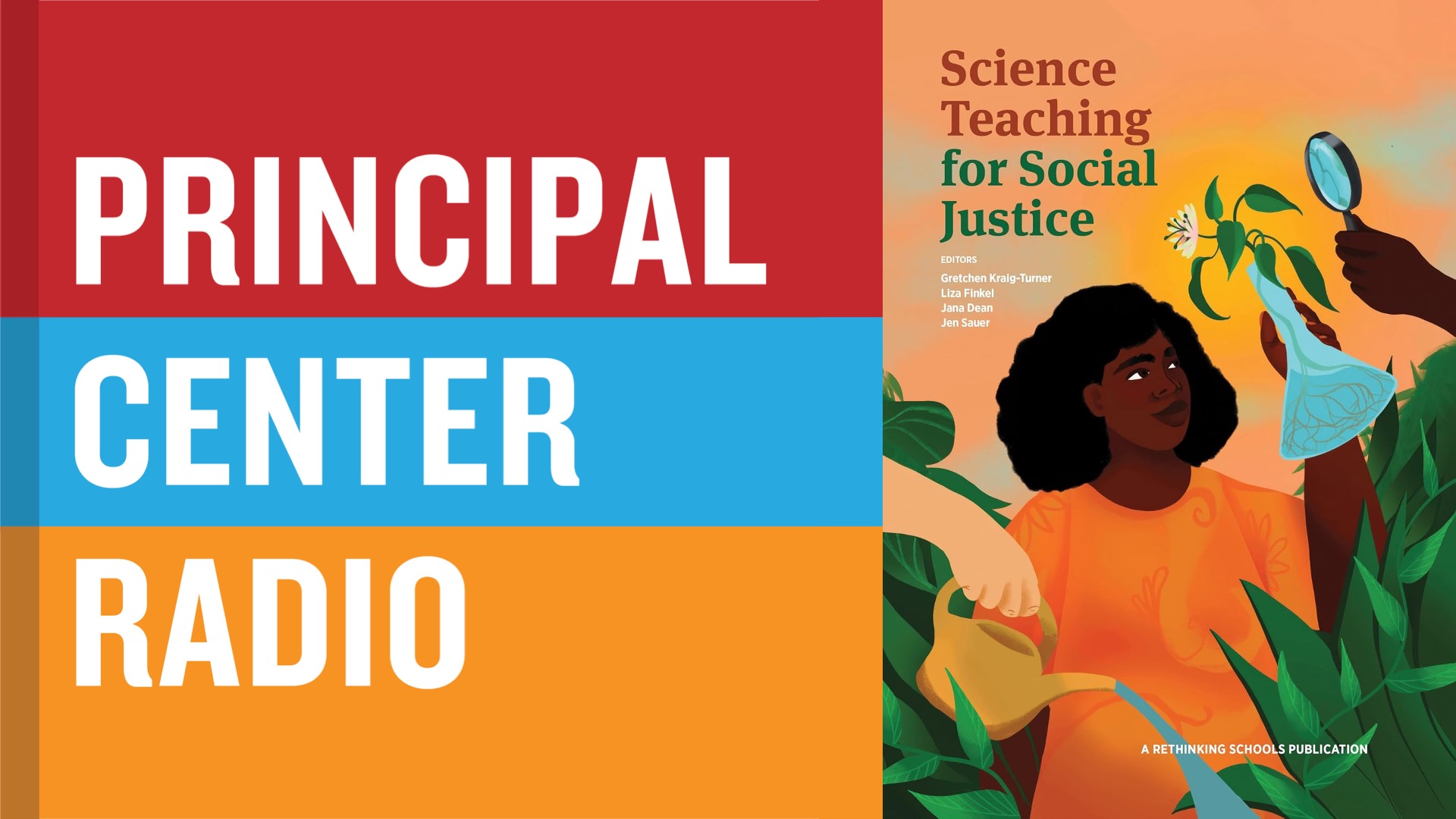
I'm your host, Justin Bader, and I'm honored to be joined today by the editors of Science Teaching for Social Justice, including Gretchen Craig-Turner, Jana Dean, and Jen Sauer.
[00:25] Announcer:
And now, our feature presentation. Welcome, everyone, to Principal Center Radio.
[00:30] SPEAKER_01:
Thank you. Thank you. My name is Gretchen Craig-Turner, and I am a biological science teacher in a high school up in northwest Washington. I've worked with Rethinking Schools for quite a long time. I've published some articles in their magazine, and so I came to this project almost a decade ago, and we've been working through finding good things to bring to other teachers and educators. And I'm Jana Dean.
[00:59]
I'm both a math and science educator. Also happen to be in Washington State. And I... I think I first encountered rethinking schools before I became a teacher.
[01:10]
And it helped me see that I could do world-changing work from inside a classroom. And then I started writing for Rethinking Schools about seven or eight years into my career and wrote several articles out of my practice as a science teacher and several from... that came from teaching mathematics. I currently work as an instructional coach and a math education consultant.
[01:38]
But when I came onto this project, I was teaching an integrated sixth-grade math and science program. So, I teach 6th through 8th grade STEM. It's a science support class, and I've been teaching in Tennessee for about 10 years now. Um, I came across this project from a mutual friend in Atlanta when I taught there, and she brought me on board because she knew I was very interested in social justice...
[02:11]
Um, I've been in the public school system for quite a while, and I saw that that was definitely a missing piece in our schools. So that's why, that's how I came on board through the science committee.
[02:24] SPEAKER_00:
Great, thank you. So the book is, we should mention, an edited volume. Talk to us a little bit about how you decided, kind of, what would fit within the scope of the book, because you've got quite a few chapters, quite a few contributors on a pretty wide range of topics. What brings the book together and kind of draws the scope of it?
[02:47] SPEAKER_01:
So, the themes of, uh, social justice are throughout. Um, we did really want to have a wide variety in terms of both, um, grade levels. We have pre-K through, uh, actually teacher ed programs represented. Um, we also wanted to really try and represent the different disciplines within, uh, science. And so, all science teachers should be able to see themselves in these articles. Um, but yeah, so we do have some common themes throughout the book.
[03:21]
Um, thinking about, uh, grounding our classrooms in student lives, um, exposing injustice, uh, bringing in, uh, worldviews beyond just the Western paradigm of what science is... And also, uh, hopefully leaving our readers with ideas of how to bring hope and action and joy into the science classroom.
[03:51]
And I can add that most of the articles originally appeared in the magazine, Rethinking Schools, and our committee was initially brought together to cultivate more science articles for the magazine, and in that process realized that there might be a book in all of this. The other criteria that Gretchen didn't mention that was really important to us Mm-hmm.
[04:44] SPEAKER_00:
Right, and Rethinking Schools, both the organization and the publication, are broader than science, right? They're not science-specific, but they cut across curricular areas. So these are articles that were either previously published or solicited for the book specifically on science. Is that right?
[04:59] SPEAKER_01:
Yeah. Yes.
[05:01] SPEAKER_00:
Are there any kind of common frameworks that Rethinking Schools, or that you, particularly in putting this book together, brought to bear to say, you know, what is justice, what does justice look like in the science classroom, or what is social justice? Any kind of common terminology there, or frameworks that guided the thinking and the curation of the articles?
[05:19] SPEAKER_01:
Yeah, so I think that is something we thought pretty deeply about, um, and I remember in the process of going, when we went through it, it took us quite a few years, right, to make this book, um, that we went through, and we looked at previous Rethinking Schools books... Um, and we took some language from there, but if you look at the way our sections are, so it's grounding science in students' lives and communities, um, expose, teaching science to expose injustice, um, broadening participation in science, um, teaching science for hope, joy, and action. All of those, I think, are, um, good indicators of what we were thinking social justice was, and especially in the classroom.
[06:07]
And we didn't always agree. So, I mean, there was a lot of, a lot of the work of putting the book together was having long, intense, deep discussions about what it really meant to teach science for social justice. And the book represents a place in time where we are now in our thinking, I would say. I don't know if you would agree or disagree with that, Gretchen and Jen. I would. Mm-hmm.
[06:35]
And I, like, and I didn't mention Section 1, but I think through that process, it was ways of knowing and understanding science, like, broadening what we even define as science as a way of looking at social justice. So, including Indigenous science, um, science as relational instead of always being objective. Um, so, yeah, definitely a place where we're at, and, um, if we were to write this five years from now, obviously, it would change, it would evolve. Mm-hmm.
[07:07]
Yeah, we started using a framework that Rethinking Schools has to define what social justice teaching looks like. That framework has been published in multiple of their books, including the New Teacher Handbook. And it was a great place to start. And, yeah, like Jenna said, this is kind of a snapshot, right? We had to stick to a publication date, and, um...
[07:34]
Version two will probably look a little different. I think that was actually a challenge for us, because in the process of soliciting articles and deciding what was going to be in the book, we had to have lots of conversations about, okay, what does this really look like? What does it sound like? What does it feel like? I think there actually is an article in the book written by one of the editors, Liza Finkel. where she approaches an operational definition of teaching for social justice as she describes what happens in her teacher preparation classes.
[08:09]
We tried to represent sort of different facets of teaching for social justice, right? Like, there's methodologies of making sure everyone in the room has their voice represented and included and celebrated, right? So, we can look at just science teaching methods alone and also content. You know, many of the articles in here are looking at social injustice and how science either perpetuates or can fight against those. So, I would say that, you know, it is a very fluid definition of And there's just lots of different ways as a teacher to approach how you're bringing social justice into the classroom. And context matters a great deal as well.
[08:54]
So who you're teaching, what you're teaching, where you're teaching. What Jen might do in Tennessee might look very different from what I might do in Washington State. Two of my favorite articles in the book were developed by Gretchen and Jen, but I want to start with yours, Gretchen. So, Gretchen had taught a unit, and I'm going to ask you to add details to bring it to life, Gretchen, if you don't mind, and had realized that there was an aspect of her teaching that she needed to interrogate, and she went and interviewed...
[09:28]
prior students to find out from them their perspective on what they had experienced in that unit, and then went back and decided to make some significant changes to her approach. And so I just love that that demonstrates... I think part of teaching for social justice has to be about really deeply understanding our students' perspectives, because as teachers, we have power. We're in a position of power.
[09:56]
And working for social justice requires that we understand the power dynamics as they play out in society and in our classrooms. And so, the fact that Gretchen did that, I think, is just absolutely beautiful. So, thank you, Gretchen, for that contribution. And that example of what it truly means to take the perspective of our students, because if we're not doing that, I don't, I really don't think we can be teaching for social justice. Yeah, I, um, so I had been teaching about the untreated syphilis study at Tuskegee for quite a while, and through the Black Lives Matter movement, especially what we saw in the spring of 2020, I realized that a big part of my lesson was missing, and that was showing how the men fought back.
[10:47]
Okay.
[11:10]
So, I went and interviewed, um, a handful of former students to find out, like, what they really took from the lesson. Um, and... I found that they did take more of a perspective of victimization and less of resistance. And so I did rework big chunks of that unit to emphasize resistance and agency and how it really led to some tremendously powerful changes in healthcare and medicine and science studies as a whole.
[11:46] SPEAKER_00:
Yeah, yeah.
[12:02]
serving in the military and getting healthcare treatment that way so that they could be studied essentially for, you know, for decades without being treated for a treatable disease. And obviously, you know, many of them died. There were lifelong consequences to that. And I think that that raises a pretty crucial issue here, that, you know, whenever we're talking about any of these, you know, these issues, these cases that occurred, and, you know, getting students to empathize with the people who are involved, there is definitely the potential to, you know, to stir up feelings, to get people upset, to get students fired up, and...
[12:39]
Right. Right.
[13:07] SPEAKER_01:
Yeah, I think we start that unit and we end that unit with thinking about current practices, you know, and we still see huge health disparities by race and gender in this country. And students are pretty aware of that at the high school level, and some of them have experienced that. So in terms of where they're left, you know, we, we have a few tools that, you know, we can teach. Talk about how to write letters to people in power and things like that. But also what that looks like when, you know, they go to the doctor or what does it look like to ask questions if they are, say, doing translating or interpreting for their families. You know, things like that.
[13:50]
So, I think there's both small and large actions that we can think about showing students how to address the, um, disparities that still happen. I've also... My students were much younger. They were sixth graders.
[14:07]
Yeah.
[14:28]
didn't believe that climate change was real, and that put him... Him being in my class, he was... That put him in a really awkward position, because I, as a teacher, have power and authority, and so did his dad.
[14:42]
And I also... And I had a principal at the time who I went to, and I said, um, you know, I've got a problem here. How can I... How can I continue to teach the science?
[14:54]
Because I was using... teaching climate change to teach a whole bunch of physics and chemistry. Um, how can I continue to teach the science thematically? I've got this underway, and this kid is in a bind, and his answer was a great answer.
[15:10]
He said, just teach the science. And so I made absolutely sure that the whole unit was based on what actually happens in the carbon cycle. From the short carbon cycle, the long carbon cycle, short carbon cycle, we're talking about a banana. Long carbon cycle, we're talking about fossil fuels. And then the unit ended with all of us, me and the students, and I think I probably, I probably had a paraeducator or a couple of parent volunteers. We measured...
[15:45]
...the diameter and calculated the approximate carbon sequestration on every tree on our campus. And it was not a tree-forested campus, but the amount of carbon in terms of weight was enormous. A really surprising amount, but then if also, if you've ever stacked wood, you know it's heavy.
[16:06]
The weight of one tree is heavy. And they decided to plant a maple tree. They named it Edgar Murphy Wood... And it's still standing there.
[16:15]
So we spent a day digging a deep hole and knowing that the fact of planting a tree, not that planting a single tree is going to change climate change, but we are, we were having an impact on the carbon cycle by planting that tree. And it was fun.
[16:36]
So that's... And your question is a good one, because that's something that's always on my mind as I'm designing learning focused on social justice.
[16:47] SPEAKER_00:
I think that gets into a really interesting tension, you know, that also gets into, you know, how students are made to feel by what we're teaching. I know younger students in particular, maybe at the upper elementary grades, tend to take on causes very personally and maybe feel very responsible. You know, if you teach kids about any environmental issue, they will, you know, often want to take very dramatic action personally. And, you know, we live in a world with billions of people with, you know, forces that extend far beyond...
[17:16]
you know, any individual's ability to, you know, to kind of offset.
[17:20] SPEAKER_01:
Yeah.
[17:21] SPEAKER_00:
There's a chapter in the book by Ursula Wolf Rocha who talks about the ecological footprint calculators that students sometimes use to see, okay, if I'm taking a shower that's this many minutes long and using this much hot water, or if I'm using this much plastic, that can raise some issues that students take on very personally and take the attention away from You know, some of those bigger forces in the world, you know, there are oil companies that, you know, swamp the impact of any individual. And yet there's a tension around, you know, what do I do as an individual? How much do I take responsibility for? What do I, you know, how do I feel about, you know, my own role in all of these things as a person who, you know, who has to live and maybe doesn't get total control over how we live as a family? How do you think about some of those issues that can come up for students who may take them very, very seriously?
[18:11] SPEAKER_01:
Well, I think it's really interesting to think about, like, how students internalize these different ideas. And that's a great article to bring up, right? Because she is trying to, in there, say that this is not, climate change is not a single person not flying to see their grandma this summer, you know, or whatever that might be. But I think if we can actually sort of utilize that sense of justice that kids sort of innately have, right? I mean, one of the first phrases that we think about, like, kids saying is, that's not fair, right? And so, a lot of the stuff that we talk about is not fair.
[18:50]
And how do we kind of capitalize on that? as a way to get the kids interested in learning more. So if the kids can see that things are, in some cases, not fair, then the natural next step is, well, how do we make it fair? And as science teachers, how can we use science to think about how to make some of these issues more fair? So I don't think we're ever trying to tamp down that innate sense of justice and fairness that kids have when they do take things like that kind of personal.
[19:24] SPEAKER_00:
I think one other issue that may be addressed by a lot of the articles in the book is the issue of disagreement among adults as to what constitutes, you know, a legitimate issue to bring up. You know, if I have an issue that I feel very strongly about, someone else may be on the opposite side of that issue. Parents may, you know, even if as a school we agree, maybe in our department we agree on an issue, but parents may, as you've already indicated, I think one of the things that's challenging...
[20:05] SPEAKER_01:
Wow. Wow.
[20:24]
Like, there was a time when scientific research seemed to tell us all kinds of things about eating fat-free foods, and it turns out that that's not quite accurate. And so, it can be easy to say, well, wait, they were lying to me? No, they weren't lying to you. There's just more science that is indicating that different things, different phenomena seem to be present. And I think That to think that there is no disagreement is not doing our kids any favors. So that's one part of it.
[20:59]
And then another part of it is that places of disagreement are really rich and fruitful. Like, if we... We need to jump on that stuff because that's where people are interested and willing to engage and willing to...
[21:17]
learned something. I actually was teaching in a rural southwest Washington school, and I, very early on in a climate change-oriented unit, I was teaching an earth science class, and I needed to teach atmospheric science, and Al Gore was vice president, and there was a lot of conversation at the time about climate change, just as there has been ever since, but it was sort of New-ish, the hockey stick graph had just become popular. Like, we were... Science was discovering that, wow, we really have increasing global temperatures right now.
[21:59]
And that was threatening, particularly to the young men in my eighth grade science class. I used that... sort of sense of urgency they had. Wait a minute, are you trying to tell me I can't drive a truck?
[22:15]
I'm like, no, I'm not trying to tell you you can't drive a truck, but you, let's learn this. Let's figure this out so that you are, you, you know what's happening and what's going on. So I don't see it as a, I don't see the disagreement as a problem. And that, and then I'm kind of back to the advice that my principal gave me. That was something like seven or eight years later.
[22:38] SPEAKER_00:
So, in closing, I wonder if we could just have everyone say a couple of things that you want people to take away from this work, knowing that it covers quite a range of topics and issues in science teaching for social justice. What do you want people to walk away with from the book?
[22:58] SPEAKER_01:
I want educators to understand how much richness bringing social justice issues into the classroom is. How much richness, uh, comes into the class? Students are really hungry to understand how science applies to them, right? You know, we get that question all the time. Well, when am I ever gonna use this, right? Like, that's a real classic science student question.
[23:22]
And we can help them figure that out through... through thinking about how it impacts their world. And, yeah, I just feel like there's so many great examples in this book of how to do that. And, you know, you were just asking about, like, when there's disagreements and things, and oftentimes when we strip away some of the surrounding noise and just get really accurate...
[23:49]
becomes really clear to kids what's what and how their concepts that we're trying to teach, right, can actually benefit them.
[24:01]
Well, when I think about your audience of principals, I have always known that the support of my principal is absolutely essential. And I think I'm proud to say that I've always known every principal I've worked for, I've worked in four different public schools, has had my back. When, and was there to be a sounding board when the content that I was bringing to students was a little bit addressing real issues about things that people may not agree with. And I think I've always been proactive in letting any principal that I was working with know what I was doing so that If there were issues or anything with community members or parents, they could support me. And in every single case they have. And so, I guess I'm expressing gratitude for the principles I've had.
[24:55]
And, um, know that your audience is probably full of similar people. So, teachers can do great work. And they can do great social justice work in a world that often doesn't care about fairness when they have the support of their administrators and other people in the system. And without that support, it's very, very difficult to do. I'm grateful for the support I've had.
[25:21] SPEAKER_00:
And I'm sure your audience is full of those kinds of people. Well, Jen, Jana, Gretchen, thank you so much for joining me on Principal Center Radio. It's been a pleasure.
[25:30] SPEAKER_01:
Thank you so much.
[25:39] Announcer:
Thanks for listening to Principal Center Radio. For more great episodes, subscribe on our website at principalcenter.com slash radio.