[00:01] Justin Baeder:
Welcome to Principal Center Radio, bringing you the best in professional practice.
[00:06] Announcer:
Here's your host, Director of the Principal Center and Champion of High Performance Instructional Leadership, Dustin Baeder. Welcome everyone to Principal Center Radio.
[00:15] Ilana Horn:
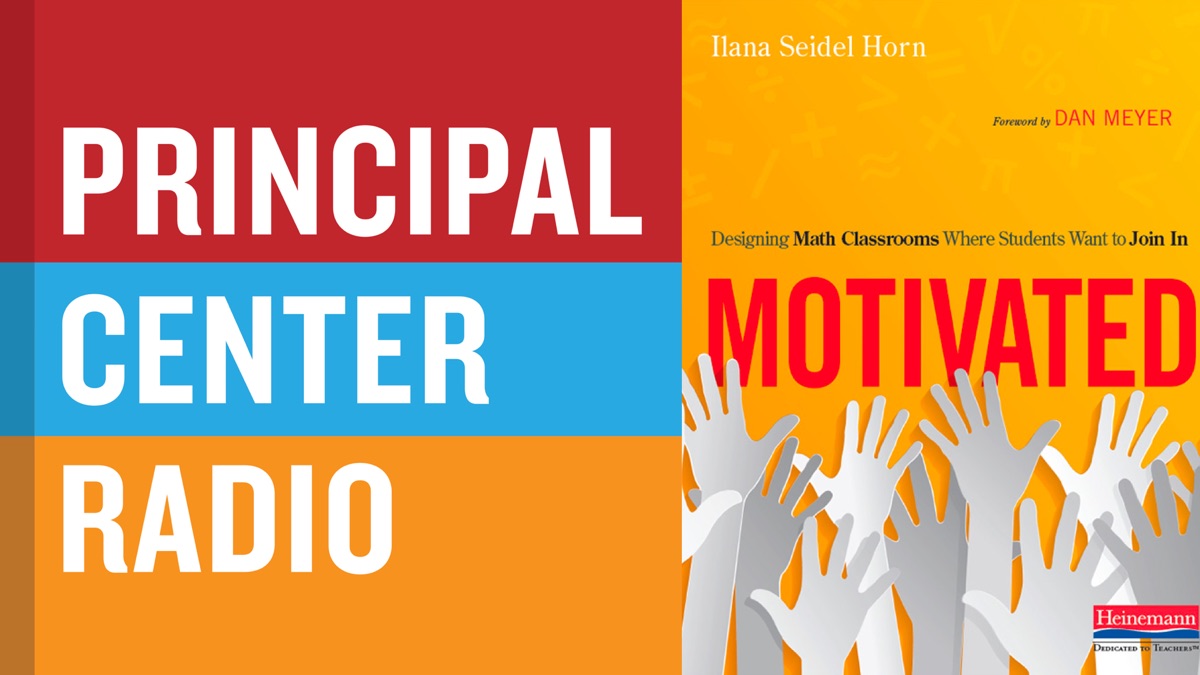
I'm honored to be joined today on the show by Dr. Ilana Seidel-Horn. Dr. Horn is professor of mathematics education at Vanderbilt University's Peabody College, where her research and teaching center on ways to make authentic mathematics accessible to students, particularly those who have historically been disenfranchised by our educational system. She's the author of numerous scholarly publications and several books, including her new book Motivated Designing Math Classrooms Where Students Want to Join In.
[00:45] Announcer:
And now, our feature presentation.
[00:47] Ilana Horn:
Dr. Horne, welcome to Principal Center Radio.
[00:49] Ilana Horn:
Thank you for having me.
[00:50] Ilana Horn:
Well, it's an honor to speak with you, and I've been aware of your work through work friends for many years, and I'm excited to see you writing a book for teachers, for people who are currently teaching math, and perhaps those who support them. What did you see happening in the field, in your research and in your work with teachers, that prompted the need for Motivated?
[01:10] Ilana Horn:
I actually feel like this book is directly coming from conversations I've had with teachers. When I have done professional development and teacher education over the years, teachers will often get excited by ideas and new techniques and curriculum. But the pause that always comes up is, my students don't seem motivated enough to work in this way or do this kind of math or whatever, fill in the blank. And instead of hearing that pushback as, wow, the teachers just don't know how to engage enough the students, I thought, well, let's start there and let's take that really, really seriously as an important problem of practice that we as researchers need to do a better job supporting teachers in addressing. So it really came directly out of conversations with teachers and problems that they consistently communicated experiencing in their classroom.
[02:08] Ilana Horn:
And I feel like we should contrast this to what we might think of as kind of a traditional great math teacher. And I think back to my high school experience, I had a fabulous math teacher named Mr. Piercy, who was great in the traditional ways of A, really knowing the math. So he was very into math, loved math, really understood it. He could teach calculus and not have any trouble with the concepts. And then B, being engaging in the sense of making class fun, making class interesting, coming in costume, you know, not just for Pi Day, but, you know, 20 times a year, Mr. Piercey would come in costumes.
[02:41]
And, you know, there's that kind of motivation that comes from a certain kind of teaching. But as I read about your work and I hear about your work from colleagues, I get the sense that you're talking about something different. That's more about the way the class is set up, I guess, in terms of a class culture. Is that a fair statement?
[02:57] Ilana Horn:
Yeah, I think it's partly a cultural thing and it's partly a design thing. I wrote this book mostly trying to help teachers imagine ways to redesign their classrooms to invite more authentic student engagement. So to try to find ways to make mathematics meaningful and the usual shortcut for that. So what you're talking about, your teacher who dressed up in costume, is sort of the, like, get the kids excited to be in class thing. which is, that's a really important thing. You want people to feel like it's a positive experience being in there and knowing his content obviously was really an important thing too.
[03:35]
But I think we're looking beyond the sense of belonging and excitement and beyond the idea of making math meaningful by putting it in real world context. That's the usual way of trying to make math meaningful. And in fact, that's what students usually complain. They say, when are we ever going to use this? complaining that this doesn't feel relevant to my life, right? So I think that there are ways to make things meaningful by sparking kids' curiosity, by engaging them in inquiry, even on abstract ideas that maybe don't have real world applications, but that could still engage them and feel personally meaningful for their learning.
[04:10]
So I think it's an issue of engagement and an issue of culture, and I really frame it as things for teachers to do as they're designing instruction and reflecting on instruction.
[04:21] Ilana Horn:
I love the attention that you're drawing to that issue of designing a classroom, because if we think about how a math classroom feels to the average student, not the student who is excited to take calculus, but the average student who might not take calculus or might not feel confident in taking calculus at least, and of course we're talking about all grade levels here, but I feel like there are some issues around self-doubt and some issues around status that are operating in math classrooms whether we think about it or not. Could you take us into some of those issues?
[04:52] Ilana Horn:
Yeah, absolutely. I think you hit the nail on the head that a lot of these things are operating, whether we're being intentional and aware and reflecting on them or not. And the first one you named would be under the part of the framework that I call belonging. Do I belong here? Am I someone whose ideas matter? Am I a legitimate person in this math classroom?
[05:17]
Or do I really not belong? And we see a lot of this in upper level math classes, But in lower level math classes, too, because there the issue becomes, well, I'm not really a math person. So I don't really belong here. And we have this pretty powerful idea in our culture of math people and not math people. And so kids are kind of opting out before they even step in the door. So there's a lot of work for teachers to do around those ideas.
[05:44]
And then the stuff you started to mention about status, you know, especially the teachers I'm writing for are grade 6 to 12 teachers, although I know I've been told there's stuff that's useful for younger grades teachers as well. But I'm really thinking about the particular challenges that come with adolescence. And that's when kids really start to develop a different level of awareness of their sort of place in the social world. That's why some of the social stuff becomes really tough in middle school and high school. And it doesn't leave itself at the door when kids come into the classroom. It's not just what happens in the cafeteria or the playground or the schoolyard or whatever, or social media for that matter.
[06:26]
It's happening. Those social dynamics are playing out in your math class as well. And as a result, kids also kind of have predetermined who they want to talk to, who they want to interact with, whose ideas they think are worthwhile. And some of that comes from judgments about popularity and social desirability. And some of that comes from who they have decided by sixth, seventh, eighth, ninth grade is smart. And math does a pretty good job in our school system of sorting people into smart and not smart in a pretty binary and harsh way, especially in our current environment where kids are actually getting published test scores almost annually.
[07:07]
telling them and ranking them and sorting them in percentiles. So these ideas about who's smart, who's not smart also are playing out and those play into the status issues you were talking about.
[07:20] Ilana Horn:
Yeah, absolutely. And I appreciate your attention to the secondary issue there, because of course, at the elementary level, we don't have kids saying, well, I'm not an addition and subtraction person. I just, you know, I don't identify with that. You know, intellectually, everybody can master addition and subtraction and thinks that they can, but we start to lose that as kids get into adolescence and we get that doubt and those identity issues.
[07:41] Ilana Horn:
Yeah, no, I think you're right. I think there's something to the content where adding, subtracting, and all kids care about sharing, right? So division and fractions have some natural connections to their lives. I also think the way we've organized school so that elementary teachers tend to be trained to pay attention to the social, emotional dimensions of their work. And they also often, not always, but a lot of elementary folks are less confident with math themselves. So sometimes this leads to math being downplayed in elementary school.
[08:12]
And so there's other issues. But in terms of motivational stuff, the teacher's usually do more to invest in their relationships with kids. They spend longer amount of time with them during the day. They're trained and oriented that way. And secondary teachers usually have their students for a lot less time. Not always, but generally people who go into elementary teachers are more about the kids.
[08:38]
And a lot of times the folks who go into secondary are about their content. Their identification is more with their content. So they, they may be less aware of the need to build relationships. And again, these are sweeping generalizations, and my book is actually filled with a ton of wonderful counterexamples to that general statement. But I think that the way school is set up is it sort of invites those orientations on the part of teachers at different grade levels as well.
[09:04] Ilana Horn:
And I think that specialization that happens at the secondary level, you know, where you have people teaching math who, in a lot of cases, are math people. They see themselves that way. Students see them that way. And then, of course, you have other people who have to teach math and don't see themselves as math, you know, especially we find that at the middle school level, like you're going to teach math. You're not certified in it, but somebody needs to and you're it. We were the science teacher last year, so that's close enough.
[09:29]
So how does that play into design? So someone is teaching math. They have some students who are math people like them, or maybe they're not math people. But in every classroom, in every school, there are going to be kids who don't self-identify as math people. And we need to help them find success. We need to help them see themselves as competent students.
[09:49]
in math because we know they will need it. It's not that you can opt out in sixth grade and never learn any more math and just have great outcomes in life with that. You know, we can't leave that alone as an equity issue. So how does that play into the design of a classroom?
[10:03] Ilana Horn:
Right. So a lot of times when I talk about the need to broaden access and participation in math, it gets heard as, oh, you're going to water it down. You're going to make it less authentic somehow. And actually, the irony is that it's actually the opposite strategy that works. If we look at the history of mathematics and what moves the field forward, it's a lot different than the kinds of mathematical smartness and competence that we value in school. In school, the most important way of being smart in math in typical instruction is being a quick and accurate calculator, meaning that a teacher asks you what the answer is.
[10:43]
You can be the first one to raise your hand. When you get a test, you are able to reliably get the correct answer without making sloppy mistakes. So this answer orientation in traditional curriculum really values a narrow set of mathematical competencies. When you look at the history of math, though, you see that that is not the skill that has moved the field forward in itself. In fact, there's a lot of other kinds of skills and the kind of math competencies that have moved the field forward, the field of mathematics. So we have being able to see patterns, being able to ask good questions, being able to develop clever representations, being able to work systematically.
[11:27]
I could go on and I do this at more length in my book, but these are all things that kids have very few opportunities to do in typical math instruction, and yet most kids are good at at least one of them. So if you have a teacher who's working from a deeper sense of what it means to do math and be good at math, that's a really important starting point to broadening access. So it's actually not a watering down strategy. It's a becoming more disciplinarily authentic strategy and thereby offering kids more paths in to the ideas and concepts.
[12:04] Ilana Horn:
Oh, I love that. And I appreciate your point there that professional mathematicians, people who do research in math, you know, it's not who can do arithmetic in their head the fastest who becomes a great mathematician, right?
[12:16] Ilana Horn:
Yeah. One of my math professors, because I have a math degree, my undergrad degree, and my advisor, he used to say he studied algebra. And, you know, obviously theoretical algebra. And he said, I didn't see a number the whole damn time is what he used to like to say.
[12:32] Ilana Horn:
That it's lots of different kinds of thinking and representing thinking and talking. I wonder if we could talk more about talking because I feel like the way that students are told or sent the message about who should speak up and who should come to the board and share their thinking. I feel like that factors into this. And I wonder what your thoughts are on talk, you know, about student discourse about math.
[12:53] Ilana Horn:
Yeah, that's a really, really important thing. It's actually probably one of the aspects of math instruction that's gotten the most attention, in fact, in research and professional development. There's a lot of wonderful books out there about math talk, about discourse routines, the Five Practices book from NCTM, Mary Kay Stein. There's a lot of really wonderful resources about talk. And actually, part of why I wrote this book is a lot of those things were developed in elementary school. And part of what happens in elementary is kids are more inclined to do what the adult in the front of the room is asking of them.
[13:30]
And anyone who's taught middle school will tell you that that doesn't happen. Just because you're the adult doesn't mean the kids are going to follow along, right? Sort of the silent rebellions that happen. So that was part of the motivation for writing the book. And to answer your question about what it means to get kids to talk and deciding who talks, that is where...
[13:52]
the section of the book that I call accountability, which has to do with the norms of the classroom and the structures of the classroom. So it's important for there to be ways to support kinds of talk that aren't about right and wrong answers. And that right and wrong answer type discourse is all a part of the sort of same instructional system as being quick and accurate is the way to be smart. So therefore, When you answer correct, you're good at math. When you don't answer correctly, you're not good at math. So instead, if we think of mathematics as sense-making instead of just getting the answer, then that opens up new ways of talking and thinking about math.
[14:35]
So one of my colleagues, Mandy Jansen, has done a lot of work around the idea of rough draft talk, of naming that for kids, saying, you know, I just want to know what your thinking is. This is just a rough draft. It doesn't have to be a final answer, but I just want to hear your ideas. My colleague, Max Ray, has talked a lot about a routine called notice and wonder, where you put up some kind of a mathematical representation or situation and you just ask kids to notice things and you ask them what they're wondering about. There's nothing you could say that's right or wrong there. You could say silly things, which is totally fine.
[15:11]
But there's just a lot more opening in both of those kinds of strategies to invite kids in.
[15:18] Ilana Horn:
Well Lonnie, as we're talking about these ideas about classroom design and about thinking about the way that students are communicating and what kinds of thinking get valued, one of the things that comes to mind for me is enrollment in those advanced courses. Because as I think about my own experience in high school, I took calculus and I went to a pretty diverse school, but my calculus class had five kids in it. And it was all kids that stereotypically you would think would be in a calculus class in a school that has not really done much work on the equity side. So you mentioned earlier that kids, before they even come in the door, kind of decide how they're going to see themselves mathematically. And I wonder for schools that are noticing that same pattern where We have kind of the upper middle class white kids taking our advanced math classes.
[16:09]
We have maybe certain other populations taking those classes, but also populations that definitely are not. And maybe they're getting that message from us, or maybe it's an internal message. What do we do about that to start to say, okay, math is for everyone. These advanced math classes are not just open to everyone. We're not talking about excluding people. We're talking about getting kids to believe in themselves, getting teachers to believe in kids, and making this a normal thing for everyone to be in these more advanced classes.
[16:43]
Because we know that those classes play such an important role in college, in access to careers. What do we do from an equity standpoint if we're noticing, okay, we have these classes and not everyone is taking them?
[16:54] Ilana Horn:
So, I mean, some of that is obviously structural and that's not really within the province of classroom teachers, right? Because there's a whole process bunch of pipeline issues of how tests get counted and how tests are biased and how we know that there's bias in discipline and grading and all of that kind of thing. I think once the students are in your classroom or if you're trying to construct in your school a pipeline of classes that might do more to pump than filter kids into calculus or toward calculus, I think it's really, really important to foster a sense of belonging. And I think that that can be done in a lot of ways. I was a female math major, and that was not a really common thing in the early 90s when I was getting my degree. I would have a lot of seminars where I was the only woman in the room, especially once we got to the upper level.
[17:52]
And I can tell you that I felt like I had less room for error because I felt like my legitimacy there around the seminar table was a little bit, even if no one was explicitly saying, why are you here? I definitely was not one of the dudes. And I think we need to be really careful about the messages we send about who belongs around that table and think about how to invite people. So one of the things that's really simple is just representation around the classroom. posters that show diverse mathematicians. There's a teacher, Annie Perkins, who has really done a lot of wonderful work.
[18:37]
She's on Twitter. A lot of the teachers I feature actually in the book are on Twitter. And Annie has done a really wonderful job of helping her children, her students, see the incredible diversity among really accomplished mathematicians. So that's just one example. I think it's really important to pay attention to unconscious bias and That can be done in a lot of different ways. There's some online tests that teachers can take to see if perhaps they might have unconscious bias that might come out when grading is subjective and there's judgment calls involved.
[19:09]
You could have a trusted colleague come into your classroom and just sort of take notes on which students you ask what questions to and do some reflection on that. Are you proportionally calling on certain groups of students more than others? Again, using gender as an example, we know there was a study, I think it was in the 1980s, that showed that when teachers called on girls more than 30-something percent of the time, the boys thought they were giving the girls too much attention. So these systems of bias are sort of socially embedded, and it's not just about the teacher's expectations, but it's about the cultural expectations. And so a lot of times teachers are falling into these patterns of bias and not even realizing it.
[20:02]
But what I was talking about earlier about moving away from quick and accurate calculation is the only way of being smart at math, that can help broaden access in the sense of really showing kids who maybe have had a patchy history academically that they can do something and they can contribute something that's of intellectual value to the classroom's inquiry or discussions. And when teachers notice that and name it and celebrate it in ways that are fitting for the situation, that can really help kids develop more positive identities around mathematics too.
[20:41] Ilana Horn:
So the book is Motivated, Designing Math Classrooms Where Students Want to Join In. Lonnie, thanks so much for joining me on Principal Center Radio.
[20:48] Ilana Horn:
Thanks for having me.
[20:50] Justin Baeder:
And now, Justin Baeder on high-performance instructional leadership.
[20:55] Ilana Horn:
So high-performance instructional leaders, what did you take away from my conversation with Dr. Horn about designing math classrooms where students want to join in? I want to challenge you to pay attention to enrollment patterns in your school because I think it's very easy for us to go on assumptions that we've dealt with for a long time in our profession that may be advanced math is not for everyone, that not everyone is a math person, and that those patterns follow certain demographic groups. We've really got to take responsibility for that as educational leaders. And we've got to say, hey, if we are designing a system where not all of our students have access to these advanced level math courses, not all of our students have the message sent to them that they can succeed in these courses, we've got to take responsibility for changing that.
[21:47]
And I loved what Dr. Horn said about pumping students into those math courses rather than filtering them out. And I want to encourage you to check out her book, Motivated, Designing Math Classrooms Where Students Want to Join In, where you will hear stories of teachers who are succeeding at doing just that, of pumping students into those math classes rather than filtering them out.
[22:10] Announcer:
Thanks for listening to Principal Center Radio. For more great episodes, subscribe on our website at principalcenter.com slash radio.