[00:01] Announcer:
Welcome, everyone, to Principal Center Radio.
[00:02] Justin Baeder:
I am Justin Bader, but I am actually not your host today. I'm going to turn it over to my good friend, Dr. Barbara Blackburn.
[00:21] Barbara Blackburn:
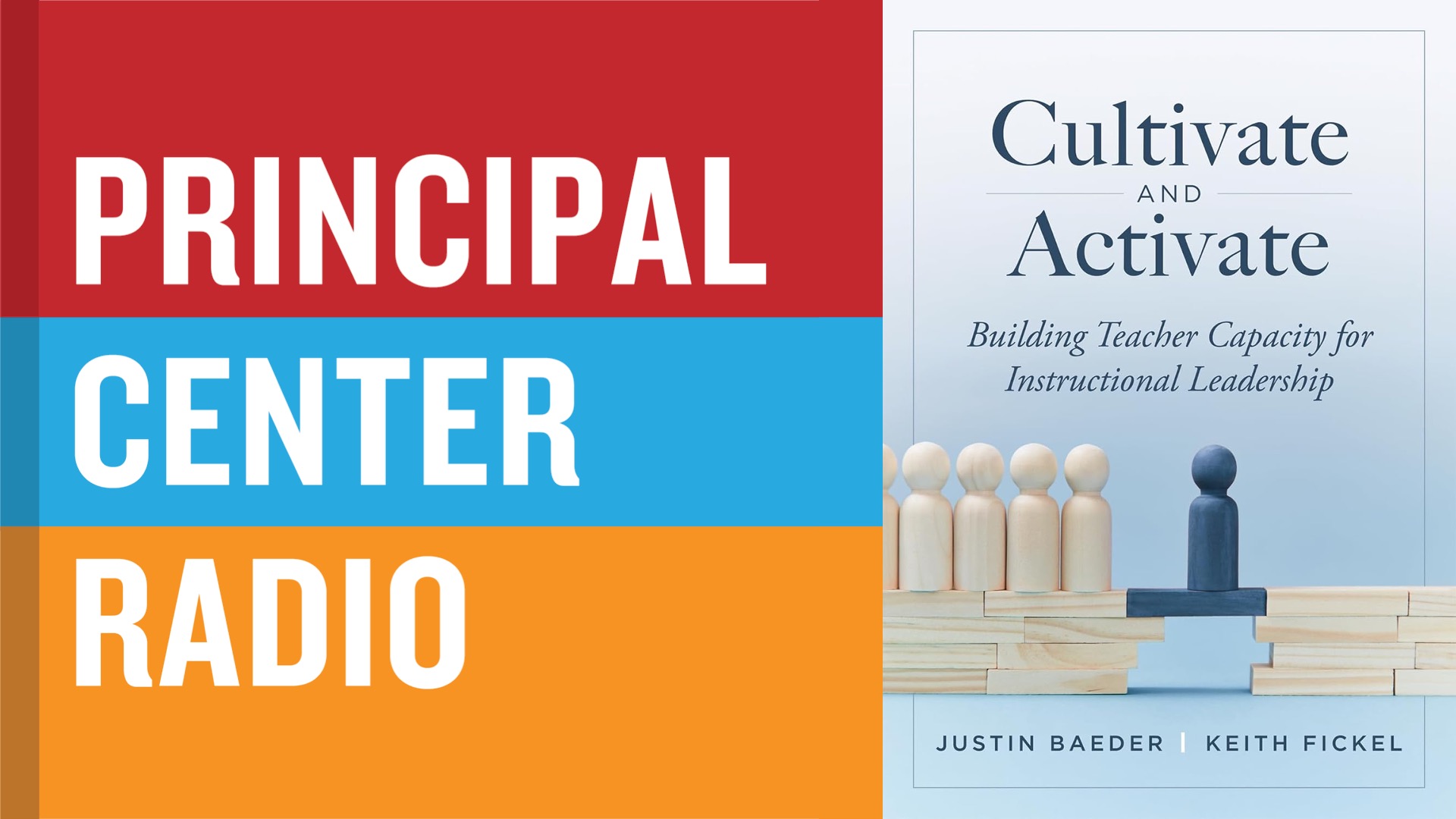
Hey, this is Dr. Barbara Blackburn. Today, I am the guest host of Principal Center Radio, and my extra special podcast interview is with Justin Bader. We're doing this sort of turnaround today. And Keith Fickle, the authors of Cultivate and Activate, Building Teacher Capacity for Instructional Leadership. So, welcome, both of you.
[00:41] Justin Baeder:
Thank you. Thank you, Barbara, and thank you for hosting today.
[00:46] Barbara Blackburn:
We're gonna have so much fun. I love being on this side of the interview process. This is really cool. So, let's start. I was really intrigued at your new book, uh, because just the, the topic of instructional leadership is so important, but it's also one that a lot of people write about. And so, I bought your book interested in how you would approach it differently.
[01:08]
And so, let's just start with, from your perspective, who is an instructional leader and how did you come to that view?
[01:16] Keith Fickel:
So, an instructional leader, in my view, is anybody who assists in improving situations for the students, the outcomes that the students have in terms of instruction and learning, and also who is involved in decisions that affect those outcomes.
[01:33] Justin Baeder:
I think a big part of...
[01:59] Barbara Blackburn:
Yeah, and I think that's a really important view that maybe exists, but isn't clearly delineated. And so that, to me, is a real focus of the book. So you talk about four gaps. Talk a little bit about those.
[02:19] Keith Fickel:
In the authority gap, there's this idea to where administrators have... the power, this power dichotomy where administrators make the decisions and it's the teachers who implement them. And then the teachers don't really have the authority, but they have the information that is needed to help make really strong and sound decisions. And so there's a little gap there that in our book, we talk about how to bridge that gap to include teachers in the decisions that affect them because they have greater information to affect positive outcomes for them and for their students.
[02:52] Justin Baeder:
Then the second gap is the other side of that, the information gap, that often the people with the formal authority, the administrators, often don't have the firsthand information about the implications of a decision, the details that would lead to a good decision. So we've got this kind of artificial separation where one group of people has the authority to make decisions, and the other group has the information to make good decisions. So our big idea here is to, you know, to bridge them, to close those gaps, And then we've got two more gaps that go along with closing those first two gaps, the opportunity gap and the culture gap.
[03:26] Barbara Blackburn:
Great, great. Keith, let me ask you this. Let's talk about teacher leaders for a minute. Which of the gaps is probably the most challenging for teacher leaders?
[03:36] Keith Fickel:
the system is set up in such a way that they don't have a lot of agency to affect their outcomes. It's kind of like Stephen Covey's idea of having influence over a situation rather than control. Um, you know, teachers really can't control many of the outcomes at a school. They can't, they don't decide the budget. They can maybe influence it, So, it's kind of, it's a challenge for teachers, I think, to have authority over situations because that's not their role, you know, in the traditional hierarchical sense of schools. So, that's just kind of my view of it, is that authority is kind of the one that they lack.
[04:12] Barbara Blackburn:
Keith, what would you say is the biggest challenge for administrators, whether it's a challenge for them to deal with or a challenge for them to give up? What do administrators struggle with?
[04:22] Keith Fickel:
Kind of conversely, like Justin was saying a little bit ago, it's... They don't always have the information. Teachers do. They don't...
[04:30]
They think they have the information, but they're, like, at a 30,000-foot view when teachers are kind of more on the ground, in the grind, in the work. And so when they don't have the information that they really need to really make the best decisions, if they don't realize that, they kind of put themselves into a bind. So I think it's probably harder... For administrators to recognize that they lack the information that they need, but when the scales fall off their eyes, then, you know, they can make some positive change that way.
[04:59] Justin Baeder:
The reality may be that the authority is not officially going to move, right? The buck stops with the principal, the, you know, the administrators often are formally in charge of a lot of things, and that's probably not going to change. But one thing that we talk about quite extensively in the book is how to delegate that authority, not just the responsibility to work on something, you know, and delegate the task, but to actually delegate the authority. And, you know, if somebody is going to work on something, if they're going to, say, put together budget scenarios, Take that authority that is officially the administrator's and delegate it to the people that the administrator is trusting to look into the issue, to study it, to make a recommendation, and then take that recommendation seriously. And I think if we reflect on our own, perhaps, teacher leadership experiences that we had that were not very satisfying, that were subpar, you know, we put time into something, you serve on a committee, and we have some examples of this in the book...
[05:54]
You know, when teachers are asked to serve on a committee, often, they do a lot of work, and then it doesn't go anywhere. Somebody makes their own decision, maybe their recommendation is rejected, maybe there's some sort of other influence that they didn't even know was going to be operating, and it feels like all of that effort that they put into teacher leadership went to waste. I think if we want teachers to invest their effort in leadership work, if we want them to contribute to decisions... Part of our responsibility there is to actually delegate that authority and actually take that input seriously and not just say, well, thank you for your opinion.
[06:28]
Now I'm going to go do what I wanted to do anyway.
[06:31] Barbara Blackburn:
Yeah, yeah, yeah.
[06:55] Justin Baeder:
Well, I think it comes down to...
[07:11]
But I think right-sizing teacher leadership means looking at those situations where teachers legitimately have better perspective. They have better insight because they have firsthand information, because they're doing this work day in and day out, you know, and a lot of curriculum decisions... Obviously, teachers have more firsthand insight if they are teaching the curriculum. You know, there's just no other way to get that insight as an administrator if you're not actually teaching it.
[07:36]
And I think there are a lot of things like that in the day-to-day workings of a school where you make better decisions if you are closer to the work. So I think right-sizing teacher leadership is just recognizing that and empowering teachers to make the decisions where they really are the best person, the best people to make those decisions.
[07:53] Barbara Blackburn:
Great. And I think you're right. Getting them at the point of decision-making needs to be where they understand it best, where they can make the decision. Now, that really leads to my next question, because another thing that I was really struck by, related to the information gap, is this idea of a decision matrix. So, Keith, can you talk a little bit about the decision matrix?
[08:15] Keith Fickel:
Yeah, that's something that's like a visual or a concrete tool that we can create to help put the right people around a decision, but also involve them in the right way. So it's, you think about all the different stakeholders that have some kind of benefit or stake in whatever decision is made. Not everybody always needs to be fully involved, but maybe they need to be informed, and it's not always the same group of people. So, like, for example, Certainly, you'd want to keep parents informed about decisions that are made at the school regarding their kids and their instruction. However, parents may not necessarily be the people who are involved in the actual decision, but maybe there's somebody that you need to keep informed about the progress of something. So, it's about clarifying roles and responsibilities and just involving the right people in the right way at the right time.
[09:05] Barbara Blackburn:
Oh, that's great, and I love the idea of it being a visual. Keith, I'm gonna stick with you for just a minute, because as you're talking about roles, one of the things in the chapter on Opportunity Gap is that there can be hybrid roles. And, you know, everybody's heard of a hybrid car, but I don't know that we've heard of hybrid roles. So, what are you talking about with hybrid roles?
[09:26] Keith Fickel:
If I'm a, let's just say that I am a math teacher, maybe I'm the math department head, and I want to be somebody to help grow people in my work. And maybe I have a period or two where I'm not actually teaching students, but I'm still a math teacher, I'm still the department head. But maybe I'm going to coach or support a new teacher in such a way to help them grow and to mentor them.
[09:51]
So, maybe I'm not fully six periods. I'm thinking from a secondary standpoint. I don't really have experience at the elementary level. That's Justin's kind of area of expertise. But, you know, typically, if I'm teaching six periods a day out of a seven-period day, maybe I take a couple of those periods to support a peer, a new peer, as an instructional coach with them. But I still have the opportunity in my classroom to still teach and perfect my craft alongside of somebody else that I may be mentoring along the side.
[10:19] Justin Baeder:
Yeah, and certainly at the secondary level where you have discrete class periods, you know, it's easy to say, okay, this person's going to be released one period a day to do mentoring or to do coaching. At the elementary level, sometimes it's more about responsibilities that perhaps if a veteran teacher is mentoring a newer teacher, maybe there's a shift in responsibilities where the veteran is doing more of the planning and less of the, you know, the prep work. You know, you can divide it up lots of different ways. And we have some examples in the book of how...
[10:47]
That time can be freed up, and that specialization can be managed through hybrid roles. But we wanted to get away from the idea that the only opportunity for teacher leadership is for teachers to become coaches or administrators full-time. I think there is so much potential out there in people who want to exercise instructional leadership, but who don't want to leave the classroom. I think that is probably the biggest untapped well of potential instructional leadership, is people who would say, you know, I would not be a principal for a million dollars a year. Yeah.
[11:34]
That has structural implications. We need to put systems in place for that leadership to flourish and be exercised because it's not going to happen just incidentally, right? We can't just squeeze it in. We have to actually be intentional about it and put structures in place to recognize that leadership and get everybody to take it with the right degree of seriousness.
[11:55] Barbara Blackburn:
You know, it's interesting as you talk about that. More years ago than I would like to count, uh, when I was a teacher, I wanted to move into teacher leadership, and the only thing you could do at that time was be a principal. So, I got my master's in school administration, but my principal was very creative, and what he worked out was a way for me to stay in the classroom half the day... And then half the day, I would work in instruction.
[12:18]
And that kind of position didn't even exist at the time. And what I remember most is that's actually when I left teaching because the superintendent overruled him and said he couldn't do something like that. And I was 22nd in line. There were other people who were in line ahead of me, and they weren't going to do something like that. And so he was way ahead of his time, because this really is an issue of structure. You know, you can't do it without the structure.
[12:43]
And you talk about that with the culture gap, that instead of thinking from an egalitarianism perspective, you want to think about a culture of recognition. Can you elaborate on that a little bit, Justin?
[12:55] Justin Baeder:
Sure. I think, you know, teachers have very strong egalitarian norms, and as administrators, we tend to have... Fairly egalitarian views of teachers, you know, we don't want to treat people differently, but that means that it's difficult to recognize leadership, right? When you recognize someone as a leader, you are treating them differently, you are empowering them to make decisions, you're putting them in a position of some authority, and that goes against this kind of egalitarian norm that we have in the profession, and some of those egalitarian norms...
[13:25]
Right? Right?
[13:55]
or how schools can think about paying teachers for their leadership work.
[13:59] Barbara Blackburn:
Yeah, and again, there were so many things I liked in the book, but one of the ones was the very specific, clear, practical examples at all grade levels. So that, you know, I can look at it and say, I see how I could do this in my school. Or I see what the challenge would be, I need to think about that. So I really appreciated that y'all did that. Keith, let me come back to you. At the end of every chapter, there are reflection questions.
[14:24]
Why did you put those in there?
[14:27] Keith Fickel:
When Justin and I were just first discussing creating the book, we had, I guess, a larger vision of, like, this book would be much larger than it actually ended up being. But then we wanted it to not really be a tool that would just be another book that administrators might be given. You know how it kind of goes. In the summertime, the school district will buy a bunch of copies of a book and give it to their administrators, and they do a book study. But it's typically the administrators that do a book study. A teacher's time is pretty limited.
[14:55]
We kind of talked about that a little bit earlier. But we want, if we're talking about teacher leaders, we need to, like, include them in the process of this conversation. And so we set it up in such a way that the questions themselves would not just be specific to administrators, but we would want teachers. This book is just as, we hopefully, hope it is as valuable to teachers as it is to administrators. So they can, let's say we did a campus leadership team book study. This book is short enough that it could be done, uh, you know, easily during the school year.
[15:27]
But the questions are reflective in the nature of, like, where are we in our practice? Is this something that we could do? Um, does this idea sound like something that would give us some benefit? And so they were written in such a way that They might elicit one kind of a response from an administrator, perhaps a different response from teachers, but then that, the differences in responses could then really be an opening for a dialogue to where that whole, that dichotomy that Justin talked about, the admin-teacher dichotomy, maybe that's a bridge that we cross over. In fact, the cover of the book actually has a little, a blue wood person walking across a bridge. We're trying to bridge that gap.
[16:07]
So... The questions are really meant to be reflective, to think about from teacher point of view, administrator point of view. Where is our school? How can we use this information to improve our practice and make a difference for our students?
[16:21] Barbara Blackburn:
One piece that I don't want to lose in this, you mentioned it with the culture of recognition, but then the reflection questions and the dialogue with teachers and administrators, it really made me think of this. I think probably the biggest concern that people reading your book might have is this notion of stipends or pay, particularly paying some teachers more than other teachers or paying for some roles more than other roles. What do you have to say to someone who's concerned about that?
[16:55] Keith Fickel:
Well, I would say this, that no two situations are identical. And again, it goes back to, like, what are things that we can control? What are things that we can influence? And, uh, Dr. Blackburn, you talked about your experience of your visionary principle, trying to get ahead of the times, right? Sort of being an iconoclast, getting ahead of where he was in practice.
[17:15]
And now we're, you know, fast forward however many years ago that was... What are the things that we can influence? Where can a principal, within his control or her control of the campus budget, where can they carve out a little bit of discretionary money to at least try to give recognition to teachers for the work that they're going to do? Because we have this idea we talk about in the book called the salary and sacrifice.
[17:38]
There's this idea of, you know, well, you're paid a salary, so you just get the work done no matter how long it takes. But in reality, you know, teachers have a lot on their plate, and And teacher pay is always a big conversation. But, uh, we have to look at what do we have influence over and what do we have control over. And things that we can maybe influence might be something we could control later down the road. But I think every campus has some level of discretion with how they use their money. Some may have more, some may have less.
[18:08]
But you can be creative and find a way to make it happen.
[18:12] Barbara Blackburn:
Well, let me ask you this and see what your response is to this. You know, my take would be it's not so much the amount as it is you're just trying to recognize by giving an amount. So, it's not, are you paying X dollars an hour? It's, I'm recognizing you're doing the work, so I'm going to give you what you, what I can. Is that a fair statement, Justin?
[18:31] Justin Baeder:
Well, I think we have to be careful there. I think that's a really good question. I think what often happens is we try to do what we can, but then... And maybe we start out in a reasonable place.
[18:41]
Like, oh, here's a thousand dollar stipend for this, you know, committee that you're serving on. And that feels meaningful. But what then happens is that work grows, the number of hours increases, and then the stipend gets cut. So now it's $500 for X number of hours. And people cannot help but mentally do the math of, you know, how much am I getting paid per hour here? Should I actually serve on this committee?
[19:05]
Or should I get a job at a store, you know, and work the cash register if I need that extra money? People cannot help but do that math. And there's a very real risk of stipends in particular backfiring and having the opposite effect that we intend as a form of recognition. So I think with pay, one of the things we should look at is the hourly rate. People are terrified to do this. People are really reluctant to do this.
[19:28]
But I think it is very worthwhile to sit down and say, okay, how much... Does teacher time currently cost? If I have somebody on salary and they work X number of hours per year, what does that come out to per hour? And then if I have a task in mind, if I have some sort of committee I want them to be on or some sort of project I want them to work on, how many hours is that going to take?
[19:47]
Multiply that by the hourly rate. How much does that task, project, or committee cost the school in terms of teacher time? And I think what we tend to do is we see teacher time as already paid for, right? Everybody's on salary, their time's already paid for, so additional time feels free. But one of the messages of the second half of the book in particular is that it's not really free. If we get teachers to work for free, maybe they will willingly, maybe they'll gladly serve on a committee and not get any extra pay for it.
[20:17]
But it's still a cost, right? There is a cost in asking people to devote their time to something even if they're not actually being paid extra time. So whenever you're thinking about a stipend or extra pay or released time, we want to encourage schools to think in terms of the actual hourly cost and not shy away from doing that kind of math because the reality is schools have to make choices about what work to pursue, what events to put on, what projects to pursue, and we always run out of time and money, right? We're never going to have a school year where we don't run out of time and money. Right. We're going to do the best that we can with what we have, but it doesn't help us budget more effectively to pretend like things that are not free are free.
[20:54]
So we really want to encourage people to not shy away from doing that math.
[20:58] Barbara Blackburn:
Well, let me ask you this, just because of what you just said. You were talking about release time. I'm a principal, and how do I choose between money, a stipend, and release time? Does it depend on the teacher? Does it depend on my budget? What does it depend on?
[21:13] Keith Fickel:
One of the tools that we have in the book is like a little flow chart on page 59. It really kind of helps you as the, when you're kind of considering whether it's money or not so much release time, but is how does this work that we're asking this person to do? How does it reflect the campus mission, vision, values, and goals? And is it a significant amount of time or effort? If it's like a one hour a day kind of thing, and it's something that can be done during the day, maybe release time is the best way to take care of it. I think since this book is about teacher leadership, then we also have to ask ourselves, is this truly instructional leadership, or is it just simply a task that needs to get done that's really not leadership related?
[21:52]
So we kind of have to evaluate that. And in a way, we define instructional leadership in the book is that it's the making and implementing operational and improvement decisions in the service of student learning. So, the degree to which that task or whatever it is that you're looking at meets that definition, that might be, you know, a stipend or it might be a release time. But then does it also create a meaningful professional advancement opportunity for them? Kind of that whole hybrid role thing we were talking about. Or a teacher who really wants to stay in the classroom and work directly with kids, but then also help his or her peers in their profession.
[22:27]
So, you know, those four questions are ones that we present our readers with to maybe think about and ponder the kind of question you just asked. Is it, do I do release time or do I do a stipend? I don't have a pat answer, but that's a way to frame or walk your way through the decision.
[22:44] Barbara Blackburn:
And I think that's what people are asking for, you know, just some help in how to make that decision. So that sounds really good. Well, as we're finishing up, what do you think is the heart of your message in this book? In other words, what's the most important takeaway you want your readers to have when they read this book?
[23:02] Justin Baeder:
For me, it's that teacher leadership is real instructional leadership. And it's not just a matter of, you know, patting people on the head and saying, oh, yeah, you're an instructional leader, too. It's about really valuing their expertise and their insight that they have from the work that they do every day and the contribution that they can make to important school decisions. And it's often the people...
[23:23]
In the middle, you know, the department heads, the people who could be a department head, who are the glue of a school that really makes things function, because they're doing that day-to-day work, they're making those decisions, they may never have a title, but I think it is worth recognizing that leadership work, taking it seriously, maybe giving it a title, maybe giving it a stipend, but at least recognizing the important work that those teacher leaders are doing and calling that instructional leadership. Keith?
[23:49] Keith Fickel:
So, for me, you know, campuses already have certain types of leadership in place. We call it that, like, department leader, team leader, team lead. We have them in name, um, and maybe they have their page and whatnot, but the Part of our big message is that leadership work does have a real cost. We just talked about that a little while ago. A little bit of a trade-off. And you have an opportunity, a pool of people in your campus who are very willing to participate in making not only the students' outcomes better, but also their just working environment better.
[24:25]
To kind of go against the idea of an us versus them, you know, the traditional, the dark side, you're going to become an administrator, and so you've moved over to the dark side or whatever. But I think the big thing for us is, and I'm glad we talked about it and we named it specifically, is that you don't have to leave the classroom to become a leader. You can be a leader right there where you are and exercise leadership in the decisions that
[24:50]
So, and I really have fallen in love with the definition that we gave to instructional leadership overall. And once again, that's the idea and the practice of making and implementing operational and improvement decisions in the service of student learning. And I know we've talked a lot about teachers, and we haven't talked a lot about student learning, but that's why we're there. We're trying to make great outcomes for our students to improve them in some kind of way. And they have to always be the background against which the decisions that we make are made.
[25:23] Barbara Blackburn:
I think that's a great point to end on. I loved the whole book, so I would hate it if you made me pick what I liked best, because I thought that you did a really good job of not only broadening the discussion of what instructional leadership is, but of tackling some tough issues related to it. And not every book does that, so I was particularly impressed with that. For more information about the book and how to order it, it'll be in the show notes. Uh, I want to thank both of you for your time today. I really appreciate you letting me guest host.
[25:56]
This is always fun. And I hope everybody just has a great day.
[25:59] Justin Baeder:
Thank you so much for hosting, and I just want to say to Keith, thank you so much for partnering with me on this project. I know we started talking many years ago about working on a book together, and it's been just a real privilege to work with you, Keith, and get your, especially your secondary perspective as a middle school and high school principal and award-winning principal in the Houston area. So, Keith, thank you. Barbara, thank you.
[26:21] Keith Fickel:
Thank you. Thank you, Justin. Thank you, Dr. Blackburn.
[26:24] Announcer:
Thanks for listening to Principal Center Radio. For more great episodes, subscribe on our website at principalcenter.com slash radio.