
What is observability bias and why does it matter for instructional improvement?
Observability bias is the tendency to focus on what you can see a teacher doing and ignore the invisible thinking that makes the visible actions effective. It's like judging an iceberg by the 10% above water.
When a skilled teacher asks a well-timed question that redirects a struggling student, what you see is the question. What you don't see is the teacher noticing the confusion, recalling what this student struggled with yesterday, choosing from several possible interventions, and deciding this was the right moment to act. That invisible decision-making is the skill. The visible question is just the output.
Most observation tools — checklists, walkthrough forms, data collection instruments — are designed around observable behaviors. That makes them systematically biased toward the surface of teaching and blind to the substance. When you build improvement tools around observable behaviors, you inadvertently train teachers to perform the visible actions without developing the underlying judgment.
Instructional frameworks are deliberately designed to capture the insider's view — what it's like to practice, not just what it looks like to observe.
We discuss observability bias and how to overcome it in Mapping Professional Practice, Chapters 1 and 2.
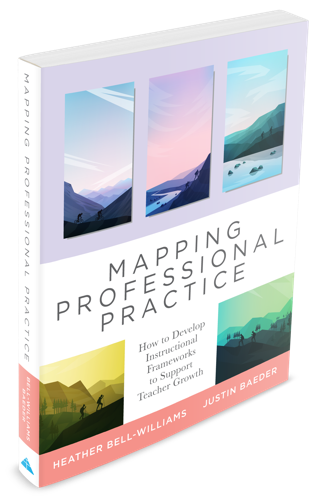
From the Book
Mapping Professional Practice: How to Develop Instructional Frameworks to Support Teacher Growth
About the Authors
Justin Baeder, PhD
Justin Baeder, PhD is Director of The Principal Center, where he helps senior leaders in K–12 organizations build capacity for instructional leadership. A former principal in Seattle Public Schools, he is the creator of the Instructional Leadership Challenge, which has helped more than 10,000 school leaders in 50 countries around the world:
- Confidently get into classrooms every day
- Have feedback conversations that change teacher practice
- Discover their best opportunities for school improvement
Dr. Baeder directs the Instructional Leadership Association, the premiere professional membership for school leaders, and is the author of three Solution Tree books on instructional leadership:
- Now We’re Talking! 21 Days to High-Performance Instructional Leadership
- Mapping Professional Practice: How to Develop Instructional Frameworks to Support Teacher Growth (with Heather Bell-Williams)
- Cultivate and Activate: Building Teacher Capacity for Instructional Leadership (with Keith Fickel)
Justin is the host of Principal Center Radio, a long-running audio podcast featuring more than 400 education thought leaders and more than 500 books, as well as The Teaching Show and The Eduleadership Show. A prolific education commentator, he has more than 250,000 followers and 30,000,000 annual impressions on social media, and is frequently consulted by major media outlets on issues of education research, policy, and practice.
As a consultant, trainer, and speaker, Dr. Baeder has worked onsite with groups across the US, Canada, and Central America, and virtually with groups across the Middle East, Australia, and around the world. He is a frequent speaker at conferences, and regularly provides administrator professional development on classroom walkthroughs, teacher evaluation, and instructional leadership.
He holds a PhD in Educational Leadership & Policy Studies from the University of Washington and an MEd in Curriculum & Instruction from Seattle University, and is a graduate of the Danforth Program for Educational Leadership at UW.
Heather Bell-Williams
Heather Bell-Williams is an author, education consultant, and instructional coach, having recently retired as principal of Milltown Elementary School in St. Stephen, New Brunswick, Canada. Her focus during her twenty years in the principalship has included academic, social, and community interventions to promote community growth and wellness. Heather has been in education since 1988 and has served as a classroom teacher, resource teacher, vice principal, district coordinator, and elementary school principal.
Heather has facilitated leadership development modules; professional development at the district, provincial, and national levels; and professional development for not-for-profits. She is a member of the New Brunswick Teachers’ Association In-School Administrators Committee and a former member of the New Brunswick Provincial Principals’ Advisory Committee. In 2019, she won the Vince Sunderland Memorial Award for Outstanding Educational Leadership. Heather is a certified life coach and a trained Fierce Conversations facilitator and has completed numerous courses and programs to foster the integration of special needs students in the general classroom setting. Heather has contributed to her professional associations’ publications and has been a presenter at the Canadian Association of Principals Conference and at LearningForward.
Heather received a bachelor’s degree in psychology from York University; two bachelor of education degrees from York University, with specialties in primary-junior and reading education; and a master’s degree in educational administration and leadership from the University of New Brunswick. Heather resides in Saint John, New Brunswick, with her husband, Garth. They have two adult sons, Connor and Kenton.
To learn more about Heather’s work, or to contact Heather, visit consultHBW.ca.