[00:01] Announcer:
Welcome to Principal Center Radio, helping you build capacity for instructional leadership. Here's your host, Director of the Principal Center, Dr. Justin Bader. Welcome, everyone, to Principal Center Radio.
[00:13] Justin Baeder:
I'm honored to welcome to the program Sir Nick Gibb. Nick served as Member of Parliament for 27 years, serving first as Shadow Schools Minister and then as Schools Minister under four different Prime Ministers from 2010 to 2023.
[00:27] Announcer:
And now, our feature presentation.
[00:28] Justin Baeder:
Sir Nick, welcome to Principal Center Radio.
[00:47] Nick Gibb:
Thank you very much, Justin. Delighted to be, uh...
[01:11] Justin Baeder:
...of the work you did, you know, summarizing a pretty substantial career working as a member of parliament and minister for schools. I wonder if we could talk just briefly about the kind of the political and institutional story and then get into some of the ideas that make up many of the transferable international lessons for schools.
[01:30] Nick Gibb:
Well, I went into politics, I became a member of parliament, uh, in, when I was 36, in 1997. And I'm a chartered accountant. I believed I came to politics because I believed in certain things in the market, free market, if you like, the Thatcher type economic politics. It wasn't education that drove my desire to be in politics. And then I felt that the arguments about the free market had been won at the fall of the Berlin Wall and so on, and socialism and communism was collapsing all over the world. But actually, we hadn't won that debate, but I thought we had.
[02:02]
And so I turned my mind to this other burning issue that I felt strongly about, and that was about education. And I had been at school... You know, I'm ancient as heck, you know, and so I was at the school between 1965 and 1978. And in those 13 years, there'd been massive shift towards what I would call a progressivist ideology in schools in Britain.
[02:24]
And I detected some of that as a child. And then, you know, I followed the debates and our school system was declining and the public schools particularly, less so the private schools at that stage. Um, so I decided that this is where I wanted to specialize, and I became a shadow minister. So this is a... We have a parliamentary system, so all our ministers are taken from Parliament.
[02:45]
You have to be a member of Parliament, either the lower house or the upper house, which is the House of Lords. And I was, uh... And then when we're the minority party, you are called a shadow minister if you are on the front bench. And so I did that job for five years, between 2000 and 2005.
[03:00]
Sorry, between 2005 and 2010. And I wanted to understand why our schools were declining in those international league tables. These are Pearl's, uh, Tim's. Even while our own internal tests, GCSE exams and our end of primary school tests, showed our schools improving. And I wanted to understand why this thing didn't add up. And so I visited schools every Monday for five years, asking lots and lots of questions to headteachers and touring the schools, informing a view about what was the cause of our declines.
[03:37] Justin Baeder:
And then starting in 2010, you began one of a number of terms as minister for schools and actually led some pretty substantial reforms that had a big impact on English education. Take us into some of those reforms.
[03:53] Nick Gibb:
Yeah, so they're touring their schools for five years in opposition. The thing I learned from those visits was that there was a progressivist ideology that was causing the damage. So I saw poor behavior, curricula, poor teaching methods, low expectations for children from disadvantaged backgrounds who were almost pushed into less academic activities. I, you know, and I saw the way they were teaching maths, I learned about the dreadful way they were teaching children to read. In 2003, I met a lady called Ruth Miskin, who was a phonics specialist. She'd been a head teacher, she'd been a teacher, and she herself became disillusioned with the way she had been trained to teach reading, so she...
[04:32]
I learned all about systematic synthetic phonics. She produced her own reading scheme called ReadWriteInc, a very effective step-by-step approach to teaching young children to read. And I went on her course, and I really got to learn about the reading wars debate. The Rudolf Fleischer book came out in America in 1956, I think, called Why Johnny Can't Read. And then there was a study called the Klack-Manisch, a study in a small...
[04:59]
Small borough in Scotland, where they'd taken 300 children just starting school, they divided them into three groups. One of the hundred groups, one of the hundred children, they taught systematic phonics, and the other two groups were taught reading in the way that they were doing so in English, and Scottish schools at the time. And after 16 weeks, the phonics groups were, you know, were seven months, uh, ahead of their chronological age and eight months ahead of the other two groups. So, they moved all the children onto phonics and they followed them for seven years. And at the end of the seven years, these children had a reading age, a word reading age of three and a half years higher than their chronological age. Very significant study.
[05:40]
It had a big influence. I made it. I used it to campaign within Parliament. for phonics. And so when we came into office in 2010, it had been in our manifesto in the 2005 election and in the 2010 election. And so we introduced, we changed the national curriculum to require teachers to use systematic synthetic phonics in the teaching of reading.
[06:02]
We changed the teacher standards. So to qualify as a teacher, you had to be able to teach children this way. And we introduced the phonics screening check. So this is a test that I devised, with some help from Ruth Miskin and other experts, 40 words. Children take the test when they're six, and they have to get 32 out of 40 correct answers to pass. And if they don't pass, then they have to retake the test the following year, in year two.
[06:28]
So that became the law. It became compulsory in 2012. All state schools, public schools, had to sit this, had to, the children have to sit this test. Um, in the first year, 58% passed. Then the following year, 2013, 69%, and it went up and up and up.
[06:45] Justin Baeder:
Many of our listeners will be familiar with the podcast Sold a Story by Emily Hanford, which recounts much of the history of phonics instruction in the United States, where the idea of teaching explicit synthetic phonics has been, uh, You know, a little bit controversial in the past. It's been, I think, something that people felt was drill and kill or felt went against their kind of progressive sensibilities, but turned out to be something that students very much needed. And there was a sense that too much of the way we approach literacy in particular was driven by feeling, was driven by the sense that education should feel a certain way That was divorced from what actually worked, divorced from empirical evidence. And I wonder if you see that thread of feeling and the kind of intuitions that we have as a profession about how things should work, how things should look, the idea of, you know, not only whole language instruction, but 21st century skills and discovery and exploration and kind of child-centered learning...
[07:53]
At the expense of explicit instruction, teacher-centered instruction, uh, you know, just a lot of ideas that have held sway in schools of education and in the profession broadly for many years. Uh, what's your take on that kind of paradigm that seems to be dominant in the United States and that was dominant in English schools?
[08:15] Nick Gibb:
And still very dominant in England. You know, we are tackling the debate and we have a lot of teachers now who... who believe in evidence-led approaches to teaching, but it's a long process of changing the thinking of 450,000 teachers who were trained in that other method. And on the phonics in particular, what was happening was that they were conflating the concepts of decoding and comprehension.
[08:41]
And so I was... This was controversial in 2012 when we introduced this test. And people said, you're just teaching children to bark at print. And the point they overlooked is that you have to, children have to be able to effortlessly decode those squiggles on a page.
[08:59]
And as, like, learning your scales on the piano. And from that, you will then, in a, like, almost like in a separate lesson, you, of course, you want children's vocabulary to increase. They must listen to stories being read. And they need a knowledge-rich curriculum to, again, to improve their vocabulary. And from that will come the comprehension. So, they're two separate things.
[09:22]
Um, but you cannot get the comprehension if you haven't learned to read, decode. And I was meeting children when I was visiting schools, you know, nine years old, who are still struggling with that basic concept of decoding. And there's no reason any child, no matter what their ability, can learn to decode and read words. And it was, I found it was so upsetting to see children...
[09:45]
of that age, uh, still struggling with that basic skill that they could have learned easily, or for some children, maybe less easily, but still they could have mastered it in the first year of primary school. So, um, so that has changed now, and I think teachers now do understand how effective it is, and you will not have children in your class and not being able to read. if you use this method. And then, what are teachers in this for? They're in it because they want children to learn. Um, so there's that debate.
[10:16]
And then, you know, I mentioned that when I visited schools, I thought there was an ideology that was doing the damage. I had an instinct for it because of my own experience as a child. And... But it wasn't until I read E.D.
[10:28]
Hirsch. My researcher said I should read this book called The Schools We Need and Why We Don't Have Them. And then on the... On a beach in America on holiday, we were on holiday in South Carolina, Hilton Head, And I read it on the beach in 2006.
[10:42]
And it was a revelation to me. It was saying everything... It explained everything I was struggling to understand. Where this ideology came from, Teachers College, Columbia, New York, what it was about.
[10:54]
And, you know, superficially, these things are attractive. You can see why it gained such currency with a profession of highly committed and caring people. You can see why they think that this sort of bookish hard work, if there's another method... Uh, it would be better, uh, particularly for children who, you know, don't quite understand that way of working, and...
[11:16]
But it simply doesn't work, and it was doing a disservice for children from disadvantaged backgrounds, because the children from educated families, they get the knowledge at home, largely, and so they could, as Hirsch says, it builds... Knowledge builds on knowledge. And the more knowledge you have, like Velcro, you can acquire more, even in a school that has a competency-based curriculum. You can build, you can still acquire knowledge if you already have the knowledge.
[11:42]
Uh, and if you don't have the knowledge, then you struggle, and the gap widens, and he calls it the Matthew effect, you know, from the rich will have more, and the poor shall have whatever they do have taken away from them. Um, so that was very influential, and he explained everything. And then I read the book by Dan Willingham, um, the great Dan Willingham, who wrote Um, why don't students like... Why students don't like school?
[12:05]
And he explained the whole concept of working memory and how small it is. You can only handle five bits of new information, otherwise you start forgetting it. So when people go around saying, you know, there's all this knowledge on the internet, Google, AI, you don't need to stuff kids full of knowledge, people look it up. But, you know, you can't critically think about just five things. You need... To critically think, you need...
[12:28]
hundreds of thousands, millions of pieces of information in your long-term memory that you've acquired over a lifetime. And if you start looking things up, you do some critical thinking. I'll look up what is the capital of Paris, France. What is the boiling point of water? But, you know, if you keep looking things up, you've forgotten the sixth thing, the first thing you looked up once you reach sixth. So you can't... And you can't quickly think with six things or ten things.
[12:49]
So you need, you know, hundreds of thousands of pieces of information. So Willingham said the purpose of an education is getting knowledge... into a child's long-term memory. And so that, again, was very helpful to a policymaker like me, who was being confronted by the education world, who said, no, you don't need to teach knowledge.
[13:11]
Just teach the competencies, this high-level-order thinking skill. This is what a modern economy is. You need problem-solving, critical thinking, creativity, these 21st-century skills that you label them as. And this, you know, again, very compelling argument. Of course you want those skills in a modern economy. Um, but the truth is, the evidence says, cognitive science says that you don't get those skills if you try and teach them directly.
[13:39]
They all come from having a lot of domain knowledge. You become a problem solver if you know a lot of science. You become a critical thinker if you know a lot of humanities. You know, you become creative if you've read widely literature and listened to great music and the arts. That's how you acquire these skills. And so, that was hugely helpful to me when we set the agenda.
[14:01]
We brought in a knowledge-rich curriculum. Um, and again, all of this was controversial because the education departments of the universities had... They were very committed to this other approach. And so we had huge battles to fight in getting it implemented.
[14:18] Justin Baeder:
Hmm. Drawn to the quote that you have at the beginning of Chapter 2 from E.D. Hirsch, he says, "...I would label myself a political liberal and an educational conservative, or perhaps, more accurately, an educational pragmatist.
[14:31]
Political liberals really ought to oppose progressive educational ideas because they have led to practical failure and greater social inequity." Mm-hmm.
[15:02]
Yes.
[15:22]
The common themes that I'm seeing there is this idea of confusing the outcomes we want or how we want things to look when students are well-educated with how we get them there. And we have a certain distaste, I think, in progressive circles for the hard work of actually building knowledge, teaching phonics, teaching math facts. You know, we have terms like drill and kill. Oh, you know, we're just stuffing students' heads full of knowledge and we're not teaching them 21st century skills. Yeah.
[16:07] Nick Gibb:
Yes, and very interesting that, I mean, Hirsch was right. This should not be a right-left thing. I mean, he himself is a Democrat, is not a Republican. And he talks about Gramsci in his book, this 1930s Italian communist who was very opposed to the modern methods of curriculum and teaching. Because he felt that the modern methods entrenched the social equalities in Italy at the time, because, you know, the people, the oppressed, the poor, they weren't being taught the things they needed to know if they were going to compete on an equal basis with the more advantaged people in Italy. So he saw this modern method...
[16:51]
of trying to teach higher-order skills by having children learn through inquiry and so on as almost a tool of oppression, uh, against equality. So I've never understood why people on the left, uh, aren't massive supporters of Hirsch and Willingham. And, in fact, in England, some of the most articulate supporters of the science of learning are actually on the left. I mean, I'm a conservative. I was a conservative minister. But some of my closest allies and friends...
[17:21]
In the education world, who believe what I believe in, and I believe in what they believe in, they are on the left. The problem is that the institutional left, the Labour Party in Britain, is not. They don't understand this issue enough. And they, they lean towards the teacher unions, who is, again, for some reason I can't understand, because they represent all teachers, not just the teachers who hold a particular viewpoint. They are very wedded to, uh, the 21st century skills type agenda. But, you know, the reason why I think the left should be supporting this agenda, because, you know, who are the children who most benefit from a knowledge-rich curriculum, from direct instruction, from phonics, from structured maths, from warm-stripped behavior in a school?
[18:03]
They are the most disadvantaged, because the advantage is they go to a school that's chaotic. If they go to a school using teaching methods that cognitive science say doesn't work, For them, it's damaging, but not as damaging to them, because they'll go to the theatre with their parents, they'll be read books, they'll read at home, and so on. They'll have all that stuff. They'll travel abroad, they'll travel around the United States, they'll learn a lot. If you're poor, you can't do those things. You haven't got the money to do those things.
[18:29]
So, you know, if you believe in equality and justice, you should be a passionate supporter for the science of learning. And we saw that with Emily Hanford's wonderful podcast. Those lives of people ruined. Uh, or not as fulfilled as they could have been because they've been taught to read or not taught to read using methods that just don't work for vast ways of people. Very well said.
[18:55] Justin Baeder:
I wonder if we could talk a bit more about some of the structural changes because I think there's an interesting contrast between the U.S. charter school world, which I believe you looked into quite a bit... And some of the reforms that you implemented in England.
[19:15]
Take us into the multi-academy trusts and just some of the changes that were made. Because I think in the United States, you know, charter schools are probably not on the rise these days. You know, that enthusiasm has maybe waned a bit, and we're seeing a lot of privatization. But English schools have taken a very different course in recent years. Take us into that, if you would.
[19:36] Nick Gibb:
Yes, so, um, we were worried that because this ideology of progressivism was so entrenched, it'd been around, it came to England probably in the 50s and 60s from America, and, you know, both the problems caused by Americans and the solution comes from Americans, the great Dan Willingham and Hirsch and, you know, Zach Groeschel and Doug Lamar, all these people are wonderful heroes who are helping us address these issues in England. Um... But we were, because it was so entrenched in the teacher training institutions, the universities, the local government, who really were the overseers, they ran the schools. 150 local authorities around, local government around England, they ran the schools, essentially.
[20:18]
And they were almost to a person in those institutions, believers in progressivism. You know, it was a very dominant ideology. So we had to find a way to, if you like, liberate the schools from that influence and that pressure. Um, and that's where the Academy's programme came in. We actually inherited the programme from the previous Labour government, which helped. They had used this method to take seriously underperforming schools away from local authorities, find a sponsor to help them, and turn them into better schools.
[20:53]
Um, so the idea of an academy is that it's an independent. It has all the structural institutions, independent sites. So it's a committee limited by guarantee. It's a charity. It has a funding agreement, a contract between the trust and the government, central government, secretary of state. And that provided...
[21:11]
It's quite a long document. It had all kinds of requirements they have to do. They have to do GCSEs, national... You know, or not the national curriculum.
[21:18]
They have to do the SATs, tests, and so on. And, um... Uh, and they have to safeguarding all these other things that schools have to do. Um, and in return, they got a per-pupil funding to fund the school.
[21:31]
Now, we have a situation... And they could become an academy by a simple vote of the governing body of the school. So, the local authority couldn't prevent them leaving. Now, 83% of high schools are academies.
[21:43]
So, that's an overwhelming majority of high schools are academies, and about half of primary schools are academies. And this has had the other effect of, if you like, liberating the teaching profession themselves to be able to think and to say and to write about what they think is the best, and to carry out. So, in the past, if you were a local authority school and the local authority advisors did not agree with phonics or did not agree with direct instruction or knowledge-rich curriculum, you would be very You find it very difficult to implement maths. Your head teacher...
[22:22]
The head teacher wouldn't be able to implement it. Uh, now they could. And they would, and they did. So we had, and the other concept we introduced was a thing called Free Schools, which is a new academy. It's the same legal structure, but it's brand new. It's set up from scratch, year by year.
[22:39]
And therefore, you could create the culture from day one. And, um, and these were set up by teachers, by, uh, by other school groups, and... And there are some great examples. If you look at the league table, we publish all our results on a school-by-school basis.
[22:54]
If you look at the league table of the schools, the top of that league table is dominated by free schools. And there are only 650 of them out of 23,000 schools. But they've had a disproportionate impact on the sector. And Michaela Community School is the famous one in North London. Very...
[23:13]
It serves a very disadvantaged community. They get the best exam results at age 16. of any school in the country, because of their knowledge-rich curriculum, their warm-stripped behaviour and so on, and direct instruction. It's a wonderful example, and it shows, actually, that it doesn't matter how disadvantaged the kids are, it doesn't matter. At that school, you'll get the same results as the other kids. Uh, it's astonishing.
[23:39]
So, it's a very exciting, uh, proposal. And then what happened, really... We didn't plan this, actually. It just began to happen.
[23:46]
Uh, but they formed into multi-academy trusts, which is basically a sort of overarching trust at the top, and it would have... It would own, if you like, some other schools beneath it, all with headteachers, but they would report to the trust, to a chief executive of that trust. And there are varying sizes of multi-academic trusts. 10 schools, 3 schools, 50 schools in some cases.
[24:12]
And what they tend to do, those big ones, is they have a sort of back office. And they can have specialists in maths or history. And they can really spread best practice in all their schools. So, we call it a school-led system where school improvement is happening at these multi-academy trust levels. And this is a key driver of, A, the fact that we've got a liberated profession who are writing, you know, 1,200 teacher-written blogs in this country. multiple podcasts presented by teachers in England, um, and they are really challenging the, uh, prevailing orthodoxies in education.
[24:52]
Um, but, but also, uh, we've got the autonomy now for these multi-academy trusts to just to drive up standards and the quality of schools as well. And that's why, that's one of the reasons why England is rising now in those, international league table was the ones I was worried about when we were in opposition, when we were dramatically falling. We fell from 8th to 28th in maths in 9 years, from 7th to 25th in reading in those 9 years. Now, we were going the other direction. So we're now... England is now 4th in the world in pearls, progress in international reading literacy.
[25:25]
So the Times newspaper, when the results came out, said that England is the best in the West when it came to reading, which was a great headline. And, um... And we've gone from 27th in maths in 2009 to 11th. This is the PISA maths for 15-year-olds.
[25:41]
So, uh, it's working. And what's working is the science of learning. So if you had any doubts about, oh, the science of learning sounds all very interesting and all these cognitive sciences, scientists saying all these things, look, we've done it in practice here. We had a competency-based curriculum. We declined. We're now wedded to the science of learning and we're rising.
[26:05]
And this movement is happening globally. So we've got an education minister in New Zealand, Erica Stanford, who is introducing phonics, she's introducing structured maths, she's introducing a Norwich curriculum. And I'm convinced we'll see great results in due course in New Zealand because of her work. There's great debates happening in this country at the state level. The work you're doing and other podcasters, Emily Hanford and so on, all the people I've mentioned earlier, Um, and there's a big debate happening in Australia as well about these things. In fact, they've introduced the Phonic Screening Check, the one that we first introduced here in 2012.
[26:43]
It's now in six states in Australia as well, because they're committed to improving their reading.
[26:51] Justin Baeder:
I have to make some allusion to the colleges of education that train the majority of teachers in the United States as, I would say, the primary bastion of progressivism and the, you know, the primary source of the progressivism that's latent in the teaching profession, although that's changing. In Texas now, I think about 40% of teachers have not gone through education. Okay, so, um, so...
[27:31]
And we're getting there, but by some interesting routes. I was thinking about how charter schools were designed to foster innovation. And I don't think it was anticipated at the time that one major form of that innovation would be a return to some methods that sound fairly traditional. And you make a comment in the book that you don't describe yourself anymore as an educational traditionalist, because certainly there are Um...
[28:21]
What's your take on that traditionalism, uh, kind of accusation that's out there that, like, oh, you just want to go back to something regressive that's vaguely bad? How do you think about tradition and kind of practices that people might see as old-fashioned?
[28:38] Nick Gibb:
Well, I'm accused of this the whole time because I'm... And it's made worse by the fact that I'm a conservative politician, so they think I just want to go back to the golden age of the 1950s. You know, with whooping cough and smallpox, you know, this is not the plan. Um, it's...
[28:55]
I see this as a modern approach, because we now know so much more about how the brain works. Cognitive science, MRI scanners, there's a lot of work done on just how the physical brain operates. Uh, and people like Bob Oakley, who, uh, Brilliant people, and Dan Willingham, of course. Yes, exactly. So, you know, this is new, this research. It just so happens that the methods that were used in the past, because they found them effective in the past, that the research now authenticates that a lot of the things that were done in the past does work, particularly things like explicit instruction, but it's not based on a sort of romantic...
[29:38]
The desire to go back to the golden age of the 1950s, um, you know, what's the beaver program called? Um... Leave it to beaver. Leave it to beaver, that's the one.
[29:49]
We're not, you know, with, you know, with housewives wearing pearls and things. That is not the desire. The desire is to do what the evidence says works, and that's what, um, the cognitive science is showing us. So, actually, this is a very modern approach to education based on that, based on that cognitive science. Yeah.
[30:26] Justin Baeder:
You know, that was actually not the right direction. And it was only by chance that my school had a reading specialist who was very strong on phonics and who made sure that every student was explicitly taught phonics and got what they needed. You know, that easily could have gone a different way because my mindset... was headed in a different direction, you know, being shaped by a lot of those, you know, progressivist ideas that are just not backed by the science of learning, by the science of reading, by cognitive science.
[30:53]
I wanted to ask if you had any thoughts on overreach, because I think there has been some concern in the wake of Emily Hanford's podcast that we're going too far in a pendulum swing in the opposite direction. I'm hearing some concern that, oh, we're teaching phonics far beyond when we need to. We're spending an hour a day on phonics. We're teaching phonics in third and fourth grade. What's your take on maybe some of the reactionary things that happen when we get behind a movement? Maybe we're late to get on board and we want the pendulum to continue swinging in the direction that we just realized is the right one.
[31:28]
Any thoughts on that?
[31:31] Nick Gibb:
Yes, I think it's important in the science of learning that people understand the ideas that underpin it and not simply take the tools and say, well, I'll just do the thing that I'm meant to do. I mean, teaching is a profession and, um, it's a matter of understanding why. And then you apply it in your own classroom in a way that adapt to the particular issues and the particular children that are in your classroom. So, I think it is important to understand the underlying principles of the science of learning. And, of course, if you understand...
[32:03]
I mean, I'm not a teacher. I'm a chartered accountant by profession. I've got a law degree. And I spent 27 years in politics. I've never taught a child in my entire life. But I do understand and I have read about these things.
[32:18]
So, I think, you know, it's important that teachers do read this stuff and understand... that reading, that phonics is a necessary condition for reading, but it's not a sufficient condition. You know, you need to... Of course you need to be able to decode, but then you need... Then the speed of reading needs to improve.
[32:37]
So children need to practice reading with phonically consistent books that don't have words in it, that go beyond the phonics knowledge. But they need to have the confidence to read and improve their speed. They need to have their vocabulary improving by being read to every day. I did a survey. I was worried about this when I was a minister, and I asked one large local authority to ask every primary school How often do they read to their children? And half of them came back and said, every day.
[33:06]
And the other half came back and said, once a week. You know, once a week is not enough. It's every day, uh, they need to be read to. And then you need to have a knowledge-rich curriculum. In England's primary schools, we tend to have this thing called topic.
[33:21]
So they spend a whole half term on water or something, or chocolate. That is not a knowledge-rich curriculum. It's... You need to have a sequenced curriculum in science and history and geography so that children are learning the knowledge, building up that knowledge to become, you know, thinkers, like, of history and so on.
[33:39]
But the key is the getting their vocabulary. And I was very influenced by Robert Pondisio, who used to talk about how important, um, knowledge is in terms of comprehension. You can't... There are no...
[33:50]
I don't believe there are comprehension skills you can learn. You're like, right, today we're going to learn inference. You know, I just don't believe there's evidence for any of that. But what there is evidence for is if you want to have children comprehending, you know, there's that wonderful baseball...
[34:04]
experiment where you have a weak reader who knows a lot about baseball outperform in a test, on a piece of text about baseball, a strong reader who knows nothing about baseball. So, knowledge is really important for comprehension, I think. And I think, the other thing about the teaching profession is that, you know, it's in many ways, um, maturing into a profession in a way that medicine did at the beginning of the, sort of the end of the 19th century. You know, this notion of Washing hands. Well, you know, there's a lot of resistance to washing your hands before an operation, because I want to wash my hands after the operation, get rid of all the gore. Um, but, you know, they didn't realise they were killing their patients with the bacteria that was on their hands.
[34:50]
And then, you know, they discovered all the importance of hygiene and so on, and microbes and bacteria, and they changed their ways. And I think that, I think now, I think the teaching profession is on the cusp of becoming... Uh, a profession along the lines of medicine in terms of using evidence. And that means that when you've...
[35:13]
When you, as a principal, Justin, discover, actually, the method you've been using, i.e. not washing your hands, you now discover that, actually, phonics is a better method than balanced literacy. You change because you're a professional. And that will happen regularly, I'd have thought. It certainly happens regularly in the medical profession.
[35:33]
They're always reading that, you know, the... professional journals to find better ways of extracting teeth or, you know, or removing an appendix. There are new solutions that get invented every day and they have to keep up to speed. And that's how I think the teaching profession is becoming
[35:51] Justin Baeder:
Very well said. Well, certainly an inspiring and gripping story of how, you know, how this was carried out, both in terms of the, you know, the science of learning, the actual content of the educational ideas, as well as the rough and tumble of politics. and certainly people are in, you know, different contexts where there are different players and different forces at play, but I think, you know, so much of what you have outlined here is transferable to other contexts and is so instructive for anyone who wants to make things better in their corner of the world. Um, anything else you want to make sure we get to? I know we're probably running a little bit long on time, but I'm grateful for your time.
[36:33] Nick Gibb:
I suppose, yeah, the other thing I would say, this is for... I mean, we wrote the book, In order to influence policymakers in other countries. And I think there is another lesson, really, about policymaking, about being a minister, being a politician, that goes beyond education. And that is that, um...
[36:54]
It's very important, and the topic of politics now, in the democratic world, has become so superficial. And everybody thinks, you know, they are...
[37:06]
So, um, so...
[37:29]
Things like low economic growth we have here, less so you've got quite good growth in America. We've got stagnant growth here. Wages have increased in real terms since the banking crash and so on. We've got young people can't get on the housing ladder. You do have that problem in America. Um, we have a terrible health service system in Britain.
[37:47]
So there are all kinds of intractable problems that need to be solved. And... Politicians, the answer to them isn't just to grandstand and make some issues and press release or do some stunt. What politicians and policymakers should be doing is thinking and researching and finding why.
[38:08]
Why are house prices so high? Why can't young people go there? Why is economic growth stagnant? And that's what used to happen in the past. I think about the governments of Margaret Thatcher. They had a great thinker, Keith Joseph, who did a lot of thinking Before Mrs. Thatcher became Prime Minister and really understood how economies work and why Britain was so in decline.
[38:29]
And I think this applies to every policy area. So I think ministers and potential ministers who want to be ministers need to understand the problem, understand the cause of the problem, and then find the solution that deals with the cause of the problem. And inevitably... Those solutions will be challenging, as it was in England with education.
[38:49]
We... I said to my...
[38:51]
The chap I wrote the book with, Robert Peel, he was my advisor for a year before he was desperate to go back to teaching. And, um... And enough of working in politics. And, um...
[39:02]
Although he is brilliant. Uh, he, um... I said to him, look, we want to change the whole zeitgeist, the whole thing. And I thought when I said it, and this is...
[39:11]
Crazy thing to say. We're not going to do that, the two of us. But we have. We have. And the reason we were able to was with Michael Gove, of course, who was the driving force behind all this. Uh, the reason we were able to do that is we, we had a deep understanding for those five years in opposition.
[39:28]
about what was causing the problem. It wasn't a superficial, schools need more money, schools need more this. It was a proper understanding based on talking to people, reading around the subject, visiting schools, hundreds and hundreds of schools for five years. And that's what we have to do in every, every policy area, right across government. And then, and this is going way beyond, you can cut all this out, uh, because this goes way beyond, um, principal centre's remit. Then, the public, the electorates, who are disillusioned in the West with democratic politics and the centre.
[40:07]
They're disillusioned with the centre-left, they're disillusioned with the centre-right, and they go to the extreme-right and they go to the extreme-left because they've had enough. And the reason they've had enough of the centre politicians is we just don't deliver. And so, if we want to get back to having proper, serious centre-right, centre-left people in politics running, kind of, countries... The center-right and the center-left have got to take politics seriously and go through that painstaking effort to really understand the problem you're trying to deal with.
[40:40]
So there we are. That's my sermon.
[40:44] Justin Baeder:
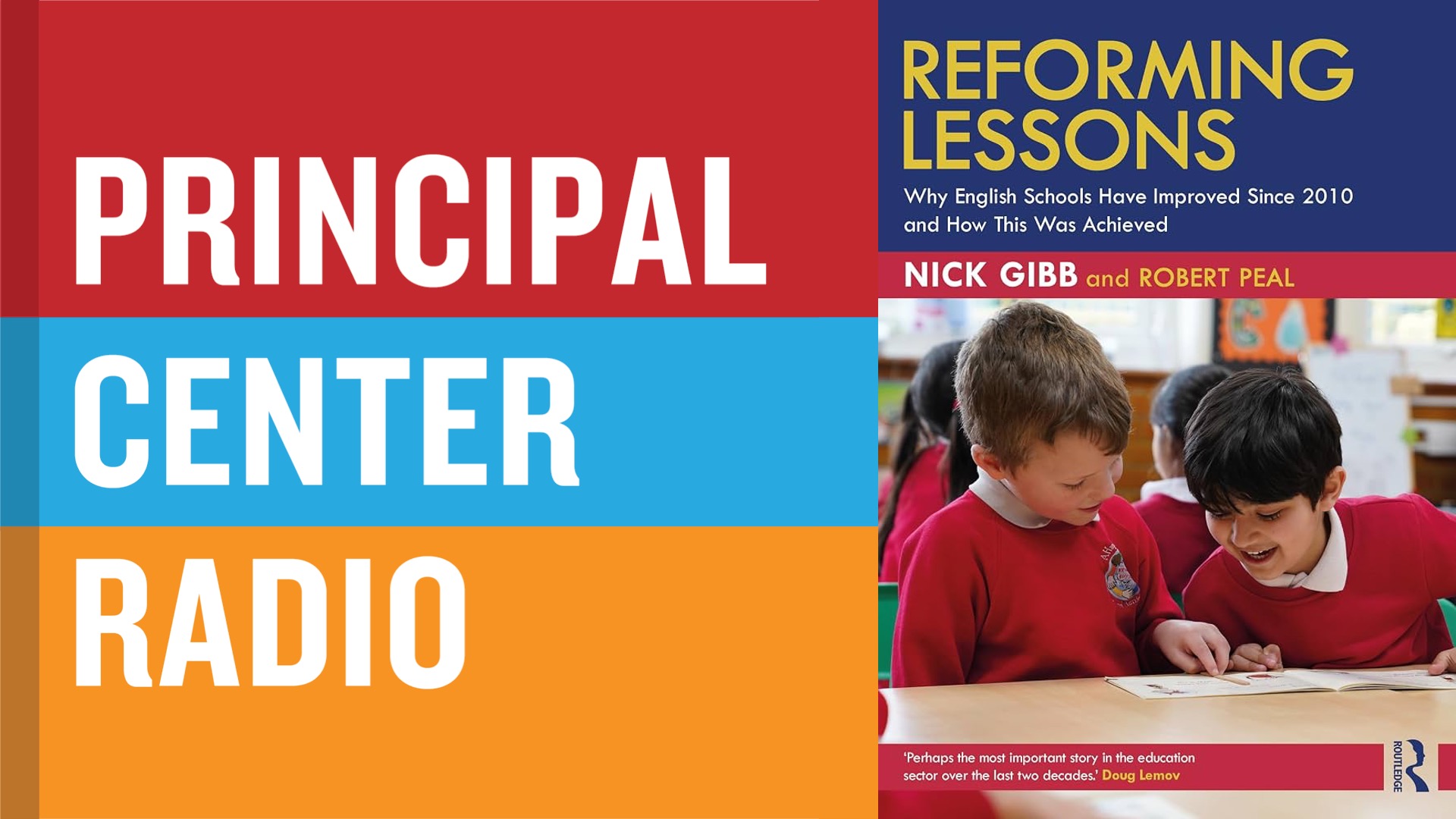
Well said. And I think that's true both for political leaders and for educational leaders that we've got to deliver. That's what it comes down to. So the book is Reforming Lessons. Why English schools have improved since 2010 and how this was achieved. Sir Nick Gibb, thank you so much for joining me on Principal Center Radio.
[41:01]
It's been a pleasure.
[41:03] Nick Gibb:
A real pleasure talking to you, Justin.
[41:06] Justin Baeder:
Thank you, sir.
[41:15] Announcer:
Thanks for listening to Principal Center Radio. For more great episodes, subscribe on our website at principalcenter.com slash radio.