[00:01] Justin Baeder:
Welcome to Principal Center Radio, bringing you the best in professional practice.
[00:06] Announcer:
Here's your host, Director of the Principal Center and Champion of High Performance Instructional Leadership, Justin Baeder. Welcome, everyone, to Principal Center Radio.
[00:15] Tom Schimmer, Cassandra Erkens & Nicole Dimich Vagle:
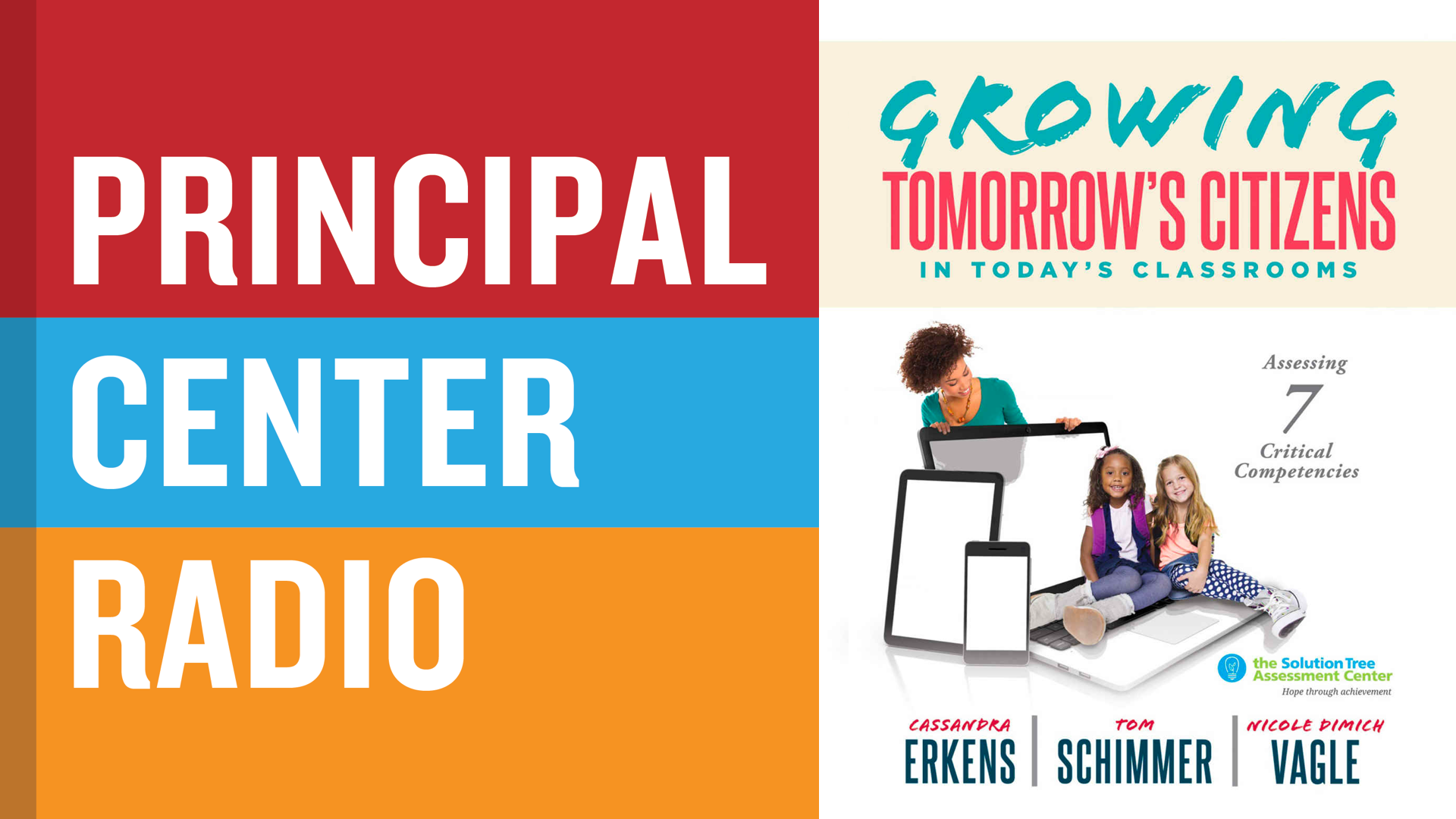
I'm your host, Justin Baeder, and I'm honored to welcome back to the program Cassandra Erkins, Tom Shimmer, and Nicole Dimich-Vogli. They are the authors of Growing Tomorrow's Citizens in Today's Classrooms, Assessing Seven Critical Competencies.
[00:31] Announcer:
And now, our feature presentation.
[00:34] Tom Schimmer, Cassandra Erkens & Nicole Dimich Vagle:
Welcome to Principal Center Radio.
[00:35] Tom Schimmer, Cassandra Erkens & Nicole Dimich Vagle:
Thrilled to be here with you again.
[00:37] Tom Schimmer, Cassandra Erkens & Nicole Dimich Vagle:
Thank you, Justin. Well, let's jump right in to the origin of the book. What prompted you in your work? I know you do a lot of consulting with school districts across North America and around the world. What prompted you to initiate this collaboration around growing tomorrow's citizens in today's classrooms?
[00:52] Tom Schimmer, Cassandra Erkens & Nicole Dimich Vagle:
Well, I think one of the things that we noticed as we travel around and we look at how learning and standards and instructional goals have evolved is We're starting to see jurisdictions really focusing in on what we call 21st century skills or what we're calling critical competencies for the future. And there's a convergence of a number of factors. We see universities thinking about how students come into their schools as doers of school, but not thinkers and not collaborators. We see the business community having conversations about the importance of collaboration on a global scale. We see the forces of acceleration happening throughout our society. And you see how schools are going to have to address that.
[01:33]
And in our work, what we've noticed is that with a lot of the work around project-based learning and inquiry-driven learning, one of the points of hesitation for a lot of people is, how do I assess that? People can get their heads around involving students in more deep and enriched learning, but The assessment piece is the part that we noticed people were struggling with. And so we felt it was important for us to address that assessment piece to help enable teachers to be able to really create authentic, sophisticated experiences for students in their classrooms.
[02:02] Tom Schimmer, Cassandra Erkens & Nicole Dimich Vagle:
And we should point out that the three of you work together in the Solution Tree Assessment Center, where you work with districts across the US and Canada and elsewhere. So this idea around assessing more than we have traditionally assessed in terms of language arts and math and standardized tests, You know, there, as you said, is a broad interest in our society in paying attention to more than just that narrow range of skills. And we're reacting appropriately, I think, in a lot of cases to that unfortunate narrowing that happened maybe around, you know, starting around the era of No Child Left Behind, where we stopped thinking so much about the kinds of citizens we were producing and just narrowed it down too much. But it seems like something that we struggle with as a profession to properly consider more than that. Like we're good at assessing students in language arts and math. We're good at making the bubble tests, but these are some harder topics, aren't they?
[02:51] Tom Schimmer, Cassandra Erkens & Nicole Dimich Vagle:
They are definitely harder. And what people don't understand is that there's been a transformation. So our earlier standards were more content specific, but as you look at the NGSS standards for science and you look at the core for social studies or the common core for ELA and math, you see that shift into the thinking. So there's been a transition, right? We went from skills supporting our ability to understand content to the reverse where now it's about our content being used to support skill development. While the transition happened with the standards, nobody helped teachers figure out how to shift how they assess to get that work to happen.
[03:28] Tom Schimmer, Cassandra Erkens & Nicole Dimich Vagle:
Well, let's get right into what the seven competencies are. Do we want to just go through them quickly and then we can circle back and go into more depth?
[03:34] Tom Schimmer, Cassandra Erkens & Nicole Dimich Vagle:
So the seven critical competencies are self-regulation, critical thinking, collaboration, creative thinking, communication, digital citizenship, and social competence. And so we have dug into each of these to define a little bit more about what do we mean when we talk about each of these skills and these competencies, because each are talked about and worked on in their own right. And so we wanted to provide some direction in what does this look like, both in terms of criteria as well as tools to be able to
[04:08] Tom Schimmer, Cassandra Erkens & Nicole Dimich Vagle:
use to assess students and also to have students self-assess well nicole that sounds like a winning list you know things we would all love for our students to really develop but again a challenging list of competencies that we don't necessarily feel as a profession that we've really gotten a handle on yet so i'm appreciative that you've you've articulated this list and you've written this book to help us get a sense of what those can look like and how we can assess them
[04:33] Tom Schimmer, Cassandra Erkens & Nicole Dimich Vagle:
So one of the ones that teachers love the most to talk about is self-regulation. Gosh, wouldn't it be great if kids controlled their own learning? And what we seldom understand is that's a set of skills that needs to be taught. It doesn't just get left to chance. So if we want kids to regulate their own learning and ask, where am I now relative to where I'm supposed to be and what strategies can I use to close my gap in between? We would start very young.
[04:56]
But even with a senior today who hasn't experienced it, you could teach these skills and support their ability to learn. But this particular chapter and these rubrics and tools that we've created are all about how do we engage kids in reflecting after a task, during the process while they're learning, and how do they monitor that growth over time? Another one of our critical competencies is, of course, critical thinking. And the interesting thing, Justin, critical thinking and and quite honestly about all of our competencies is that while teachers might feel like this is something that's brand new in fact so many of these competencies are already embedded in either practice or in the standards critical thinking is not this abstract concept teachers for years have had have have had students analyze things justify things make inferences critique, all of those critical thinking skills are already there.
[05:47]
I think the difference, and to tie in to what Cassie just talked about, the difference is we haven't been necessarily overt about articulating to students that they are learning to become critical thinkers so that they can self-monitor and self-regulate their own critical thinking. But I think the other piece of it that we talk about in the book is not just the notion of learning critical thinking skills, but it's also dispositions. So one of the differences we see now is that much like we do with reading. We don't want kids just to learn to read. We want them to love reading. We don't want kids just to do critical thinking.
[06:18]
We want them to become critical thinkers. And that transferability of that skill into my everyday life. So if I'm lost at the mall, I think critically about how to resolve that issue, despite the fact that it has nothing to do with school. So our focus on critical thinking is both about how teachers can take advantage of what's already there, enhance that experience with more authentic and sophisticated demonstrations of learning, and help students be able to transfer that into their everyday lives so it becomes a dispositional default.
[06:47] Tom Schimmer, Cassandra Erkens & Nicole Dimich Vagle:
That dispositional aspect, I think, is really key here because, you know, there's the risk that we'll waste this moment in history and make this yet another school thing that kids feel like they're expected to do in school, but miss that transfer, right? Miss that application to everyday life so that If I am, as you said, lost at the mall, I know how to think, how to solve problems, how to kind of have that, what we might call common sense or critical thinking. And too often in schools, we have intuited which kids have that and which kids don't. And we've recognized that it's something that kids have in differing amounts. But I don't think we've gone as far as being able to really define it. What does critical thinking really mean?
[07:28]
How do we assess it? And most importantly, how do we teach it? So I'm appreciative that you've unpacked those. When we think about the specific critical thinking skills, sometimes we want students to demonstrate them in the course of doing an assignment, right? We want students to show us critical thinking, but we fall short of actually teaching it. So in your work with school districts and with other organizations, when they take seriously the commitment to actually teach critical thinking, what would be an example of what that looks like to actually make it a part of instruction and not just something that we hope students can do and leave it at that?
[08:03] Tom Schimmer, Cassandra Erkens & Nicole Dimich Vagle:
Well, I think it begins with the kinds of questions that we ask. And if you look at the body of research that's coming out of Education Trust, they would say that while we have algorithms, they themselves don't support critical thinking. So are we getting kids to a level of strategic thinking? where they actually have to be able to synthesize, evaluate, critique, model, strategize. And so we'd have to start asking the right questions. So part of each chapter outlines how do you go about setting up the assessment because the assessment then backtracks into now how do I have to teach kids to get ready So we would break it into its many parts and say which skills do they actually need and then how do we help them focus on whether or not they're getting good at those skills and what types of mistakes might they make in that skill and how do we help them work through that type of mistake to be able to then become a good critical thinker.
[08:54]
So a lot of it starts with, do you have the right assessment to match the expectations? And then can you back map your instruction to support them?
[09:00] Tom Schimmer, Cassandra Erkens & Nicole Dimich Vagle:
And it sounds like a lot of that begins with unit design, with task design, with the kinds of work we're asking students to do. Like this is not something we're going to, you know, pull out of our back pocket, you know, midway through a lesson having not thought of it before, right? This is deep work.
[09:13] Tom Schimmer, Cassandra Erkens & Nicole Dimich Vagle:
It is deep work. And what teachers will tell us when we're working with them about designing higher level questions is it's really hard. We've not actually been trained to do that in the past. So if I have difficulty writing a good question for a prompt or a task, what are the chances I'm just going to naturally make it up off the top of my head while I'm teaching? You have to actually practice and rehearse until you get good at it so that you can naturally start asking kids because they're not going to perform at high levels on an assessment if you didn't set it up during the instruction. I was just going to add this idea of critical thinking is a process.
[09:45]
And so teaching kids that this is a process and there's ways of looking at information, connecting information. And so part of assessing and teaching critical thinking in particular, among many of the others, is teaching kids the process and then providing lots of opportunities for them to grapple with this process and grapple with different pieces and be able to observe how they're coming and achieving that type of process through critical thinking.
[10:09] Tom Schimmer, Cassandra Erkens & Nicole Dimich Vagle:
So this is a point where I have to jump on a little bit of a soapbox for a second, because in my work with principals and getting principals into classrooms to observe instruction, talk with teachers, provide feedback to teachers, I'm on a bit of a mission this year to get people to look beneath the surface, right? I think especially when it comes to quick things like classroom walkthroughs or required things like formal teacher observations, there's a tendency to look you know, what I call above the surface of the water at the obvious things, you know, like what technique is the teacher using to call on students or what technique is the teacher using to get students attention? You know, those easily visible things tend to be what we're drawn to as administrators because, you know, we're in and out quickly, we've got to make decisions quickly, but teaching critical thinking is something that is going to take planning. It is something that is going to have to play out over a period of time.
[10:59]
So I just had to throw that in because our listeners will have heard me go on and on and on about looking beneath the surface and not just looking at those little things, but looking at the deep work that teachers are doing throughout the year. And this is a perfect example example of that. And I think it segues nicely into one of the other competencies that you talk about, which is creative thinking. You know, we want students to be creative, but do we actually teach students to be creative? Do we actually know what that looks like and what we mean by that to the point that we can actually assess it? So talk to me a little bit about creative thinking.
[11:33] Tom Schimmer, Cassandra Erkens & Nicole Dimich Vagle:
One of the things that we herald as a hallmark to our countries is that we are innovative and we've seen this long tradition of right and wrong answers kind of kill creativity. So we know how important it is and we know that everybody wants to get back to it. We were really careful to call it creative thinking and not creativity because we don't want to be judging kids on whether or not they're creative. We want to be teaching them the creative process. Are you thinking in the right ways? And creativity is different in science than it might be in language arts, than it might be in math and so on.
[12:04]
So we tried to outline what do we know about good creative thinking. There's five-step process in the book that walks you through how do you teach kids these parts? How do you have them engage in those parts? And then how do you have them actually reflect on their process? Because everybody's process is different. And we're really careful in this chapter not to set it up so that teachers are judging a kid's creativity, but literally thinking through the where are you in the process of being creative.
[12:31] Tom Schimmer, Cassandra Erkens & Nicole Dimich Vagle:
Let me give you a scenario here and maybe we can bring your tools from the book to bear on this question. I saw in a Facebook group for principals a discussion of this rubric that someone had seen in a classroom. I think it was one of those common rubrics that you'll see in kindergarten classrooms where it was kind of a kindergarten level smiley face, frowny face rubric for coloring in the lines. And it was a really interesting discussion among people who teach kindergarten and who haven't taught kindergarten and all the different perspectives on this. Some people felt that having a rubric to teach kids to color in the lines was just the worst thing ever. and that it was like killing kids to, you know, be taught to color in the lines.
[13:14]
And other people had a more nuanced argument about, you know, teaching the development of skills from not being able to color in the lines to being able to, to, you know, being able to draw your own pictures. And so help us with that debate, because it was a lively one that this rubric, you know, having a rubric for coloring in kindergarten, are we killing creativity? Help us think about that using the perspectives that you have in the book.
[13:35] Tom Schimmer, Cassandra Erkens & Nicole Dimich Vagle:
So one of the things that came out in the research that we did on creativity is that you have to know form and function in order to be creative, right? So it's when you understand the lines that you can then break the rules to be more creative. It's not an either or, it's a both and. It's a how do we teach kids there are times where you color inside the lines and then there are times where the lines are giving you permission to go outside and to think differently. So you have to have structure. And that's why they talked about, for example, poetry, like limericks have a structure and structure can force creativity to happen.
[14:13]
So we have to be able to teach kids the both and not the either or. But I think to your point, when teachers are helping kindergarten students understand that there are lines, maybe by the end of the year, we should start talking about what if we blurred the lines? What could that look like? And this speaks really to the larger picture of the competencies, because I believe it's Howard Gardner who said in order to think outside the box, there has to be a box. And the larger picture of the competencies is that notion of the means and end switching places that Cassie talked about earlier. It's the idea that knowledge is still important.
[14:47]
Foundation is still important, but it's used as a means to an end. It's a springboard. And you think about those in our society who are most innovative and creative. they typically have mastery over their discipline. Those who can design automobiles that are innovative are those who have mastery over how automobiles work. So there is a place for understanding That foundation, it all goes back to what is it that you're looking for and what are you're assessing.
[15:12]
Now, of course, you could question whether or not a rubric for something as binary as whether or not you colored in the lines might be a little overkill. Typically, we'd use a rubric for something about an increase in quality, but we also have to remember that rubrics are not just for the students. They are also to bring clarity and specificity to what teachers are looking for and consistency. for across the grade level so that teachers who teach the same grade level have a consistency in terms of what they're assessing as well. So there's a dual purpose to creating those tools. Not being familiar with that conversation online though, I can't speak directly to it, but certainly there is a place to build that foundation that serves as a springboard to creative thinking and allows you to think outside that proverbial box.
[15:54] Tom Schimmer, Cassandra Erkens & Nicole Dimich Vagle:
Well, and I think when we have that rubric, the specificity there lends itself to the instruction that students actually need, right? It's like when we think, oh, I have students who are critical thinkers or I have students who are creative and I have other students who are not. Like when that's how we're thinking about it, we don't know what to do to teach it. But when we're super clear with ourselves about what it looks like at different levels of proficiency, it almost becomes obvious what to do to teach it. Like once we know clearly what we want. And I think back to your idea about constraints and about, you know, having a box in the first place, you know, thinking about what we want for our students in life.
[16:29]
I think about my own kids and playing in the backyard. And I think about the boundary or the constraint that we've created. We live on a major highway and we have a fenced in backyard. And one of our rules for when the kids are playing outside by themselves is they have to stay within the fence. Like that is the boundary. That is the constraint.
[16:44]
And it's amazing how creative they can be. They can just play outside for hours and hours and hours. And if we make them come in the house, they'll bicker like all siblings do. But outside, they can just play for hours with so much creativity. And I think...
[17:00]
Eventually, you know, that constraint will fall away and they won't have to stay in the yard anymore. It's just kind of an age-appropriate safety thing. But I think that's true across the board when it comes to creativity, that the constraints, and we've certainly seen this in curriculum design as well, the constraints that you're working with really foster the creativity and really shape that. So I appreciate your comments on creativity. What do you think about collaboration? One of the key competencies that employers say they're looking for and that higher ed says they're looking for is the ability to work with other people.
[17:32]
So let's shift gears. In chapter four, you talk about the competency of collaboration. What does that look like and how do we assess it?
[17:39] Tom Schimmer, Cassandra Erkens & Nicole Dimich Vagle:
So collaboration, when we dug deeply into collaboration, we quickly found out that everybody has their story or their horror story on group work. So when you recall a moment when you had to work with your peers to complete a project or do something like that. And so we wanted to dig into How are we shifting in helping kids really understand how to work together and not only just to learn content? So we broke it down into collaboration 1.0, 2.0, and 3.0.
[18:11]
So collaboration 1.0 is where kids are working together in collaboration to really learn a concept or some content. And so this is your structures of different group work, different dialogue, those sorts of things. Collaboration 2.0 was where we start to define what does it take to really do collaboration well and be a productive collaborator, if you will. So how do you navigate conflict?
[18:35]
How do you tap into the strengths of those within your collaboration? So Collaboration 2.0, we really defined what does it take? What are the skills that are needed to engage in the process of collaboration? And we tapped into some work that PISA is doing, actually, where they recognized also the importance of teaching kids how to collaborate and ensuring that they leave with the ability to really work with others in a productive way.
[19:00] Tom Schimmer, Cassandra Erkens & Nicole Dimich Vagle:
PISA is the Program for International Assessment, basically, right? The international kind of country to country.
[19:05] Tom Schimmer, Cassandra Erkens & Nicole Dimich Vagle:
Yes, they do large scale assessment, international assessment. They have assessed things like reading and mathematics, as you said in the very beginning, and they are now dabbling in assessing collaboration. And so they created this matrix that really helps define what are the different skills kids need and people need actually to collaborate well. And then they also tied in problem solving. So that's where collaboration 3.0 comes in, where now students are collaborating with each other, but they're focused on a problem, an authentic problem that they're grappling with and that there are multiple solutions for.
[19:39]
And in the collaboration, one person could not solve the problem or, or present a solution. It would need to be that all of the collaborators would have to work together to present and impose a solution. So in the competency of collaboration, we're moving from using it as an instructional strategy where you're just getting kids talking about content. to really helping them develop those skills that will allow them to tap into the strengths of their group as well as navigate conflict and then get to solutions that are really innovative. So using collaboration as a process to engage and to be honest, actually engage all of the other competencies. It comes together within that collaboration.
[20:17] Tom Schimmer, Cassandra Erkens & Nicole Dimich Vagle:
Well, and I think collaboration is one that really stands out to me as one that not only do we want our students to develop it, but we want to exhibit that as a staff. We want our PLCs to be places of collaboration, not places where we have a meeting and we all do what the person with the most authority in the meeting said. But as you said, there are problems that we have to solve together that we cannot solve individually. So collaboration is not...
[20:43]
just sitting around the table and all agreeing to do what the one person says what are some of the components of that what are some of the skills that students need to master in order to collaborate effectively because again i think this is such a focus for employers but at the same time employers don't quite know what that means or what that wants what were some of the things that you highlighted in your examination of collaboration yes so we highlighted role in terms of what role are we playing and playing it really well we highlighted contributing ideas
[21:10] Tom Schimmer, Cassandra Erkens & Nicole Dimich Vagle:
And how do you contribute ideas? How do you build on ideas? So not just throwing out your idea, but also building on what others around the table are saying. That's such a huge part of effective collaboration, not either or thinking, but really value added. And then new ideas come from doing that. Another skill is navigating conflict because inevitably in really solid collaborations or really effective and productive collaborations, You want differing perspectives and you want to look at all sides of an issue or a problem.
[21:42]
And so being able to look at the other side and then navigate conflict when somebody doesn't have the same idea that you have, how do you productively engage with that idea and that person without the collaboration ending? Because we see sometimes that when collaboration gets tough, kids will either stop and people in general will either stop collaborating and just go off and do it on their own and aren't skilled at being able to work through that conflict because when you get to the other side of it, usually you come up with something that's incredibly innovative and new. And so that was another skill that we looked at.
[22:18] Tom Schimmer, Cassandra Erkens & Nicole Dimich Vagle:
I love that because it feels like there's a synthesis that's happening there, that the ideas that are generated collaboratively are more than the sum of their parts. And they're not just a matter of, you know, the card game war where you both put down a card and whoever's card is higher wins both of them. Like if it's just taking turns playing war in our collaboration and, you know, whoever throws out the best idea, we go with that one and then we do it again on a different topic. Like we're talking about something more than that. That's building something that, as you said, one person could not do on their own. And I think that's a nice segue into two more of your competencies, communication and social competence.
[22:52]
So how did those start to play in and what did you highlight in terms of communication and social competence?
[22:57] Tom Schimmer, Cassandra Erkens & Nicole Dimich Vagle:
Well, I'll start with communication. And one of the things that we know is we're already in ELA teaching, reading, writing, speaking, and listening. And so we feel like we've got that one nail. But there's more to think about in this area. And it really does tie into the prior competencies in terms of self-regulation and creative thinking and so on. But what we wanted to see is, are we really taking kids to the next level when they're speaking and listening?
[23:18]
Are they referencing sources as they talk? Are they building on each other's ideas? And we wanted to help them because one of the things we know is You have to write to learn. Are we doing enough writing? And are we doing genre specific writing? Because social studies writing is very different from science writing is very different from.
[23:36]
So we wanted to help teachers grapple with that. Like, how do you track that? And a lot of times teachers are, one of the reasons we don't score writing as often or ask kids to do it is because it's time intensive. It takes a lot. And yet it's a really important part to support the learning. So what if we gave ourselves permission to, to stop looking at every tiny detail and just look at the essence to say, does this piece of writing, is it comprehensive?
[24:01]
Is it accurate? Are the ideas solid? And does it match the type of writing that would need to happen in history and so on? So we tried to give teachers tools that really were supportive of all of the other competencies as kids were communicating their thinking. From a social competence perspective, we know that, and I think this is where you've seen a theme emerge over our conversation here, is that each competency is dependent upon the others. That collaboration is a highly socially interactive experience, and being socially competent would allow me, ultimately, it is what it says.
[24:38]
It's my ability to act competently in a social situation. It's sort of an idiom, like an umbrella, that Being socially competent is the collection of social skills. So as I become, you know, competent in different social skill areas, overall, I become competent. So now with globalization and our quite literally our global interactions, being aware of cultural nuance, being sensitive to how communication happens across cultures also allows me to be competent in that situation. So it's not just in the sort of short term. being socially competent within the school setting, but it's socially competent within my community, but it's really socially competent in navigating a number of different situations.
[25:22]
So as I'm communicating with others, I need to be socially aware of disposition, affect, reactions, being respectful, those types of attributes and characteristics that we want to help students develop as well, because we know we are teaching the whole child and students are part of a larger society. That social competence piece is that layer that allows that social aspect of learning to be at the forefront, as well as students learning the skills of the competencies they are becoming dispositionally competent in any social situation. And we see an increase in the value of this almost, I think now, every state, if it's not already done, it's in production, every state and every province. is developing social and emotional learning standards, because it's a really important part of rounding out that child. And I think in the US, our heavy dependency on that
[26:13]
paper-pencil test and those high-stakes tests for reading, writing, and math have blocked teachers from focusing on some of the aspects that they consider most important to a well-rounded learner.
[26:22] Tom Schimmer, Cassandra Erkens & Nicole Dimich Vagle:
Having covered most of the competencies that you cover in the book, I wonder if we could talk about some of the tensions around doing this work, because some of the challenges that I'm seeing districts grapple with come in when we start assessing, when we start talking about some of those what might have been once called soft skills, but we're not really calling them soft skills so much anymore, but like self-regulation. I think there's the potential for a district to hear about, you know, listen to this podcast and say, you know what, we really need to think about self-regulation. So the first thing we're going to do is we're going to put self-regulation on the report card and we're going to give kids a grade for it. Walk me through that scenario a little bit and some of the challenges that that district might encounter if that's their starting point.
[27:09] Tom Schimmer, Cassandra Erkens & Nicole Dimich Vagle:
It's teaching students how to be self-regulatory. And the way we talk about it is really, we talk both about it in our first book, Essential Assessment, as well as this book about how self-regulation and assessment have a symbiotic relationship in that We actually use the assessment experience to teach kids how to be more self-regulatory about their learning. But the focus isn't really about grading your self-regulation. It's about students becoming more self-aware. So if a district was going to do anything from a reporting perspective from self-regulation, We would want to go down the road of self-assessment and self-reflection and that level of awareness, but really our focus is on how do we use all of the instructional experiences to teach kids to think through goal setting, to think through monitoring strategies, to think through reflective practices that allow them to set new goals and sort of embed that experience and infuse it into the instructional sequencing
[28:03]
versus trying to create yet another standalone column for the report card. It's more about the habits that we can develop on an ongoing basis and having students become aware of ways in which and strategies, like how do they learn? Do they understand how they learn? How do they themselves understand that they're stuck and that they need to navigate through an obstacle in their learning and how do they overcome that and how do they remember that for next time and allow themselves to navigate through some of those hiccups that happen as they're beginning to go through some things that are more sophisticated. So that's an example of where we might want to redirect their focus to not sort of putting a new column on the report card, but really embedding these practices and helping students become aware as they're learning the competencies or even those foundational skills and knowledge that serve as that foundational piece. And Justin, to further your point, it's more than just even putting the grade on the report card.
[28:54]
We see schools that rush to help kids self-regulate by creating a million goal-setting forms and a million data notebooks and a million. And they think that simply engaging kids and filling in those boxes or forcing reflection is going to teach self-regulation, and it's not. So to stop the madness, it's about actually asking teachers to step back and think about What does learning look like? How do we know it when we see it? How do we help kids understand their own learning preferences, styles, skills, their gaps, and how they could fill it? And maybe it's not a form that does that work.
[29:27]
So now what do we need to do?
[29:29] Tom Schimmer, Cassandra Erkens & Nicole Dimich Vagle:
And I can't help but think that the foundational, like when we dig down to the root of that problem, we have to get to curriculum at some point, right? Like if we're going to put something on the report card, we have to ask ourselves, are we actually teaching this? Do we actually know what we're looking for? And it seems to me, to your point, Tom, about what we really want to happen for students, it seems like curriculum is an unavoidable focal point for
[29:54] Tom Schimmer, Cassandra Erkens & Nicole Dimich Vagle:
for this so are you seeing districts you know dig deeply into these questions and then say you know what we need a curriculum for that or we need to develop one we need to buy something we need to do something to make sure that we're actually teaching this if we are going to assess it i would say there are few in between but we do see districts making this shift in fact i've been working with a district in rhode island right now where they're putting it in their strategic plan they're identifying their core competencies and they're starting to say okay so where in the scope and sequence Would we embed the instruction for this? And what does it look like in kindergarten versus 12th grade? And what are the moments where we would benchmark that skill and what would that skill need to look like as we did that work? What are our rubrics and tools for that? So we do see some districts beginning to take this fundamental shift to heart in their curricular processes.
[30:44]
But I would say, I don't see the majority of them doing it quite yet. Time is a factor too, because as we look at the minutes are the minutes, if we're going to have kids go deeper and more authentic and more cross-curricular they still have to acquire that foundational knowledge as we talked about earlier to be innovative i still need that foundation so one of the things that districts and classroom teachers are going to have to wrestle with is how do i accelerate the acquisition of knowledge how do i make sure that i get what i need to know so i can actually go deeper that's why you see districts or schools focusing on inquiry-based learning. Because often, as I develop an inquiry-based learning cycle, as I think about what I'm curious about and what I want to investigate, that question will drive what content I need in order to answer that question as a foundation. So it almost works in reverse, whereas if I ask the question, my higher level question,
[31:37]
it then puts me in the area of what content I'm going to have to acquire. So it creates an efficiency in how content is acquired and it also undercuts that whole notion of why do I need to know this? because you're the one that's developed the question of curiosity. Therefore, you inherently understand why this knowledge is necessary for you, because you need it to answer the question that you're curious about. And so it can create some efficiencies in the instructional sequencing, because in all of this deeper work, we're not extending the school year, we're not extending the school day, nor are we asking to. So we have to find some efficient ways in which we get to those places of depth.
[32:14]
And we have to give ourselves permission to stop doing some things. Let's take a look at the whole system, assessment, instruction, curriculum, and say, where are the places we can take things out or modify them to be the right work so that it's not adding more, it's doing different. And I would tap back into your thought around planning. And this is where planning becomes so incredibly important. If we're going to plan these different assessment tasks and not see content and skill as an either or, where there's just too much to cover, if you will. If we look intentionally at the plan and help people reframe how they think about assessment, how they think about what they're assessing, how they're assessing, it becomes much more manageable and much more efficient.
[32:58]
It's a shift from looking at quantities and trying to count things and hold people accountable by counting to qualities. And that's a big shift in how we assess and what we assess. And so that would be another component of addressing some of those challenges that educators are trying to address.
[33:17] Tom Schimmer, Cassandra Erkens & Nicole Dimich Vagle:
You just said like eight things that show up in project-based learning unit development. Dr. Amy Baeder, my colleague, works very closely with teachers who are developing project-based learning units and every bit of that factors in, you know, the constraints, the competencies that we want students to have, figuring out where in the scope of the unit you're going to teach those, figuring out what you're going to leave out and what you're going to selectively focus on. So much of that shows up in PBL. So I would imagine that a big part of the audience for this book is going to overlap with people who are doing things like project-based learning, developing their own units, really digging deep into those problems and saying, how can we actually make sure that we're teaching these things to our students and teaching them, you know, of course, the academic content that we want, but also these competencies that are so critical, not just for doing the kind of work that we want them to do in school, but for becoming the kind of adults who think the way they need to thrive as citizens.
[34:16] Tom Schimmer, Cassandra Erkens & Nicole Dimich Vagle:
And we have to ensure that those projects are sophisticated. This goes down to assessment design and task design, because we know not all project-based learning environments are created equal. Some are just, you know, superficial and some are incredibly enriching. And so that comes back to our own assessment literacy and our understanding how to design tasks that are sophisticated, they're authentic. They really reach that level and put kids in positions to maximize their ability to develop those competencies for sure.
[34:42] Tom Schimmer, Cassandra Erkens & Nicole Dimich Vagle:
It is a great, a great context for doing that kind of work. And I know Amy has worked with a number of schools. You know, not a lot of schools are doing 100% PBL where every unit is fully designed as an interdisciplinary, you know, the entire year. Not a lot of schools are doing that. But man, you look at the schools that are and they are doing some incredible things, you know, on all the fronts that we've talked about today. I wonder if we could conclude by having each of you, Cassandra, Tom, and Nicole, share just one final thought on teaching these seven critical competencies and assessing them.
[35:16]
I think, as I said already, this is deep work. This is work that is going to carry us through the end of this century to figure out how to make public education successful in teaching these competencies and preparing kids for the world that they need to live and work in. So final thoughts.
[35:32] Tom Schimmer, Cassandra Erkens & Nicole Dimich Vagle:
I'm incredibly excited about this work because we're taking steps to go deep, but to also make it feel possible. I'm kind of thinking along the lines a lot now around simply deep. So how do we do critical competencies? How do we ensure kids are learning these absolutely essential skills that we know they're going to need to be able to thrive as they leave us? And we also know that we have to make this manageable and we have to make it meaningful And we have to make it relevant. And so I'm incredibly excited about the tools, the templates, but even just the thinking and the process that we get to facilitate around this work, because it gives teachers and principals and leaders and educators a way in to start to conceptualize what this could look like in their context.
[36:19]
So simply deep, meaningful and relevant and tools that will really, I think, be able to guide these conversations so that people can take an actionable step and not feel mired in the details or paralyzed with all of the different ways of thinking about critical competencies. My final thought would be that we are not starting from scratch. And I think as intimidating as the notion of teaching critical competencies is, if you take a close read, so part one is take a close read of the existing standards in any discipline And you're going to find elements, either elements explicitly stated in the standards, or you'll find natural opportunities, for example, with collaboration, you'll find natural opportunities to bring that to the forefront. So I think teachers just taking a breath and realizing that the elements of these critical competencies are already present.
[37:12]
What we might need to do is raise their profile, raise the articulation of criteria, but the elements are not, we're not starting from scratch. They're there to take advantage of. And the other sort of side to this is that we're not starting from scratch from an assessment perspective either. Our assessment fundamentals are timeless and we would submit specifically to the audience of principals that leaders need to invest in their assessment literacy. They need to understand the principles and practices of sound assessment because there are some things we need to do differently, but there's equally as much that is transferable into assessing and teaching the critical competencies. So as leaders lead this work in their buildings, it's critical that they at least have a level of understanding that will allow them to engage in meaningful conversations to help teachers connect to these competencies and lead students through this more sophisticated work.
[38:07]
And I would piggyback off of both Nicole and Tom. Nicole was simply deep and I would say less is more, less is more, less is more. Like let's start creating our stop doing list. So to Tom's point, Principals really do need to understand what's worth measuring, what's the best way to go about that so I can guide staff in those conversations on what can we stop doing or modify doing so that we can start heading in the right direction.
[38:33] Tom Schimmer, Cassandra Erkens & Nicole Dimich Vagle:
So the book is Growing Tomorrow's Citizens in Today's Classrooms, Assessing Seven Critical Competencies. Nicole, Cassandra, and Tom, thank you so much for joining me on Principal Center Radio.
[38:43] Tom Schimmer, Cassandra Erkens & Nicole Dimich Vagle:
It's always a pleasure.
[38:44] Justin Baeder:
Thanks, Justin.
[38:46] Announcer:
Thanks for listening to Principal Center Radio. For more great episodes, subscribe on our website at principalcenter.com slash radio.