[00:01] Announcer:
Welcome to Principal Center Radio, helping you build capacity for instructional leadership. Here's your host, Director of the Principal Center, Dr. Justin Bader. Welcome, everyone, to Principal Center Radio.
[00:13] SPEAKER_01:
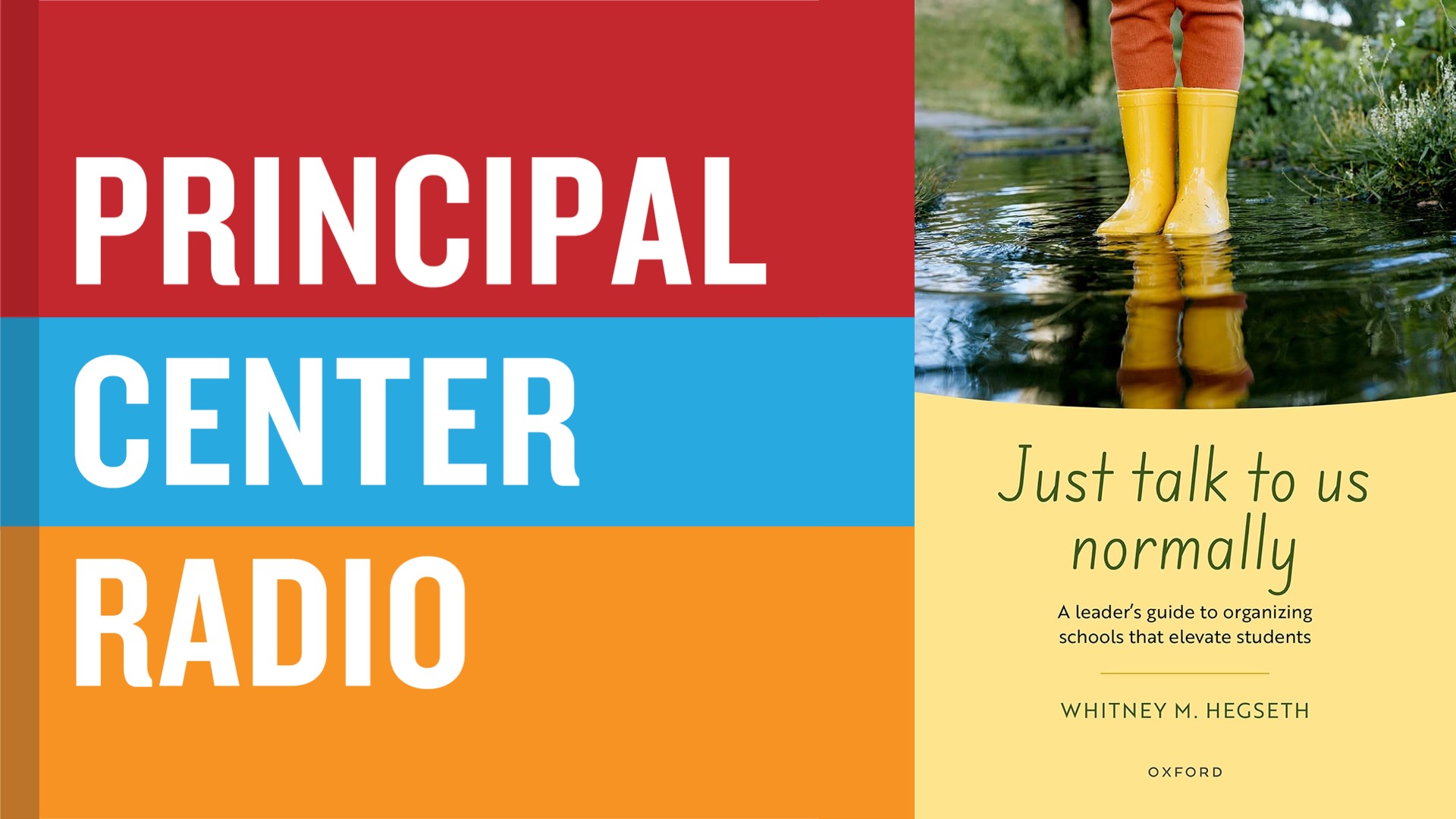
I'm your host, Justin Bader, and I'm honored to welcome to the program Whitney Hegseth. Whitney is an Assistant Professor of Educational Leadership at the University of La Verne and is the author of the new book, Talk to Us Normally, published by Oxford University Press. Her work focuses on student-centered education, effective school leadership, and helping educators build supportive environments where every student can thrive.
[00:37] Announcer:
And now, our feature presentation.
[00:40] SPEAKER_01:
Whitney, welcome to Principal Center Radio.
[00:42] SPEAKER_00:
Thank you so much for having me. I'm happy to be here.
[00:44] SPEAKER_01:
Well, thrilled to have you on today. Let's start with the title, if we could. I'm very intrigued by the title, Just Talk to Us Normally. Where does that come from?
[00:55] SPEAKER_00:
Yeah, I am a huge fan of this title, and I cannot take any credit for it. This title is a quote from a little girl with whom I worked for the research that informs this book. And one of the research methods that I leaned on when writing this book and doing the research for it was I had videos of kind of a typical day in classrooms in different countries and in different types of educational systems. And I then showed those 20-minute videos in focus groups with students, with teachers, with school leaders, with district-level leaders. And a nine-year-old little girl was actually watching a video of a classroom in a different educational system, and she observed something that none of the adults who had seen the same video had observed.
[01:45]
And so, in that one comment, she kind of summed up everything that my book is about. So, I'm really grateful.
[02:11] SPEAKER_01:
Yeah, well, let's get into that. Talk to us about the research behind it, and then kind of some of the driving ideas that made their way into the book.
[02:20] SPEAKER_00:
Yeah, so this research, you know, the main research that informs this book is this big comparative research study that I did where I was working for a long time with four different elementary schools, two in the United States and two in Canada. And in each country, I was looking at a Montessori elementary school and an international baccalaureate elementary school. So a lot of the data I talk about stem from those four schools, but it's also been some years since I was doing that research. And so I'm also drawing on ideas from my work in other types of educational systems, whether it's public schools or Catholic schools or charter schools, my work in other countries where I've been a teacher in Singapore or France, etc. And the main idea in this book...
[03:10]
Yeah.
[03:31]
And so what this book is meant to be is a guide for educational leaders, teacher leaders, principals, even superintendents, a guide for them as they work to transform both our actions towards students but also our beliefs towards students.
[03:48] SPEAKER_01:
Tell us more about those actions and beliefs and how they relate to another topic that comes up in your book that may be surprising to people, what you call infrastructure.
[03:57] SPEAKER_00:
Yeah. So, this, this book, you know, you really get bang for your buck with this book because it's two stories in one, effectively. The first is a story of culture change and really how school leaders and district-level leaders and teacher leaders, just any educational leader, how they make decisions that can help systemically improve our actions and our perceptions of students. And that's kind of story number one. A very related story to that in this book is about educational infrastructure. And so educational infrastructure is this big, clunky term, but really, any school leader knows, like, this is the water that we swim in.
[04:41]
Educational infrastructure is all the work we do to organize and support teaching and learning. So it's the decisions we make around curriculum, around assessments, around policies, whether they're at the classroom or school or district level, around how much time we allocate for professional development or collaboration. So all of that work is the work of educational infrastructure. And in the book, a point I'm making is that leaders can change culture. They can system... systemically improve the way we treat and perceive students, and they can do it with their educational infrastructure.
[05:23]
But, of course, there's no one right way to do this, you know, and what I show throughout the book is that there are actually a lot of decisions you can make around your educational infrastructure... Okay.
[06:01]
An additional suggestion I make in this book is I talk about the power of comparison. So we in education are maybe suspicious of comparison, because when we see kind of school rankings or national or international rankings... Okay, so, um, let me think.
[06:42]
Try to observe schools and schooling in other places beyond where you're a leader. You know, try to look at other classrooms, other schools, other districts, other countries, and see how folks are doing things. And this is not so that you can understand the quote, other. But it's rather a way for you to hold a mirror up to your own practice and better see and understand the work you're doing and how you might want to do it a little differently to work towards the outcomes that you desire for your students. So, for example, I mentioned, you know, Montessori and IB. Um, and I lean on them in this book, and I show some examples of, you know, how differences between these two systems and how adaptable their educational infrastructure is.
[07:32]
So IB, at the system level, they have some general guidelines that they offer up for any IB school. But the details of how those standards get enacted, that really can vary school by school. Yeah.
[08:12]
And so for a leader reading this book, you know, when they're looking at, when they're reading kind of the examples I offer in different types of schools and school systems, it might help them reflect on, well, how adaptable is my curriculum or my standards for my teachers and my students? And what are some of the implications of that for the work that I have to do, for the work that my teachers have to do, for the experiences of my students? So I don't know if I fully answered your question, but there's a couple of different nuggets in there, which is just comparison can be really powerful in holding up a mirror to your own practice and figuring out some of the decisions you want to make around your instructional supports.
[08:54] SPEAKER_01:
Right. And we should mention, again, that you've worked in a variety of educational settings, internationally, in a variety of different types of schools. I would say probably most educators have only worked in, you know, one or two school systems, right? Maybe...
[09:08] SPEAKER_00:
Right.
[09:09] SPEAKER_01:
Maybe a little bit of movement locally or maybe one geographic move, but most people have not worked in dramatically different types of schools. What are some of the major differences for IB in particular, International Baccalaureate, that people who have only ever worked in domestic traditional public schools just might not be aware of and that shed some light on some of these issues?
[09:31] SPEAKER_00:
Right, and that's exactly something... So, you know, my background's in anthropology, and like I say, one of the stories I tell in this book is a story of culture change. And it's really hard to change culture, right? It's really hard to change our deeply held assumptions.
[09:49]
Right.
[10:10]
Um, but for exam- and so that's- that is why I chose Montessori and I.B. as examples for this book, because they both, in different ways, are very countercultural. And so in reading about, kind of, them and their stories...
[10:25]
Again, it's not for the people reading this. It's not for them to become more like Montessori or IB, but it's more for them to see something really different so that they can more critically examine, oh, well, what's my approach? So for IB, there are a lot of different priorities that they have for their students, but the one I focus on in my book is this idea of international-mindedness. And in Montessori, for what it's worth, the priority that I focus on in the book is around independence. And so I talk about how IB leaders really foster and cultivate international mindedness for their students. And in Montessori, how those leaders really foster and cultivate independence for their students.
[11:12]
And the myriad decisions that leaders make to kind of work towards those outcomes for students.
[11:18] SPEAKER_01:
Interesting. Now, I don't think I've spoken with very many anthropologists, so I wonder if you can help us get a little bit of a better handle on school culture, because it's one of those issues that we're all aware of. Usually, every school culture has its pros and cons. We have some things that, you know, we might want to change about the culture. People might say, oh, well, the culture here has been...
[11:37]
Yeah. But I wonder if you have a, uh, a more helpful definition for us.
[12:03] SPEAKER_00:
Yeah, it's... So, culture is a hard thing to study and talk about because everybody can have a different definition for it. Um, the way that I define it in this book, and this is drawing on anthropologists that came before me, but when we think about culture and changing culture...
[12:20]
You know, a previous scholar kind of presented this idea, this spectrum of, like, in order to change culture, you first need to offer up an ideology. So kind of this very explicit guide for how to think, act, feel, what to believe. We often see this in different religions, right? Like, that's an example of an ideology, and it kind of tells you how to live your life. Okay.
[13:07]
But then with more time, that tradition becomes something called common sense, which is a deeply held belief or assumption that is so tacit, we don't even think to question it. Right? And so that is exactly what I'm trying to help people in... people who are reading the book kind of surface and then tackle.
[13:29]
Um, and so I can give you an example. So...
[13:34]
So I guess I could say, like, for those reasons, it's really hard to change culture because, first of all, it's these taken-for-granted assumptions you're not even thinking could be different. But one way, for example, that the Montessori system is trying to change assumptions around children and how it... Okay, so, let me think.
[14:16]
Yeah.
[14:37]
And so when a teacher is in this class, she's got a ton of students. They're all doing different things. They're all different ages. And she might see them struggling, whether it's an academic struggle or a behavioral struggle, but she maybe can't always get to it, right? Because she might be tied up in a small group lesson, and she's seen something across the room. And so she's kind of necessarily restrained by the rules of her system.
[15:07]
Okay, so, um, let me think.
[15:27]
And then, meanwhile, the teacher is observing all of this and seeing, oh, hey, they were actually able to figure it out.
[15:44]
And so that's just one example of, like, we as humans are often, you know, it's often our default to think that children can't do something. Like, if we see them struggling to tie their shoes or work on a tricky math problem or settle an argument on the playground... It's often our inclination to step in to try to help them, but sometimes if we take a step back and let them help themselves, that's actually what develops the confidence and resilience and social skills that they'll need for later school and life. And so that's an example of how kind of system supports or school-level supports of infrastructure can create a new school culture.
[16:26] SPEAKER_01:
Love it. Very well said. I wonder if we could talk now about a phrase that you use in the book, elevating students. What does it mean to elevate students?
[16:37] SPEAKER_00:
Right. And I think, you know, this is back to this, this problem that, as, as you mentioned, I've been, I have been a K-12 teacher both in the U.S. and in a couple of different countries. I've also done research in a couple of different countries and systems within a given country. And I'm now a parent of three semi-feral little boys.
[16:59]
And so, you know, in all of those roles as parent, as teacher, as researcher, um... Something that I've seen is just how we... Again, and this isn't our fault.
[17:10]
This is our culture. I think we all are in a culture that tends to underestimate these young people. And we tend to not recognize how capable and how good they inherently are. And so when I'm talking about elevating, I'm talking about really improving not just how we're treating them, trying to treat them the same way we would want to be treated...
[17:34]
but also what we're perceiving in them and how we're perceiving them as capable and able to be part of the conversations and part of the decisions that we make around what their school day and experience should look like. Something I really want to convey again is, like, I'm not... I am certainly not the person who's here to tell you what your culture change should be, right? Every leader...
[17:59]
They are brilliant, and they know their school, they know their learners, they know their families, and together with their community members, it's up to them to decide, really, the main thing they want to work toward. And what I try to support them with in this book is just a guide and a framework and some reflection questions for them to think through, okay, if this is the culture change I'm aiming for, then here are some decisions I need to make to get there. And so, you know, an example from IB, an example of how they were elevating students, again, a main thing they were working toward was international-mindedness. And so at kind of the system level of IB, there's a system-level standard. So you might think of, like, a district or state-level standard that you have to abide by. But for IB, it's like all students in working towards international-mindedness, they need to learn a different language.
[18:56]
Right.
[19:24]
Right.
[19:41]
And so, you know, the school leader in that school kind of summed it up. She was like, you know, brown boys speaking Chinese, you can write your ticket. You know, and so the assumption was these young children, regardless of the families they're in, regardless of what they were like before they came to this school, they can be fluent in Mandarin. They can be fluent in kind of the mindsets and practices and language at the same time that we're teaching all of this in English, too. And we will raise them and kind of teach them to be real changemakers and tackle these big, thorny global and local issues. And again, you know, I've already mentioned a Montessori example, but in the Montessori system, something that the whole system is trying to do, and they don't allow as much variety at the school level, but again, it's really to cultivate and foster independence.
[20:33]
So, it's letting students decide, you know, all the students get the same lessons at some point, but then how they pursue the follow-up work and who they work with and how they really demonstrate their learning, a lot of that is left to them to kind of direct all of those decisions. So, there are different ways to elevate these students, and it results in drastically different school experiences based on the decisions that these school leaders are making.
[21:04] SPEAKER_01:
Interesting. I'm reminded that one of my very first projects in my principal preparation program was to do an ethnography of my current school and to try to take a bit of an anthropologist's view of the school and understand the culture. With your professional background and your extensive training in that area, what is some of your advice for school leaders, especially who are new to a school, maybe an experienced leader who is moving into a new school and realizing, okay, this is not just the same job done in a different place. This really is a different place that needs to be thought of differently. And I need to really get my mind around what is unique about this place and this culture. What would you advise a school leader to do or to think about?
[21:52] SPEAKER_00:
Yeah. I mean, I'll take the low-hanging fruit, and I would advise them to please buy my book as a tool for them to read with their leadership team. But more seriously, I think there's a, you know, it's really hard for us to do this. It's really hard for me to do this as a parent, but I'm constantly trying to tell myself to slow down. And take time to observe before you act and take time to talk to the diverse members of your community so that they are part of the conversation around how to move forward. You know, and so, especially if you're new, you do not know, kind of, institutionally and culturally what you're walking into.
[22:40]
And so really trying to talk to family members, students, teachers, previous leaders, current leaders, and just take your time to observe and see, kind of, how things have been done before jumping on how can we, how can we maybe tweak things to do things differently. And again, the other thing that I'll say is really this power of comparison, where as much as you can, you know, if you're a new school leader, talk to other school leaders. Like, try to lean into your network and see how are things done in different places so you don't get stuck in a rut. Something that I showed in one of my videos that folks commented on in my research was...
[23:21]
I saw... I showed a Montessori student who, unattended, was, like, taking down this big glass cage from... You know, she was on a step stool with this really big, heavy glass cage.
[23:34]
And then she was using a knife to cut up food for... I forget what type of lizard they had in the classroom. But she was taking care of the lizard. Maybe it was a bearded dragon.
[23:43]
Um... Yeah.
[24:08]
Yeah.
[24:26]
Right.
[24:50] SPEAKER_01:
Yeah, and I think, you know, part of the reason organizations like to hire people from the outside and not only promote people from within is because they do bring that perspective from somewhere else. And then, of course, if you are the outsider, then you're kind of in that magic school bus situation of saying, well, at my old school, we used to do it this way. And, you know, not always easy to be the bringer of new ideas, but certainly... Yeah, if we can let organizations learn from each other's experience and cross-pollinate some of those ideas and, you know, things that might be unimaginable in one context might be very normal, like, you know, children using cooking knives in Montessori.
[25:34]
Right. Absolutely.
[25:35] SPEAKER_00:
Right, or little four-year-olds, you know, who you wouldn't expect just rattling off in Mandarin, you know? And so it's just, yeah, kids can do phenomenal things, and educators are already doing phenomenal things. And so what I hope this book does is just help leaders reflect a little bit around the work that they're already doing and how they might do it a bit more strategically as they're working toward whatever culture change they desire for their students.
[26:04] SPEAKER_01:
Very well said. So the book is Just Talk to Us Normally, A Leader's Guide to Organizing Schools that Elevate Students. Dr. Whitney Hegseth, if people want to find out more about your work, where's the best place for them to go online?
[26:17] SPEAKER_00:
Yeah, I have a website, product of being on the job market for a long time. It's whigseth.com, and that has more information on me and the work that I've done and how to contact me. And then this book, you can find it on Amazon as well as the Oxford website. So, either one would be much appreciated.
[26:37] SPEAKER_01:
We'll link in the show notes. Well, Whitney, thank you so much for joining me on Principal Center Radio. It's been a pleasure.
[26:43] SPEAKER_00:
Yeah, thank you for having me.
[26:50] Announcer:
Thanks for listening to Principal Center Radio. For more great episodes, subscribe on our website at principalcenter.com slash radio.