[00:01] Announcer:
Welcome to Principal Center Radio, helping you build capacity for instructional leadership. Here's your host, Director of the Principal Center, Dr. Justin Baeder.
[00:13] Justin Baeder:
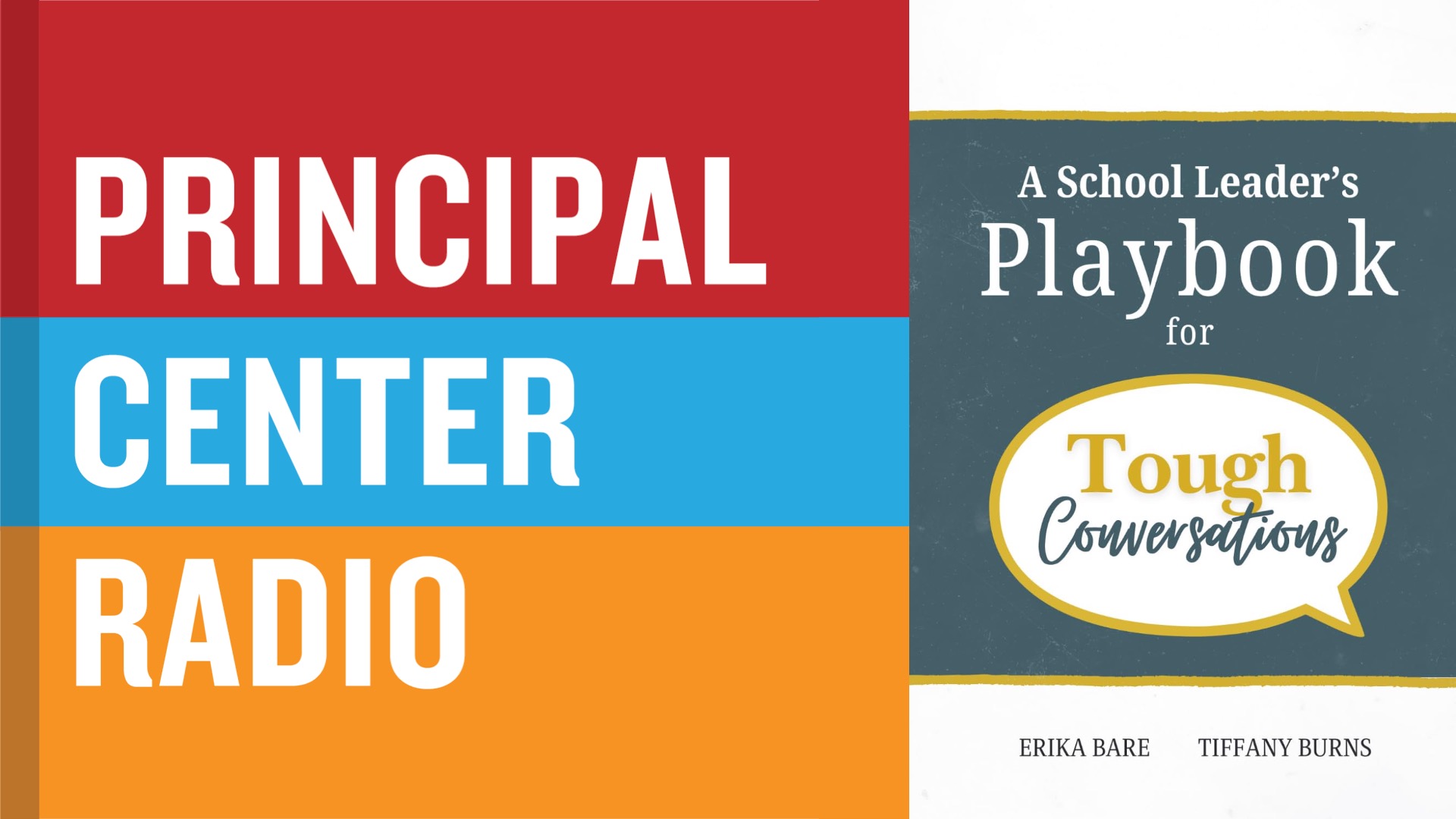
Welcome, everyone, to Principal Center Radio. I'm your host, Justin Baeder, and I'm honored to welcome to the program Erika Bare and Tiffany Burns. Erika is superintendent of South Umpqua School District in Oregon and has more than 20 years in the profession as a teacher, principal, and district leader. Tiffany Burns has served as a principal, instructional coach, and teacher in her more than 20 years in K-12 education and is currently teaching pre-service teachers at the university level. And they've worked together for more than a decade and are the co-authors of two books, including Connecting Through Conversation, a playbook for talking with students, and their new book, A School Leader's Playbook for Tough Conversations, which we're here to talk about today.
[00:50] Announcer:
And now, our feature presentation.
[00:53] Justin Baeder:
Erika and Tiffany, welcome to Principal Center Radio.
[00:55] Erika Bare:
Thanks so much. It's such a joy to be with you. Thanks, Justin. We're excited to be here.
[01:01] Justin Baeder:
Well, I'm excited to talk about this topic that you've written a book on because I think it's one that leaders everywhere face. What did you see as the challenge that you were helping school leaders tackle when you set out to write this book?
[01:13] Erika Bare:
Yeah, so we, as you mentioned, had the great joy of publishing a book a couple of years ago that was all about really how to have tough conversations with kids to really improve their behavior and get them moving in the direction that we wanted them to go. And so we got the opportunity to travel over and talk to schools and districts about that. And in almost every single room we were in, a school leader would come up to us and say, this is so helpful. Thank you so much. And now, how can you help me apply this to the adults that we're supporting? Because so much of the work...
[01:47]
Um, as a school leader is ensuring that everyone's moving in the same direction, that we're all doing excellent things in the classroom, and that we're able to support the parents and caregivers in our community in a way that is really supportive as well. And those conversations, as it turns out, are not Usually easy, um, and they tend to be the ones that really, um, can trip us up. They keep us up at night. Um, they for sure live rent-free in our heads way past, um, time that they should be exiting. And so we really wanted to provide...
[02:21]
Some really concrete tools and strategies to, one, make sure that we engage in the conversations because they're really important. And then, two, how do we do that successfully? And how do we do that in a way that's going to build connection and hopefully strengthen connection instead of break connection in our schools?
[02:38] Tiffany Burns:
When, what we found is that there are so many, you know, if you've been in education for five minutes, you know how important relationships are. And there are so many books and series and philosophies on the importance of relationships and the importance of connection. And there's not really a lot of strategies or tools or resources for what's, how do you do that? What's the step-by-step? What are those practical tools? I want something I can learn today and immediately put into, um, into play tomorrow.
[03:04]
And so we wrote that. We wrote a book for really busy people with step-by-step tools, strategies, templates, sentence stems, so they can turn right to the situation they're having, get the tools they need, and then use them immediately.
[03:16] Justin Baeder:
And it is central to the work of leaders. As one of the teachers I worked with liked to say, Justin, that's why you get paid the big bucks, because you have to talk to this person about this issue, not me. That's why you get paid the big bucks. So, in order to earn those big bucks and fulfill our responsibilities as leaders, yeah, often we do have to have conversations that are not terribly pleasant, that involve maybe setting boundaries, maybe, you know, upholding expectations and confronting issues that we would prefer to just, you know, hope they resolve on their own. And often we know that they don't resolve on their own. Take us into the connection aspect, because I think, you know, there are certain personalities that like confrontation and certain personalities that don't.
[03:57] Erika Bare:
Yeah, so, you know, it's funny that you say so many of us would like to avoid those conversations, and that's true. And what we know is that problems don't tend to get better with time. When we ignore something, it doesn't get better, um, with time. So the first lesson is really we have to engage. And the only way to do that is to really make sure that we have spent the time...
[04:18]
We've invested in our people so that we know who they are, we know what's important to them, we know what's going to make them tick, how we can maybe get movement where we need to get movement, and also demonstrate that we really care about them as people. And this is for both, um, the staff that we support and the community that we support. So when we've done that work, Right.
[05:01]
It isn't possible if we haven't taken the time to really lay that foundation. With families and caregivers, we try so hard to make sure that our first contact with every caregiver is a positive one. And so, you know, putting a lot of time up front so that when we do have to have a more challenging conversation... Yeah.
[05:40]
I mean, in our world right now, there is a lot of divisive things happening. And we have to be able to have conversations about really hard things. And when we can have those conversations in a productive way, in a way that's really about care, in a way that's really about moving things forward, then we can come through those really difficult conversations, oftentimes more connected, or at least in a way that isn't going to break connection across our system. And so that's really where we focus around connection.
[06:10] Tiffany Burns:
Well, I think, too, we spend time really diving into what gets in the way of connection, you know, because as folks that work with students, you know, as educators, leaders, whatever area of education you're in, we all, for the most part, want the exact same thing, right? We want our... Students to be successful. We want them to be happy.
[06:28]
We want our staff to enjoy coming to work, have high expectations for their students. And what we disagree on is how we get there and what our strategies are for getting there. And to figure out kind of what gets in the way of that connection. You know, emotions can run really high. People, when they feel deeply and they feel passionately, they might have some really big emotions that come out, kids and adults. And so we talk about this idea that emotions are contagious, and how do we recognize that we can catch other people's emotions based on our mirror neurons and the actual brain science of catching emotions?
[07:01]
What can we do to purposefully unmatch so we're not catching others' emotions? And then how can we set a tone so they're actually catching ours, you know, in a more calm and deliberate way? And then, you know, there's so many other things of just the way in which, in which we communicate. We don't often look for points of, um, of connection or points of agreement or we might, but other folks might not. So we want to really point that out deliberately and intentionally. Um, so we spend a lot of time looking at what, what gets in the way and what can we do to not just overcome that, but to really do it differently.
[07:35] Justin Baeder:
Talking about a condition that takes time to develop, right? That connection is not instantaneous. You mentioned it has to be kind of established in advance. And it just occurred to me that maybe one reason for the popularity of the feedback sandwich is we want to make up for that lack of connection. Like, oh, I don't really have a relationship with you, and I'm about to say something difficult, so maybe I'll say something nice to butter you up, and then after I say the hard thing, I'll try to cushion the blow with another nice thing. And often that doesn't really work, because then people just get a mixed message, and they're like, what are you talking about?
[08:03]
Why are you flattering me? And then, you know...
[08:05] Erika Bare:
Yeah.
[08:05] Justin Baeder:
Coming down hard, I mean, and then flattering me some more. What's going on here? So talk to us a little bit about what that, that culture of connection looks like. And maybe we could start with talking about staff members and certainly the challenge of holding staff members to high standards and building a culture of excellence requires that sometimes we do say hard things to people and address performance issues, address attitude issues. What does that connection look like to build that foundation that allows us to, you know, to uphold high standards?
[08:33] Erika Bare:
It's, that's layered, right? And it does take time and you have to be really intentional. And I first just have to say I love that you brought up the feedback sandwich because, um, that gets in the way of so many really important conversations being successful. So I just want to put out there, um, we believe strongly that the only way to be kind is to be really, really clear. We have to kind of channel Brene Brown a little bit. And if we're not saying it, if we're not being honest...
[08:59]
We're doing a disservice to them and a disservice to us and a disservice to our kids. And so we have to be really careful that we don't soften the message to a degree to where it's not going to be successful. Because then we just, like, tiptoed through a really awkward conversation and got no positive outcome. So I will just say, do not believe in the feedback sandwich. Yeah, and at the same time, we have to leverage every opportunity outside of those conversations to layer in...
[09:27]
the parts of the sandwich that aren't a part of the meeting, right? So we have to think about how am I intentionally getting to every single staff member as often as possible to connect on, you know, how are their kids doing? What's happening with their parents? What are they, like, doing on the weekends? All of those really informal...
[09:45]
hallway conversations add up over time, and they don't happen on accident. You have to actually calendar this. I spent, when I, um, was a high school principal, I, you know, got to serve about 120 staff, and I had a...
[10:00]
On my calendar every day, I was doing very specific rounds, and I was making sure that I was rotating that so I could connect with every staff member at least once a week. And that isn't going to happen by just hoping it does. So you have to be really intentional. You also have to be really clear about your intentions. So, the other piece about front-loading is letting everyone know, you know what? I care about you.
[10:26]
I care about the kids. I care about the school enough to where we're probably going to have some challenging conversations. And it's because I care and I know you can be successful. And that's why we're going to be having those conversations. That's something that happens in August and that we revisit. We also have to have sometimes hard conversations as a whole staff.
[10:45]
And so, again, laying out our intentions and exactly why, because if we're not doing that, then they're making up intentions for us, and they don't usually match what's actual. And so, it's about taking time to really get to know every single person, and then also being as transparent as we possibly can be about our intentions for why. And when we're stepping into a difficult conversation, actually saying... This is hard, and we're going to have to have a challenging conversation, and it's because I care about X that we are stepping into that.
[11:17]
And so, you have to actually say it, and it's awkward and necessary.
[11:23] Tiffany Burns:
And there are some real concrete steps that you can take in the conversation to make it be more clear and to make it be less awkward, and... ...to help you, as the leader, sleep better the night before.
[11:34]
And so, we've got, on our website, we have a whole, and in our book, we have a whole planning guide, you know, thinking through, what are those concrete steps? Where are you gonna have the conversation? When? Because timing really matters. If you've got somebody that you know, when you have this tough conversation, they're going to go to the staff room and tell everybody else about it...
[11:53]
Okay. Okay. Okay.
[12:20]
We talk about using, um, a third point, and a third point is, I'm sure you're familiar with it, Justin, but maybe listeners that aren't, that third point is, you know, a piece of paper, some piece of data that we put in front of us that we can put on the table between us when we're sitting side by side so that we're not forcing eye contact, so that we're not forcing this really awkward, you know, you have to look at me when I'm sharing this really challenging information. We know that eye contact can be really difficult in those heated conversations. Use the third point as a way to say, hey, now, take a look at, you know, when I was in your room observing, I saw this, this, and this on these days. So, it shifts some of the emotional weight from between us to the paper. And then just how do we clearly outline what the impact is, what next steps are, and then how do we follow that up in writing? So, like you said, with that feedback sandwich, people walk away not having any idea what just happened.
[13:12]
You know, they're like, I think I'm doing great. This is awesome. No, that's not... Okay, I understand why you got that, you know, as a takeaway.
[13:20]
But when we outline afterward with a summary of conversation, and we also outline how to do that, people can leave, even if they maybe had a different idea of what we were talking about during the session. You know, afterward, they know, that's what you meant. Okay, now I've got real clarity there.
[13:35] Erika Bare:
The last thing I want to say about this, too, is it's really important when we're struggling with a staff member, maybe there's a performance concern, maybe there's professionalism issues... Before and after the conversation, we like to say you have to go to the problem. So when you're going to, doing your rounds, when you're checking in with teachers, it's really tempting to skip over that room and be like, they don't want to talk to me anyway. And it's three times more important that we step in and check on them outside of all of that, just to see how they're doing, check in the way we do with everybody to, again, show that we care because we do.
[14:14] Justin Baeder:
Yeah.
[14:34]
it's not just one chance and everything riding on it, then we can be a lot more relaxed, and I think that a lot of that carries over into what you're talking about, whereas if we have a relationship, if we talk often, and it's not just a matter of occasionally going around and yelling at each person whenever they do something wrong, like, if that's not our whole relationship, we're gonna be in much better shape. Talk to us a little bit about the bandwidth for this though, because I think one of the big challenges for leaders is that there's only one of us. Maybe you have an admin team, but that probably means your school is even bigger and you have so many people to deal with, so many students, so many staff members that we just feel stretched in all the time. Like we don't have enough time to be proactive. Erika, you mentioned actually keeping a list of every person that you need to check in with, even if it's not, not really about anything, right? Those are just check-ins.
[15:17]
Yeah.
[15:19] Erika Bare:
So, I believe in a checklist, um, and I believe in systematizing this work because, like I said, it's not going to happen just because we want it to. And I have not met an educator and certainly not a building leader who is an absolutely... taxed on time. Like, none of us have enough time to do all the work that we want to do.
[15:39]
So, what can we proactively do? Because it's going to save us time in the long run, right? And so, I, like I said, I calendar this. It was the first half an hour of every day for just nothing but walking around and talking with folks. Um, and I did keep a running list of of where I had been. We do, of course, both informal and formal observations, um, frequently.
[16:01]
And the same sort of thing. You need to kind of keep track of where you're going. I would have a weekly list. This is where I'm going to be just swinging in and maybe leaving a post-it, maybe having a hallway conversation later. And then these, of course, I'm going to calendar out those more formal observations. But what we feel strongly about is that a meeting that has to do with someone's evaluation should never be the first time that they are hearing that there's a concern.
[16:29]
So, if there's a classroom concern, we've likely spoken about it after three or four of those just swinging by your room conversations before we're sitting down for, like, okay, I was in here for a chunk of time, and we're going through the rubric and all of those things. It should not be a surprise. Yeah.
[17:09]
Checklist. You've got to have all your staff written out. I mean, I, I must have had 15 of those on my clipboard because I was old school that way. And you would go through, this was for informal, this is for formal. And you have to stick to it and make sure if one week got off, you're shifting and you're making sure that no one gets missed. But it's just not going to happen because you want it to.
[17:28]
So you have to be really intentional.
[17:30] Tiffany Burns:
Well, you know, relationships are built over time, like you said earlier, Justin. You know, we have to have those connections with one another often and frequently. And I absolutely know how busy administrators are because it is just the busiest job ever. And you could work 24 hours a day, seven days a week, and still have more work. That's just the nature of that job. But with building in the time for connection, we don't have time not to.
[17:56]
Yeah, yeah, yeah.
[18:15]
So much of our job, like you said, that's why we get paid the big bucks, because we're doing the not fun parts of the job. Connecting with the people in our community, those are the fun parts of the job. So when we spend the time doing that, you know, just, there was a, there was a kindergarten class that when I was having a really hard day, I just went into that classroom. Just for, you know, 15 minutes, 5 minutes when I sometimes just had a little bit of time just to hang out and see what those kindergartners were doing. And it just, it really lifted my whole spirits because, you know, I got into that job because I wanted to make a difference and I wanted to enjoy my job. And if I'm spending all the time doing the parts that aren't enjoyable, I gotta look for something else, something to lift my spirits.
[18:58] Erika Bare:
And, you know, I think in The Speed of Trust, they talk about how much time you save by having those trusted relationships, because you can move so much faster. And the same thing is true with connection, and those two things are interrelated, right? If you don't have connection, if you haven't built that relationship, everything you try and do is going to take three to four times longer. So, just like Tiffany said, it takes time, and we don't have time to not do it.
[19:24] Tiffany Burns:
Well, and I think, too, you know, you both talked about that evaluation conference or that end-of-year conference, and we have a whole chapter in the book about leveraging that conference. Those are really important to have if we want to improve student achievement, if we want to improve school culture, if there's changes that we want to make. And if we want to leverage that the best way possible, we've got a number of step-by-step pieces to do, but it's all the time outside of that as well. If we want those high-stakes conversations to really lead to, um, big changes or really effective schools, we have to spend all the time doing it.
[19:58] Justin Baeder:
Well, speaking of that, that step-to-step, I wonder if you could take us into some of the thinking that you would go through or that you guide people through in the book, you know, when they realize, okay, I need to have this conversation. I cannot ignore this issue. It is, I'm getting paid the big bucks to have this conversation, so what do I do? Uh, how do, how do you break down some of those steps that leaders go through?
[20:17] Erika Bare:
Yeah, so, and Tiffany mentioned there is a step-by-step guide on our website. It's a free resource, um, and so encourage people to check that out. But it really starts with identifying the purpose. Why am I having this conversation? And getting really clear with yourself about what your goal is for the conversation. And this is, does a couple of things.
[20:39]
One, we want to check ourselves a little bit, make sure that we are stepping into it, Because of some kind of care. I care about this person. I care about the school. I care about the students. I care about student achievement. It has to be about that.
[20:52]
We want to make sure that it isn't about, like, I'm really angry and I need to let them know. Um, I need to kind of put someone in their place. We need to make sure that it's nothing in that side of the... Yeah.
[21:21]
Okay.
[21:38]
And then we have to really do our homework. We have to make sure that we have those observable facts, those observable details, and we like to print it off. So, like, if it's an email exchange, if it's data from an observation, if it's a parent complaint, whatever the physical thing is, we want to have that in front of us. We want to kind of rehearse a little bit the language. Like, how am I going to talk about this in a way that is just observable data? Just the facts?
[22:12]
You know, this is what happened because our goal is to present that in a way that really can't be argued with. This is just... what the situation is, and so now how can we move forward from there? So it's getting really clear on the what.
[22:25]
And then we also like to be really thoughtful about how we're going to wrap that conversation up. And so we spend quite a bit of time talking about, first of all, different strategies in the conversation, but also at the end, how am I going to make sure that the next steps are really clear? How am I going to make sure that they're taking away what I intended for them to take away? And how can I make sure that I said everything I absolutely needed to say? The reason I write it down, to be really honest with you, it's about holding myself accountable. When you have to say something really, really hard, it's easy to get in that meeting and, like, just kind of be like, oh, well, maybe I can just soften it this way, or they say something that you're like, oh, I'm not sure.
[23:10]
And so you kind of backpedal a little bit, or you don't say it, As clearly as you need to, and then again, you've just put yourself through a really uncomfortable meeting, and you didn't get accomplished what you needed to. I will actually write out that one or two sentences that absolutely, if nothing else is said, this needs to be said out loud.
[23:31] Tiffany Burns:
Right.
[23:48]
For both of us, well, I'm going to just say me, but Erika as well, but for me, I was a really great communicator with these really hard conversations. So at my school, I was having a lot of them. I'm going to say most of them. Like, Tiffany can handle this. This is a hard one, so we're going to pass it to her. And really what I wanted is our teachers and staff to be able to have those harder conversations with families or with their colleagues when it was harder.
[24:11]
And so we've created this template so we can help, as leaders, help support our teachers and staff to also have these hard conversations. As someone who's in charge of, um, communication cleanup, I cannot tell you how many times I had to go in and clean up communication because someone sent an email that should have been a phone call or a sit-down meeting because they did not want to have the conversation either, so they were like... I'll just send this quick email off, and I'm like, oh, okay. I have so much we have to do now.
[24:44]
Um, and we want to help minimize that, because when we're talking about building a culture of connection, it's with our whole school community. It's with our students, it's with our caregivers, it's with other folks in our community, and ourselves as well.
[24:55] Justin Baeder:
Absolutely. And I know you've written a whole book on communicating with students. Could we talk briefly about communicating with families? Because often, you know, we don't see parents every day, and we do need to build that relationship, but we have probably fewer opportunities, and yet we may still need to have those hard conversations. So any key points for connecting with families?
[25:16] Erika Bare:
Yeah, well, it's, it's so critically important, and this is an area where we really want to empower all teachers to know how to have these conversations also, but I've said the first part already, which is find a way to have a positive outreach to every single family before the school year starts. Whatever it looks like, we're going to call every family as they're coming in, we're going to be out there on the first day, whatever it is, front load the positive communication, because we just don't know how soon that more negative interaction is going to have to take place. Yeah.
[26:03]
They need to know we love and care about their kid, otherwise they're not going to be able to hear anything else. So we start with care. We're very clear about what happened. So again, like, just the facts, taking all the judgment out, just like, this is what occurred. And we're talking primarily about Yeah.
[26:37]
Clearly, if they had thought it through, they never would have made such an impulsive choice, and so we're going to really work on that piece. So kind of giving them an idea that we are not interested in just what happened, but also why, so that we can support them moving forward. And then... We have to be really clear about next steps.
[26:55]
So, and this is a part where sometimes people can get a little hung up. And so if there is a significant consequence, if there is something that is going to happen, maybe the student is going to be in in-school suspension for a couple of days. We need to be really clear that that's what's happening. That's not a part of the conversation where it's like...
[27:16]
You know, what do you think? Or how do you feel about that? It's like, this is what's happening. And explain a little bit of the why. Like, how this is going to help support changing that behavior moving forward. Because that's always the reason that we would do something like that.
[27:30]
And then we have to end, again, with care. So, again, we have to circle back to... I'm so glad that we can partner on this together. I care so much about Johnny's success.
[27:40]
It's really important to me that... We move forward together to ensure nothing like this happens again because this is an opportunity in his life where we can figure this out together and move forward without, you know, awful things happening. And so I'm so glad that we are able to do that now because I care so much about him or her. And so, again, starting with care, ending with care are the most important parts of that.
[28:02]
That guide is also a free downloadable resource on our website, too, for folks who weren't able to write that down.
[28:09] Tiffany Burns:
Erika says starting with care and ending with care are most important, and I absolutely agree. And the why you think it happened, which I know she touched on, but that is a part to not skip over. That is a part, I think, that really helps caregivers feel connected to us when we're like, this is what happened. You know what I think was going on for your child, or when I talked to your child, this is what they were saying, and here's why I think they were doing this. They were stressed out, and I get it. And what you're doing is you're showing them, I see your kid, I get your kid, I'm not mad at your kid.
[28:41]
We want to make sure they don't do the same thing moving forward. You want that too, right, caregiver? And so, we're going to team together on this to move it forward. Um, and so, I mean, part of why we wrote the book, because so much is just in the delivery. It's how you say it. It's what you're saying.
[28:58]
And nobody teaches you how to do that. You know, good communication doesn't happen by accident. It's really intentional and deliberate. And I can speak for Erika and I both. We've both failed miserably at it and had to learn from those mistakes and go, well, that went horribly. What can I do different next time?
[29:17] Justin Baeder:
Benefit greatly when we can learn from the experience of others, however hard one that experience may have been. So the book is A School Leader's Playbook for Tough Conversations. And Erika and Tiffany, if people want to find your website and download the resources we've talked about, where can they do that online?
[29:33] Erika Bare:
It is Connecting Through Conversation. So, Connecting Through Conversation, spelled correctly, we'll take you right there. And you can access our email there. You can connect to all of our socials there. And all of these resources are also available on that website.
[29:47] Tiffany Burns:
And I think all of our PDs on there as well, because we love getting to work with folks in schools and connect with them. That's our favorite part of the work.
[29:54] Justin Baeder:
Thanks for joining me on Principal Center Radio. It's been a pleasure.
[29:57] Tiffany Burns:
Thanks, Justin. Thank you, Justin. Had a great time.
[30:03] Announcer:
Thanks for listening to Principal Center Radio. For more great episodes, subscribe on our website at principalcenter.com slash radio.