[00:01] Announcer:
Welcome to Principal Center Radio, helping you build capacity for instructional leadership. Here's your host, Director of the Principal Center, Dr. Justin Baeder.
[00:13] Justin Baeder:
Welcome, everyone, to Principal Center Radio. I'm your host, Justin Baeder, and I'm honored to welcome to the program Dr. Erica Kitzmiller. Dr. Kitzmiller is a research associate professor at the Crown School of Social Policy Practice and Work and the Kirsten Institute for Urban Education at the University of Chicago, where she studies historical and contemporary policies and practices that contribute to inequality and identifies solutions to end it.
[00:58] Announcer:
And now, our feature presentation.
[00:59] Justin Baeder:
Dr. Erica Kitzmiller, welcome to Principal Center Radio. Thanks for having me, Justin. I really appreciate it.
[01:20]
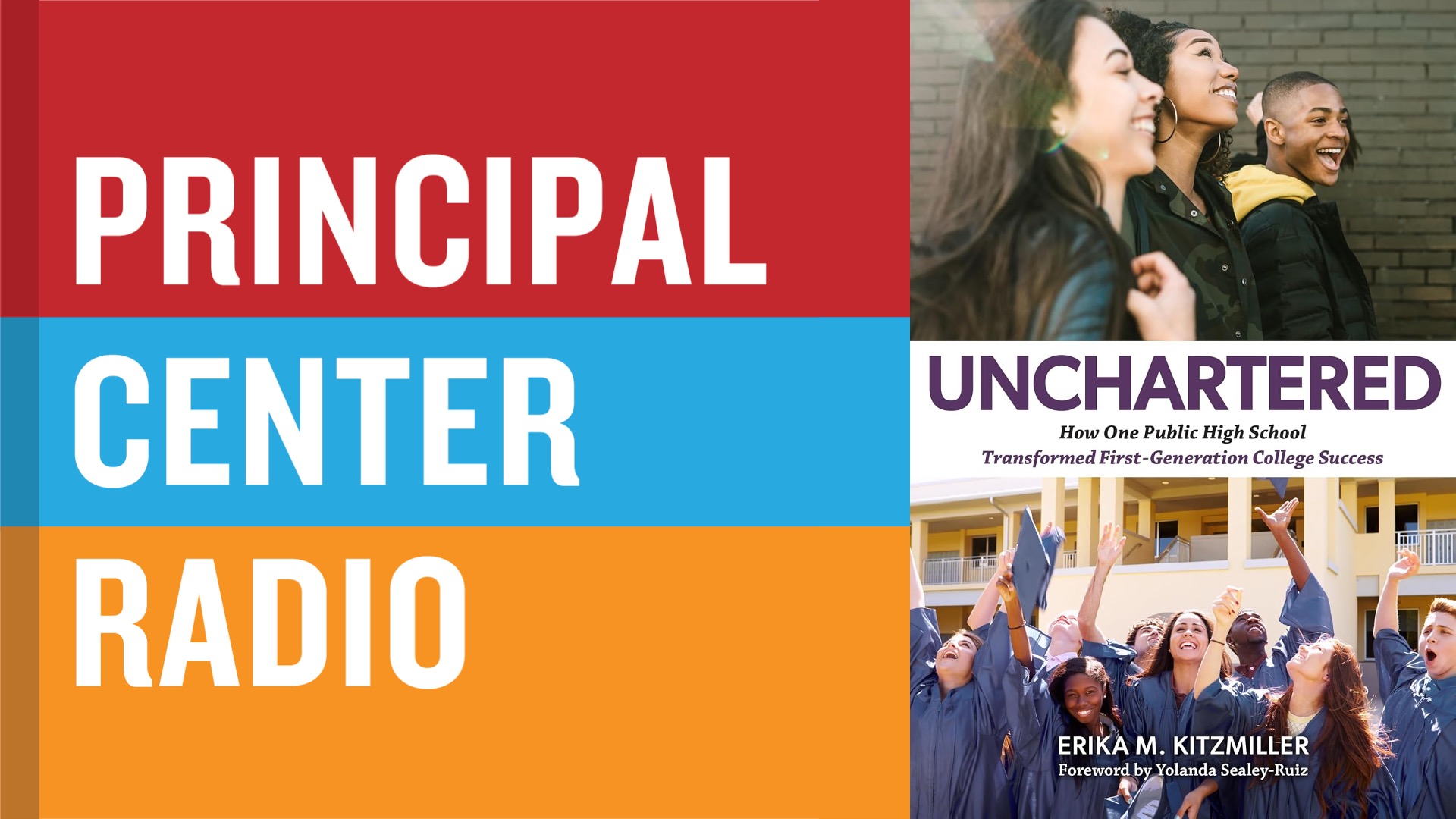
So the book we're here to talk about today is based in some long-term work that you did in a high school. Tell us about that work and the book that came out of it.
[01:30] Erika Kitzmiller:
Sure. So I started my life as a middle school educator in a public school and then turned to high schools as a researcher. The work came about with a simple phone call between myself and a very good friend who was a principal of a high school that I'm calling Clayton High School in the book. My friend's name is Zach Cairns, and he was really thinking deeply about how to align the school's outcomes with its mission. Clayton High School had a mission to support urban public school students to get four-year college degrees, particularly in STEM fields. And what Zach was struggling with was the fact that 100% of his graduates went to college, but only about 50% of those who went to college graduated within four years from their college degree programs.
[02:11]
He wanted to think more deeply about that, and I offered to help. And so we created a research-to-practice partnership study that really aimed to answer that question, but at the end really created a school that I feel like centered agency and choice for educators, youth, and families who chose Clayton as their home.
[02:28] Justin Baeder:
You know, for many years now, there's been a focus on college access, but as you alluded to, you know, getting into college is just the first step, right? What's the landscape like after students get accepted into a college?
[02:42] Erika Kitzmiller:
One of the really helpful things that we did to answer that question was we interviewed alums from Clayton High School, about 25 alums who had been in their first and second year in college, to really ask them, what did high school do or not do to prepare you for your college program? And these students were going to a range of different colleges, large flagship public colleges, large, you know, Ivy League colleges, small liberal arts colleges. So you name it, they were going to those kinds of colleges, community colleges, whatever. And we really wanted to think with students about what were the strengths and shortcomings of their high school and how could we tweak around the periphery to increase the number of students who were graduating and were prepared to do so by changing the structures and instructional practices and policies inside the high school.
[03:32]
You know, I had my own experiences with the challenges and the excitement that I had when I got to my college, you know, the first year. So I really empathize with many of those feelings, but we also looked at the ways in which there's not one story, right? There's many stories of successes and challenges that students face, and we needed to think about the wider range of diversity of those stories to think about what kind of policies and practices we needed to do. And instead of creating one pathway from high school to college, we really thought deeply about how do we allow students and families to create their pathway, those pipelines to college on their own terms and things that really excite them and to really think deeply about fit and match for college. We weren't thinking that everyone needed to go to a particular type of college, but we needed to have more deliberate conversations with students and families about what kind of college were they looking to go to, what kind of college was offering them the financial support that they might need or might not need, and we needed to think about what they actually wanted to do.
[04:26]
And so those were conversations that we really had that changed the litmus of how students were experiencing college after the study.
[04:32] Justin Baeder:
Yeah.
[04:48]
Yeah.
[05:06] Erika Kitzmiller:
I think that's so true.
[05:27]
Like, that made sense to me, but I didn't really think about that until they said that. And so what we needed to think about was how could we give students time early and often to practice one of the key things that is different about high school and college, which is you do have more choice and agency over what you do in college than you do in high school, right? In high school, as most people know, you have a series of required courses that you need to take for graduation, um, and in the state where the school was, those are pretty loose. I mean, they're not, like, super, super rigid. We didn't have, like, state-mandated exams that you needed for graduation like we did in New York. So we wanted to really think about how could we get students to understand that they had choice and agency over their courses in high school much as they would in college.
[06:08]
And to do that, we had to increase the choices that students had. And instead of... Right.
[06:39]
Right? Like, they don't show up for the required bread and butter courses in high school. They show up for things that they're really interested in, which is one of the benefits of college. And so we thought really deeply about how can we create electives, like gender studies, like robotics, like journalism, things like that, that were, like, both-and kind of courses that students could then take after they had finished their careers. But we didn't stop with just offering more courses. I'm just giving this as an example.
[07:04]
We also really wanted to educate students and families about the fact that when we... Yeah.
[07:32]
make sure that students understood the electives were available and get students interested in taking them. None of the electives really didn't run, but that was something that was put on the table. And then you had advisors work one-on-one with students to really map out what was their plan, not just for ninth grade, not just for 10th grade, but their plan for ninth grade, 10th grade, 11th grade, 12th grade. And it wasn't, like, set in stone. I joke with my kids, it's like, not Rosetta Stone. You know, it was sort of, it was flexible.
[07:56]
But to get students to really think about the arc of their career in high school. And then we brought families in for an evening presentation. Yeah.
[08:25]
Lumping all their APs in their junior and senior year and then totally stressed out, which makes perfect sense. We pushed some of those APs back. We would tell students, and we told them, you don't need to take 18 APs in high school. You need a couple, and everybody needs a couple. So that was the other thing we did, is we made sure that all students understood that AP courses were expected of Clayton graduates. This was a college prep special admit school, rather than saying, if you want to, you can opt in.
[08:49]
So I think that that really just changed the narrative about... what Clayton students were expected to do and the kind of education and practice they needed. So when they got to college, they were like, I'm used to meeting with an advisor. We also created syllabi for courses, so they got used to reading a syllabus.
[09:03]
Planning ahead, like, those kinds of things that are soft skills that do really matter. for college students and ways that you said, like, because they're going to sink or swim, like, unless they're very fortunate, right? That's generally the nature of most colleges, although colleges are warming up to the idea that they need to have a retention policy because of the enrollment cliff. But those are things that high schools can do to really think about what are the structural and instructional changes that need to be made to support students on their pathway to college before they get there.
[09:30] Justin Baeder:
So you're taking that idea of a syllabus and you're kind of intentionally teaching it at the high school level and saying, hey, look, in college, you are going to get a syllabus. The professor is not necessarily going to tell you when you have something due. You have to look at it. You have to plan ahead. So I'm going to do the same thing. I'm going to, you know, tell you now that this is how this works.
[09:47]
Did that result in kind of supplemental instruction about those kind of soft skills? Or did that result in the classes looking more like college classes ultimately? Or how did that shake out?
[09:58] Erika Kitzmiller:
Well, I think it was more the former. We had to think really intentionally that these were still high school students, and this was time for them to practice and learn, and to have their families practice and learn, too, alongside of them. So, I think, unlike colleges where, like, you're totally right, sink or swim, it was like, sink and we'll catch you, right? Like, sink and we'll catch you again. Sink and we'll...
[10:16]
We'll keep catching you. Um, and I don't think that meant we coddled students. I would not say that. Um, I think it meant that we knew they were practicing and that the practicing was more important than not catching them, right? Like, because we wanted to make a safety net that they could then make mistakes in high school that they then hopefully would not make in college. We also had office hours.
[10:36]
So, um, faculty, like, there was a common planning time that they built into the schedule and faculty would have office hours. So, again, like, I, again, I've taught at the college level. For first-generation students, like, that's not something that you're very accustomed to, like, going to someone's office and meeting with a professor to talk about something until the problem becomes a problem, right? Like, my very elite students know on day one, go meet your professor, go talk to them, you know, like, they know that. They've been socialized to know that, and so we wanted to intentionally build that in, so students were like...
[11:07]
There's nothing odd about just dropping in your office hours, right? And we also had student tutoring after school to get students to mimic, like, a learning and teaching center, and most colleges have, so that they understood that asking for help was a sign of strength, not a sign of weakness. And again, that's something that I think all students could benefit from, but particularly first-generation students who are going to college and first in their family to do so can be really beneficial for them in particular.
[11:30] Justin Baeder:
Right. And we're talking about a group of students because this is a selective enrollment school who are, you know, highly qualified academically. Like, they have the, uh, you know, the academic track record to succeed in rigorous coursework. But what they don't have is the kind of implicit family knowledge of, like, this is how college works. This is how you sign up for classes. This is, you know, their parents are not college professors.
[11:50]
Tell us a little bit more about... What you heard from the students after they were in college that, that circled back to inform the high school program, because, you know, when you don't have that family history, when you have not been, you know, raised to know a set of things that are, that are kind of implicit, that are not, you know, nobody hands you a big poster of all the things you're supposed to know on the first day of college, you know, how do you help students, you know, become aware of that implicit knowledge and succeed with it?
[12:16] Erika Kitzmiller:
Yeah, I think I also just want to say one of the interesting things is that their families are hungry for it, right? So, like, even if they don't have the knowledge, like, families or first-gen students, and I can say this about my own parents, are the first ones to show up to learn when knowledge is being offered in a culturally responsive and respectful way, right? So we wanted to think about, like... Really listening to what students were saying and, again, the diversity of what their experiences were.
[12:41]
Things that we wouldn't have seen initially without really talking to students and families and teachers intentionally and regularly was things like students, when we had interviewed them about their college experiences, they talked really eloquently about... The importance of extracurricular clubs at college for helping them find their, like, group of friends that became their lifeline. So some students would talk about, like, you know, I went to Penn State. I was a Black student.
[13:06]
I was in a predominantly white institution. And this could be any institution, but they were at Penn State in Happy Valley. And for both of us who grew up in Pennsylvania, we know that that is not an urban context, right? And she was doing fine academically, but social-emotionally was, like, really floundering. She felt very out of place. She didn't feel like she had the network of home that she had in her big city.
[13:27]
And she joined the Caribbean Students Association and she said, that's where I found my home, right? And so we then thought really intentionally about, like, We need to expand extracurricular activities, and we need to make sure that we are encouraging all of our students in high school to participate in at least one that is meaningful to them and talk to their families about the importance of that, right? So we expanded clubs and activities. If a student wanted to create a club and could find a teacher to sponsor that club, the club was created. And we did that in a variety of different ways to make sure that students' identities and interests were really reflected in the clubs and activities. We also learned from students that they relied very heavily on their classroom teachers to provide soft skills support, which should be no surprise to anyone who's in a school, although it was a surprise to both of us.
[14:12]
Me and Zach did not see this. We always think about, like, the supports that school counselors provide, and school counselors provided enormous amounts of support. I do not want to minimize the work of the school counselors at Clayton High School, but they also have about 450 students on their caseloads, right, which is... Yeah.
[14:55]
Right.
[15:15]
Wealthy, privileged students know how to do very well. I went to school with many of them, and watching them in action was something to behold, right? But that's not something that kids who are from disadvantaged backgrounds might know how to do, right? They might, but they might not. And everyone can deserve, can, you know, benefit from some practice. So those were the kinds of things that we built in.
[15:36]
Every time a student would say something... We would ask other questions to learn more, or we would think really critically about, like, what could we do inside the high school? We didn't have massive funding. We didn't have, like, splashy initiatives.
[15:47]
We had, like, trust and relationships, and we had people at the table. We always had educators and youth thinking together about what could we do. to address this thing that we learned was happening, even if it was a success story. It wasn't always a challenge, but it was like, hey, now we know that students rely on teachers. How can we make sure the teachers aren't burdened by that work, but have time to do that work in a meaningful way?
[16:11] Justin Baeder:
Very interesting that you mentioned leaning on teachers rather than counselors.
[16:42]
And yet, not wanting to, you know, crush the dreams of young people. How do you think about that tension and maybe what's different between teachers and counselors? Because certainly we don't want to be in a situation where we're lying to kids, you know, and saying, with these test scores, you can get into this school. Well, if you can't, it doesn't serve students to, you know, to tell them, you know, pleasant fictions about, you know, what paths are open to them and what are not. So how do you think about some of those tensions and what did you see happening with teachers and counselors?
[17:08] Erika Kitzmiller:
Yeah, so I think that, uh, one of the things that we thought really critically about is that oftentimes, um, counselors are the reactionary party, right? Not by choice, let me be clear about that. But generally, when the problem has gotten to a, you know, pretty high point, kids go to the counselor. Or they get forced to go to the counselor, right? Maybe they're not even going by choice, but they're directed to the counselor. And the counselor really doesn't always have time or space to do the more proactive education, learning, and teaching and trust-building that counselors are exceptional at, right?
[17:39]
Like, my school counselor, my high school counselor is, like, was my lifeline in high school, so I just want to say that, too. Like, right, we have exceptional school counselors, and that's the work the school counselors really want to be doing. So in this college seminar, what we did is we made workshop time Right.
[18:07]
You do have choices about college. And, yeah, you might not get in to that reach school, but go ahead and apply and make sure you have safeties and matches, right? And we discussed, what is a reach school? What is a safety? What is a match? We found at Clayton that many students weren't actually applying to reach schools because they didn't want to be rejected.
[18:25]
So we had to have really intentional conversations about rejection is not failure. Rejection can be you were just striving for something really great, and it didn't happen this time but might happen another time. And we also thought really critically that, and I was just writing about this this week, that the school counselor cannot be the only point of support, right? So the fact that there was a teacher teaching that college seminar course, that person became a point of support. We also had folks from a local foundation who had staff members who were pushed into the school rather than being an after-school program. Those staff members became an extra layer of support.
[19:00]
We also had a marketing executive who emailed every single school in this very large urban school district and said he wanted to volunteer to help students prepare their college applications. Zach was the only principal who said, I will talk to you. And this volunteer transformed hundreds of people's lives. He was a marketing executive. He had grandchildren. He had children.
[19:24]
He knew how to pitch an idea better than anyone. In the school, right? So when you need to pitch a personal essay and you need to think about the college match, Chris Manning was exceptional at that, and he worked one-on-one with students. Initially, Zach had him working with the top 20% of the class, and Chris said, that's not enough. I'll come in every day to work with every student in the school. Chris took kids out for lunch after they, you know, graduated from Clayton and came back from college.
[19:49]
Like, he had a standing open invitation that if a child wanted to have lunch with him, a graduate of Clayton High School, he would take them out to lunch. And then groups of kids would come and hang out in his office, right? So, again, thinking about, like, adults doing different things and adults also supporting adults was really part of what we were doing so that the school counselors are not... So again, like, integrating them.
[20:25]
And Zach also had really deliberate conversations with the school counselors about what are the non-negotiables? Like, what is the work that you absolutely want to do? And he made sure he protected that work so when the partnerships came in, the folks in the partnerships were not doing the work that the school counselor said, I really want to do X or I really want to do Y. The counselors got to do that work because they were school counselors. And he was very sensitive to that kind of tension. And there was a lot of conversations that needed to happen over time to make sure that the relationships really were good between the adults, right?
[20:58]
Which I think is really important. People were very honest, like, this is going to take time and there's going to be missteps and we don't want to dismiss the possibility of what a partnership could be just because of missteps, right? Because creating things is hard in schools. And I think there was a lot of attention to that and a lot of grace and compassion around, like, what could this partnership look like and how is it going to work?
[21:17] Justin Baeder:
Love it. Pretty amazing what a dedicated volunteer can do.
[21:22] Erika Kitzmiller:
Amazing.
[21:24] Justin Baeder:
So, the college kind of senior seminar that you mentioned, this was an actual class period that students were enrolled in, right?
[21:32] Erika Kitzmiller:
That's right.
[21:54] Justin Baeder:
Um, was there any magic? Would you say there's other magic to what made that senior seminar work?
[22:17] Erika Kitzmiller:
So I would say there was some pretty big magic on the part of some phys ed teachers. The phys ed teachers willingly took more students in their physical education courses to make sure that the senior seminar could run. So I just want to give, like, a clear shout-out to those teachers. The senior seminar met two days a week, and if those gym teachers hadn't been flexible about the number of students in their gym classes, the senior seminar might not have happened, right? And the interesting thing was, it was that volunteer who really helped Zach think through, how can we move the schedule around, right? So again, like, you never know who your partner's going to be in the moment to make something magical happen, and that's how it happened.
[22:57] Justin Baeder:
Yeah. Well, speaking of partners, maybe we can close by talking about your partnership as a researcher. So, was your role in the school entirely as a researcher, or did you have another role in the school as well?
[23:09] Erika Kitzmiller:
I mean, I was not paid by the school, so I was an outside researcher, but I would say that I really played more of a part of a participant observer. So... I was in the school every other week for three and a half years, shadowing students, observing teachers. I only observed teachers who wanted me in their classrooms.
[23:27]
So, um, I basically told Zach, I want to follow the most exemplary teachers you have in the school. And some of those most exemplary teachers probably didn't want me in there. So there were some exemplary teachers that I didn't follow, just to be clear. And I didn't, like, grade the teachers. It was just like, these are personalities that I think would welcome the opportunity to work with you. And some people stayed through the study and some people didn't.
[23:49]
I deliberately selected people across the disciplines, even though it's a STEM school. Um, I'm a historian by training, and so I really wanted to make sure that we had folks across the disciplines to talk about those things. And I missed the support of the youth, um, as researchers. So, Clayton students did alumni interviews with me, right? They helped me think through the interview protocol. They, they administered the school-wide survey.
[24:09]
SEC had this great idea to go to Costco and buy candy bars, like, snack-sized candy bars. So if you finish the survey, you got a candy bar, and lo and behold, Justin, one of the ways to get a really good return rate on your survey is to hand out candy to high school students, because it was a 94% return rate. The students helped me come up with the questions, so the questions were youth-centered, right? Like, I ask questions in very different ways than an 18-year-old or a 16-year-old. And I met with the youth for a year before we started the study, just having really casual conversations about, like, what is working in your school and what isn't. And I jotted down notes, and then I brainstormed things with Zach, just, like, back and forth.
[24:43]
And we did not select, you know, Zach would say we didn't select the student government. Zach just, like, looked at his roster and just started calling students that he felt, like, really represented the wide array of students in his class, um, in his school. And so I think that that really made... People feel like they had a role to play in the work and that I was kind of, like, some days I was the conductor and some days Zach was the conductor, depending on what was happening.
[25:07]
And I think it took a really trusting relationship between a principal and a researcher. Zach and I both went to the same graduate school programs. Like, we think very similarly, although we have radically different approaches to work. And I think we were...
[25:21]
Right.
[25:37]
And when things felt like they might be coming off the rails a little bit, I had to say, I think things are coming off the rails, Zach. This is your school, right? And he could say to me, Erica, can you ask these questions? I can't, right? And so I think that those are things that were, like, this push and pull that really make things helpful when it's a research to practice partnership. And I'd be happy to talk to anybody about, like, how to do that work or think through that kind of work with people because having a critical eye in your school is a real asset for any leader.
[26:01]
Like, I've been an educational leader. I know how hard it is every day. And to have someone that you can lean on with different skills and also who leaves at the end of the day. Like, I wasn't coming back on Thursday. I was just there on Wednesday. So I didn't have to worry about the, you know, faculty meeting that was coming up or how people at different points in their career and different levels of commitment were going to feel about things.
[26:22]
That wasn't my job. My job was to really think critically about how to make the school better and to do so with as little resources as possible because we just simply didn't have them. And I never took my access for granted. I'm...
[26:35]
I'm one lucky kid to be Zach Karen's friend. And I learned so much from the educators and youth at that school, and I'm really proud of the work we all did together, because it really is their work. It's not just mine.
[26:45] Justin Baeder:
Well, Erica, it's certainly a fascinating situation that you studied, that you were a part of as both a researcher and a participant observer. Thinking about other contexts, maybe, you know, a traditional comprehensive high school where students have a variety of paths after high school, it's not 100% college-bound education, Yeah, I think that's really important. Um, and I've thought a lot about it. Um...
[27:23] Erika Kitzmiller:
I think part of it is to not dismiss what students might want to do, right? So to just be really intentional and listen to what they want to do. I remember when I was at Germantown High School many years ago, you know, I was getting my PhD and I thought everyone should go to college. And a student said to me, I don't want to go to college, I want to be a firefighter. And he told me exactly why, right? So, like, he had a real reason and a burning desire to do that.
[27:45]
And I thought that was really awesome. And I think part of it is thinking about the fact that every child has agency and choice. Like, they have choices and we need to help them realize they have that freedom. They might not be all going to Harvard, and I don't think everyone should go to Harvard for a variety of reasons. Yeah.
[28:29]
And he was working with a nonprofit helping first-generation students, and he said, I want to go to Wharton. And they said, you won't get in. Guess who got into Wharton? That kid, right? And so I'm a big believer in...
[28:41]
Right.
[29:00]
Yeah.
[29:21]
You might want to go to X college, but can you afford that? It's not one year, it's four. And we don't have those conversations enough. College should be affordable. I really think it should be free. I think it should...
[29:32]
I've never met a kid who, if college was free, they wouldn't want to go. And I grew up in a town where only one in four people have a bachelor's degree. I think that is a tragedy. Um, as someone who grew up there and has two PhDs, right? Like, my education transformed who I am, and I went to places that really tried to make the most out of me and that I could contribute to. And I think that's what we need to say to students, regardless of what they want to do.
[29:57]
Job, trade school, vocational school, community college, like, what is the path forward and how are you connecting the dots? Those transitions are so important and we minimize them because we just think about the graduation as the end goal. The transition is actually the end goal. And how are we helping students get there? It's going to look different in every school. But Clayton is a majority Black, majority low-income school in one of the poorest cities in the nation.
[30:22]
And I'm like, look what we did together, right? Like, it's possible to improve. Like, this school did not need to improve by all metrics of how schools are measured. And yet we knew we weren't achieving its mission. Every school, even Harvard, can improve. I've been there, right?
[30:38]
So I just think that that's part of it, is thinking critically about what is your improvement? Like, what does your space look like to change it? And it might not be college, but there's something that that transition to post-high school or post-middle school isn't perfect. What can you do to tweak that so that moving down, kids and families understand what their options are because we all have them?
[30:58] Justin Baeder:
So the book is Unchartered, How One High School Transformed First-Generation College Success. Dr. Erica Kitzmiller, if people want to find your substack or your other work online, where should they go?
[31:09] Erika Kitzmiller:
Um, they can go to my website, erikakitzmiller.com, or you can send me an email at erikakitzmiller at gmail.com. I'd love to hear from you.
[31:17] Justin Baeder:
Thank you so much for joining me on Principal Center Radio. It's been a pleasure.
[31:20] Erika Kitzmiller:
Thanks so much, Justin. I appreciate you having me.
[31:31] Announcer:
Thanks for listening to Principal Center Radio. For more great episodes, subscribe on our website at principalcenter.com slash radio.